
1. Practical objective of the topic
The idea is that you can read a dermatopathology report «in clinical mode» : understand what the pathologist meant, what degree of certainty they are using, and what practical action this entails for the patient.
The literature provides clear evidence that pathologists and clinicians interpret many phrases in the report differently, with discrepancies approaching 30%. [show_150ms_ease-in] » data-testid=»webpage-citation-pill»> PubMed +1
2. Basic Anatomy of a Dermatopathology Report
Not all labs use the same format, but you’ll almost always find:
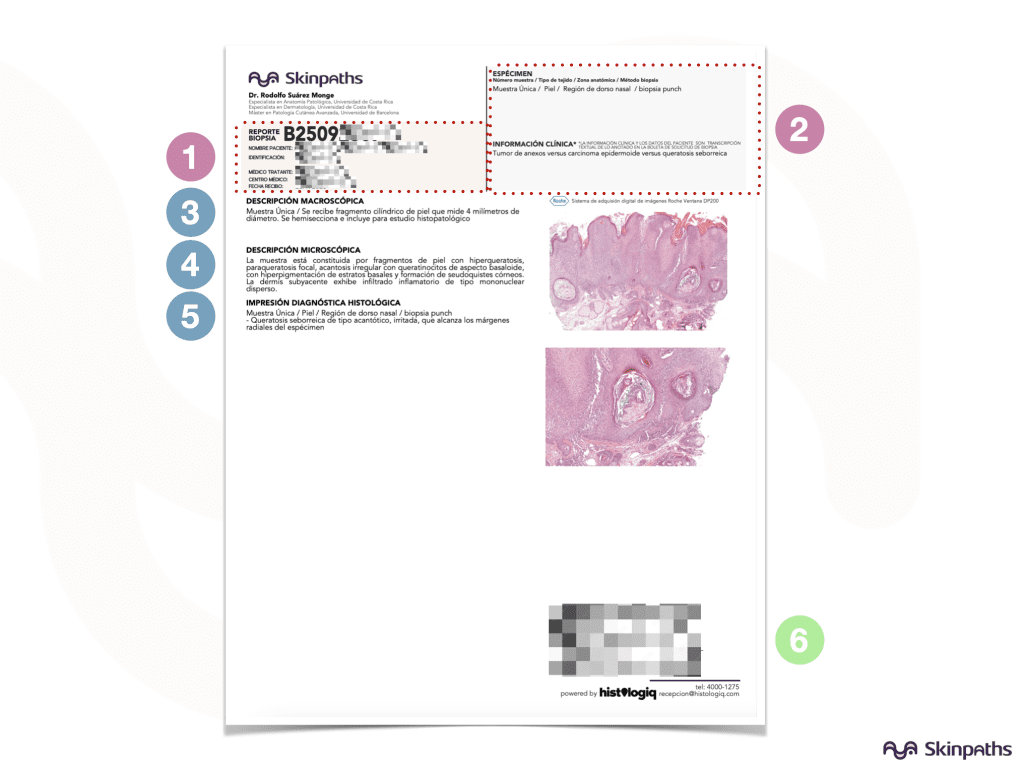
1- Identification data
-
-
Patient name, identification number (very important but often forgotten), age and gender.
-
Referring physician / clinic, health center or hospital
- Date of sample collection
-
2- Relevant clinical data
-
-
Anatomical site of sample collection, laterality
-
Relevant clinical data and clinical diagnostic impression
-
3- Description of the specimen sent
-
-
A microscopic description of the specimen to be processed is made
-
4- Microscopy / Histological description
-
-
Morphological detail that justifies the diagnosis.
- Special stains and comments are usually added in this section when they are performed or justified.
-
5- Diagnosis / Diagnostic Impression
6- Signature and code of the responsible pathologist
Phrases such as «compatible with», «suggestive of» or «cannot be ruled out» are interpreted very differently between pathologists and clinicians.
3. Levels of diagnostic certainty: how to read the nuances
Several studies show that phrases used to express uncertainty (“compatible with”, “suggests”, “cannot be ruled out”) are interpreted very differently between pathologists and clinicians. [show_150ms_ease-in] » data-testid=»webpage-citation-pill»> PubMed +2 journals.lww.com +2
3.1. Indicative scale of certainty
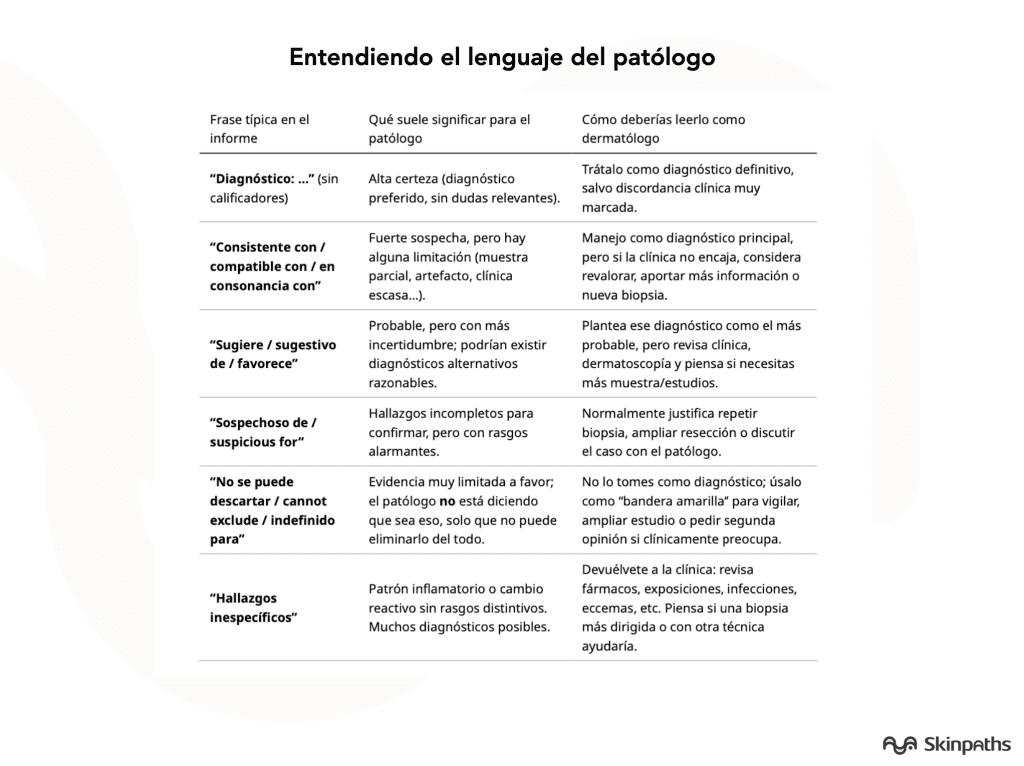
When you see these phrases, ask yourself: Does this sample really answer the question or doubt I had? If the answer is no, it’s worth talking to the pathologist.
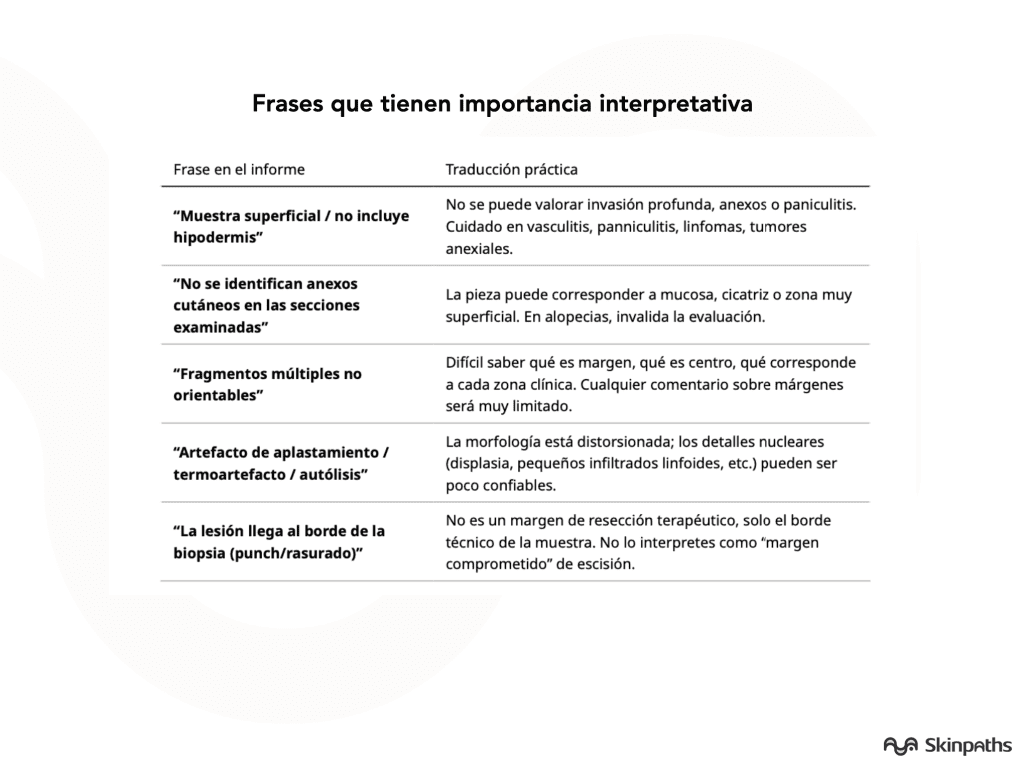
4. Phrases that talk about the sample , not the patient
Many reports include warnings about the quality or extent of the tissue. These aren’t just catchphrases; they define what the pathologist can conclude. When you see these phrases, ask yourself: Does this sample truly answer the question or concern I had? If the answer is no, it’s worth discussing it with the pathologist or requesting a new biopsy (better location, larger sample, different sampling technique, etc.).
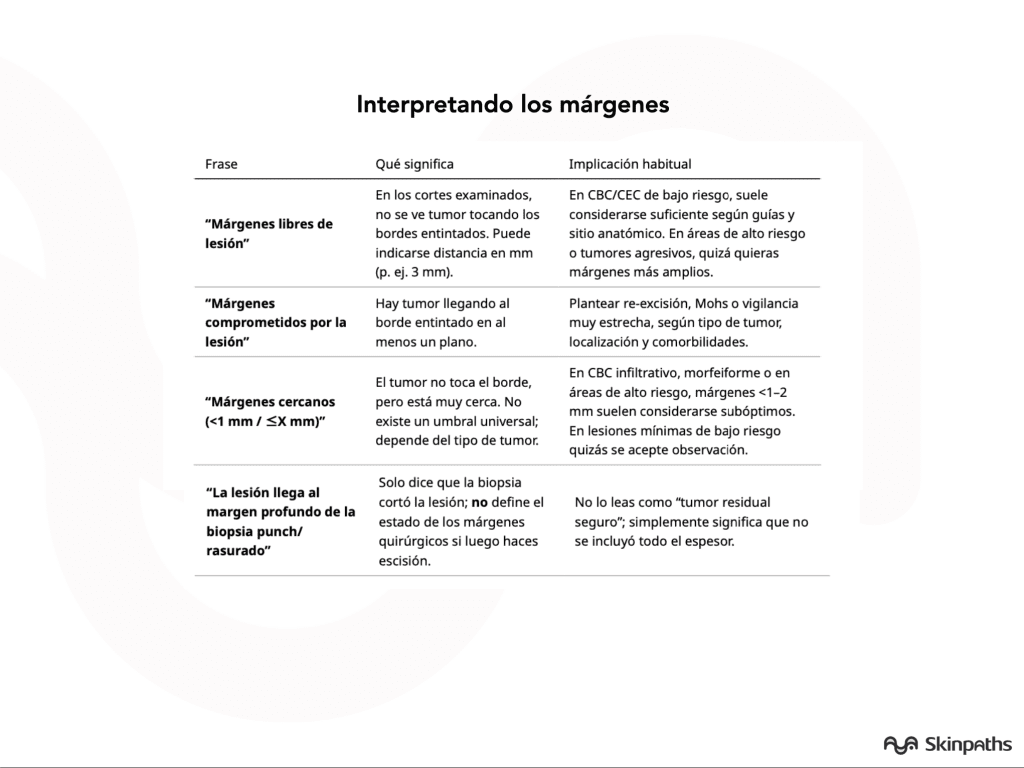
5. Surgical margins: how to read them
Margin assessment is one of the parts that most impacts therapeutic decisions (re-excision yes/no), and at the same time is subject to sampling and cutting variations.
6. Diagnostic comments: don’t ignore them
Communication studies in pathology show that a significant portion of misunderstandings are concentrated in how comments and qualifying phrases are interpreted .
Common phrases and how to use them:
-
“Clinicopathological correlation / with dermatoscopy / with imaging studies is recommended”
-
It is not a mere formality: the pathologist feels that histology alone might not be enough to close the case.
-
Action: review clinical history, reassess the patient and, if doubt persists, speak directly with the pathologist.
-
-
“The findings are nonspecific and could correspond to…”
-
List of reasonable differential diagnoses, none of which stand out clearly.
-
Action: Prioritize differential diagnoses based on clinical presentation, medications, distribution, and time course. Consider additional biopsy in other phases/areas.
-
-
“Interpretation is limited by…” (size, artifact, fixation, etc.)
-
Translation: Diagnostic confidence is lower than usual for technical reasons.
-
Action: If the therapeutic decision is significant (e.g., immunosuppression, biologics, major surgery), seriously consider repeating the biopsy or seeking a second opinion.
-
Annotated bibliography
-
Jaber O, Ammar K, Sughayer M. Communicating uncertainty in pathology reports: a descriptive study from a specialized cancer center. Acad Pathol. 2024;11(1):100109. doi:10.1016/j.acpath.2024.100109. PMID: 38433775. [show_150ms_ease-in] » data-testid=»webpage-citation-pill»> PubMed +1
-
What it’s about: It studies how pathologists and clinicians interpret phrases of uncertainty (“compatible with”, “favor”, “cannot exclude”, etc.) and shows large variations in the degree of certainty perceived.
-
-
Idowu MO, Wiles A, et al. Equivocal or ambiguous terminologies in pathology: focus of continuous quality improvement? Am J Surg Pathol. 2013;37(11):1722–1727. doi:10.1097/PAS.0b013e318297304f. PMID: 23887162. [show_150ms_ease-in] » data-testid=»webpage-citation-pill»> PubMed +1
-
What it’s about: It analyzes the use of ambiguous terms in pathology reports and their impact on clinical interpretation and healthcare costs.
-
-
Powsner SM, Costa J, Homer RJ. Clinicians are from Mars and pathologists are from Venus: clinical interpretation of pathology reports. Arch Pathol Lab Med. 2000;124(7):1040–1046. PMID: 10888781. [show_150ms_ease-in] » data-testid=»webpage-citation-pill»> PubMed +1
-
What it’s about: It measures the discrepancy between what pathologists intended to communicate and what surgeons understood when reading actual reports.
-
-
Ruby SG. Clinician interpretation of pathology reports: confusion or comprehension? Arch Pathol Lab Med. 2000;124(7):943–944. doi:10.5858/2000-124-0943-CIOPR. PMID: 10888766. [show_150ms_ease-in] » data-testid=»webpage-citation-pill»> PubMed +1
-
What it’s about: Classic editorial commentary that discusses clinicians’ understanding of reports and proposes improvements.
-
-
Nakhleh RE. Quality in surgical pathology communication and reporting. Arch Pathol Lab Med. 2011;135(11):1394–1397. doi:10.5858/arpa.2011-0192-RA. PMID: 22032564. [show_150ms_ease-in] » data-testid=»webpage-citation-pill»> PubMed +1
-
What it’s about: A review of what makes a pathology report «high quality» (complete, clear, clinically useful).
-
-
Nakhleh RE. What is quality in surgical pathology? J Clin Pathol. 2006;59(7):669–672. doi:10.1136/jcp.2005.031385. PMID: 16803945. [show_150ms_ease-in] » data-testid=»webpage-citation-pill»> PMC +1
-
What it’s about: Define the concept of quality in surgical pathology (accuracy, timeliness, completeness) and its relationship with patient safety.
-
-
Nakhleh RE. Patient safety and error reduction in surgical pathology. Arch Pathol Lab Med. 2008;132(2):181–185. PMID: 18251572. [show_150ms_ease-in] » data-testid=»webpage-citation-pill»> PubMed +1
-
What it’s about: Review of sources of error in surgical pathology and strategies to minimize them.
-
-
Clark SP, Clark OMM, Moir DH. Skin cancer: What happens in the laboratory? Aust J Gen Pract. 2024;53(8):539–542. doi:10.31128/AJGP-03-24-7191. PMID: 39099116. [show_150ms_ease-in] » data-testid=»webpage-citation-pill»> PubMed +1
-
What it’s about: It explains to clinicians the laboratory workflow in skin cancer and how this influences diagnosis and margins.
-
-
Clark SP, Clark OMM, Rosendahl CO. Skin cancer management: making the most of your pathologist. Aust J Gen Pract. 2024;53(8):543–545. doi:10.31128/AJGP-03-24-7190. PMID: 39099117. [show_150ms_ease-in] » data-testid=»webpage-citation-pill»> PubMed +1
-
What it’s about: Practical advice for clinicians to collaborate effectively with pathologists in the management of skin cancer.
-
Categories: Students and residents

Content reviewed by
Dr. Rodolfo Suárez
Médico Patólogo y Dermatólogo Master en Patología Cutánea Avanzada
- Published
- September 18, 2026
- Updated
- September 23, 2026
Medically reviewed by specialists
Our content is based on current scientific evidence and clinical protocols.