

A systematic, monthly, and non-dramatic check-up can help you recognize new changes or injuries that deserve professional evaluation.
Before you read: At Skinpaths, we distinguish between opinion and evidence. To write this content, we prioritized indexed medical sources and recommendations from scientific societies. You’ll find the complete bibliography at the end for your reference.
Important: This article is for informational purposes only and does not replace medical advice. If you have any questions, persistent symptoms, or your condition worsens, consult a healthcare professional.
Summary in 60 seconds
- Skin self-examination involves systematically looking at all of the skin to detect new lesions or changes in known lesions.
- It’s not about you making a diagnosis at home, but about you learning what is normal for your skin and what is not.
- It is usually recommended to do it once a month, in a well-lit room, after showering and with the help of two mirrors.
- It is also advisable to check the scalp, back, buttocks, genitals, soles of the feet, spaces between the fingers and nails.
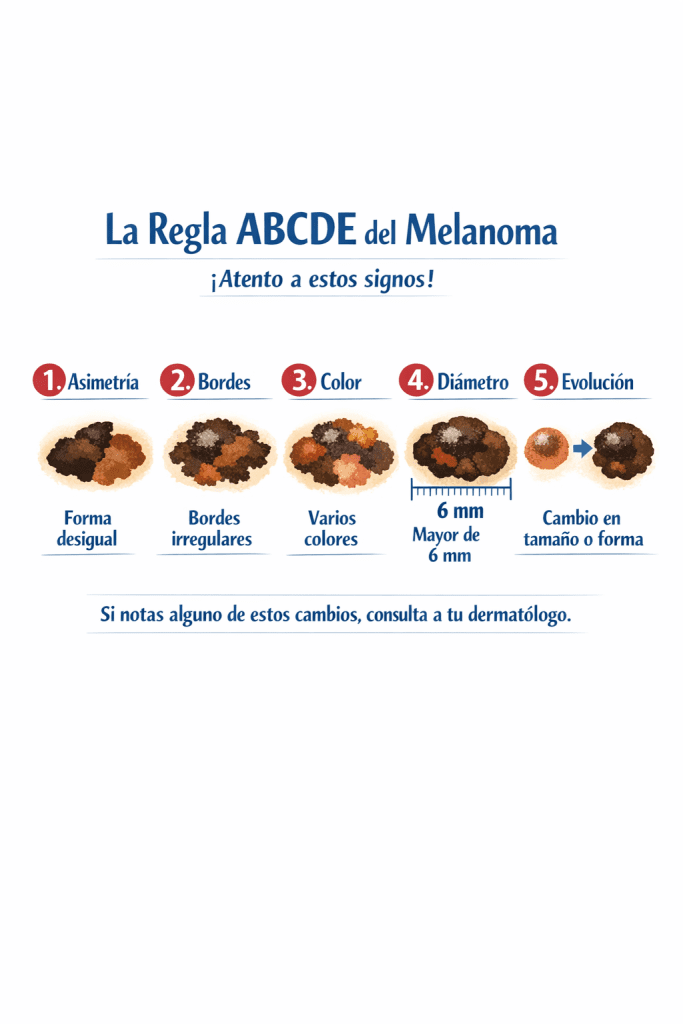
- The ABCDE rule suggests: asymmetry, irregular edges, multiple colors, striking diameter, and above all, evolution.
- Also important is the so-called «ugly duckling»: a lesion that looks different from the rest of your moles.
- They should also be alerted to a wound that does not heal, a plaque that bleeds, or a new dark line on a nail.
- Self-examination can help with early detection, but it does not replace medical consultation or clinical judgment.
- In people without symptoms, evidence on routine population screening by clinical visual examination remains limited; that does not diminish the value of consulting in the case of a suspicious lesion.
What is it?
Skin self-examination is a systematic and periodic visual inspection of the entire skin surface to recognize new changes, lesions that don’t fit in with the rest, or signs that warrant a consultation. The idea is not to turn the patient into a dermatologist, but to familiarize them with their usual pattern of moles, spots, and marks so they can notice changes sooner. Evidence suggests that education in self-examination can improve the ability to detect relevant lesions, although the exact role of self-examination in preventing mortality at the population level remains less certain than in higher-risk groups. (Yagerman 2013 , Robinson 2021 , USPSTF 2023 )
This topic matters because many skin cancers and other relevant lesions begin as subtle changes: a new spot, a mole that changes, a wound that won’t heal, or a dark line under a nail. Furthermore, not everything occurs in areas highly exposed to the sun: some lesions appear on the scalp, soles of the feet, palms, or under the nails. The risk increases with a personal or family history of skin cancer, many moles, immunosuppression, and cumulative sun damage, but anyone can develop a suspicious lesion, even those with brown or dark skin. (ACS 2024 , NCI 2022 , AAD 2023 , Skin Cancer Foundation 2024 )
What are the fundamentals of self-examination?
The most well-known rule is the ABCDEs of melanoma: A for asymmetry, B for irregular borders, C for uneven color, D for prominent diameter—although a suspicious lesion can be small—and E for evolution, which is often the most useful clue. It is also worth remembering the “ugly duckling” sign: a lesion that is clearly different from the others in that person. AAD 2023 , Ilyas 2017 , Jensen 2015 .
In addition to an unusual mole, other important patterns include: a new lesion that grows, a rough or scaly plaque, a wound that does not heal or heals and recurs, a lesion that itches, bleeds, or crusts over, and a new brown or black band on a nail. In darker skin tones, any changes on the palms, soles, and nail beds deserve special attention, as these areas may present lesions that are easily missed. (AAD 2023 , CDC 2024 , AAD 2021 , Cancer Council Australia )
In skin, the most valuable data is usually evolution: what is new, what grows, and what no longer seems «normal» to you.
The step-by-step self-examination
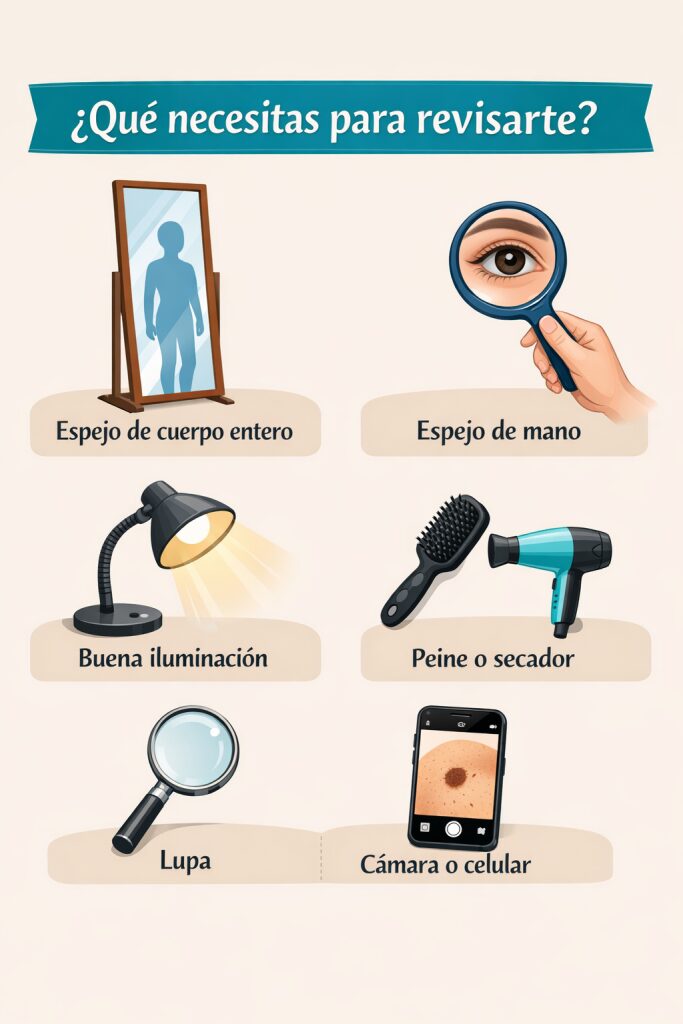
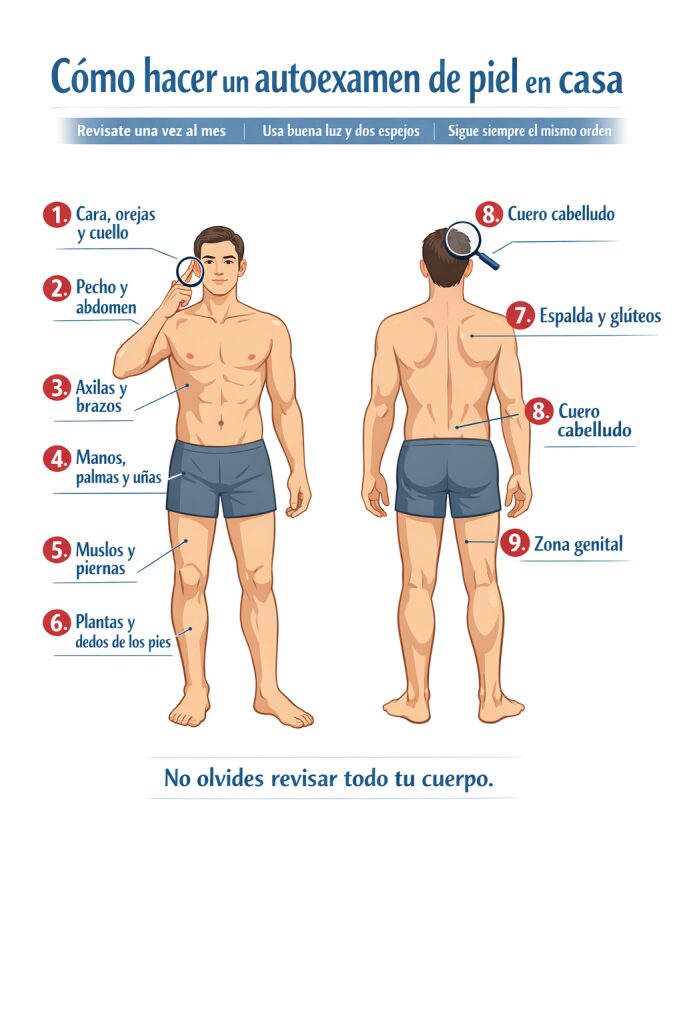
The most practical way is to check your skin once a month , preferably after showering, in a well-lit room, with a full-length mirror and a handheld mirror. If possible, ask for help with your back and scalp.
Begin with the face, ears, neck, and chest; continue with the armpits, arms, palms, and nails; then the legs, soles, spaces between the fingers, and toenails; finish with the scalp, back, buttocks, and genital area. ACS 2024 , AAD 2023
Always follow the same order. This routine reduces «blind spots» and improves comparison with previous examinations. If a lesion catches your attention, note the date, the body area, and, if possible, take a well-lit photo from a similar distance each time. A series of images does not replace a consultation, but it can help you confirm whether it is actually changing. ACS 2024 , Yagerman 2013 .
What NOT to do?
- Don’t use self-examination to automatically reassure yourself if an injury «doesn’t meet all the ABCDE criteria.» Some relevant injuries don’t follow the classic pattern, which is why change, the «ugly duckling» pattern, and context matter so much. Ilyas 2017 , AAD 2023 .
- Don’t ignore less visible or less sun-exposed areas either: scalp, back, buttocks, soles of the feet, palms, and nails. And don’t wait until an injury hurts: many people with suspected injuries feel fine and have no pain. AAD 2023 , AAD 2023 , AAD 2021 .
- Finally, avoid attempting to treat a suspicious lesion at home with acids, filing, homemade cauterization, or internet remedies. When something is truly suspicious, altering it before evaluation can delay diagnosis and complicate assessment. Diagnostic confirmation, when necessary, is made through professional examination and sometimes biopsy. ACS 2024 , Holmes 2018 , NCI 2025 .
When should I consult?
Consult your dermatologist if you notice any of these signs:
- A new injury that appears and is unfamiliar to you. CDC 2024 , AAD 2023 .
- A mole or spot that changes in size, shape, color, or texture. AAD 2023 , NCI 2022 .
- A lesion that bleeds, itches, crusts, ulcerates , or does not heal well. AAD 2023 , ACS 2024 .
- A lesion that looks like the «ugly duckling,» different from the rest of your moles. Ilyas 2017 , Jensen 2015 .
- A new dark line on a nail or pigment that invades the surrounding skin. A AD 2021 .
- A new lesion on the palms, soles , or between the fingers, especially if it changes. Skin Cancer Foundation 2024 , AAD 2023 .
Frequently Asked Questions
How often should I get checked?
- For many people, monthly checks are a reasonable frequency. If you have many moles, a personal or family history of skin cancer, immunosuppression, or are already under dermatological care, the frequency may need to be adjusted. ACS 2024 .
Are all new stains dangerous?
- No. Most new spots are not cancerous. The point is not to be alarmed by every spot, but to identify if something changes , behaves strangely, or is clearly different from the rest. NCI 2022 , AAD 2023 .
If it doesn’t hurt, can I wait?
- Not necessarily. Many suspicious lesions are painless. The absence of pain does not rule out clinical significance. AAD 2023 .
Should I also check my nails and scalp?
- Yes. These are areas that are easily forgotten. It’s also a good idea to check the soles of the feet, palms, behind the ears, back, and buttocks. AAD 2023 , AAD 2021 .
Does the ABCD rule detect everything?
- It helps, but it doesn’t detect everything. That’s why it’s complemented by the idea of evolution, the ugly duckling sign, and other warning signs. AAD 2023 , Ilyas 2017 .
I have brown or dark skin; should I still get checked?
- Yes. The absolute risk of melanoma is not the same for all skin types, but anyone can develop skin cancer. For darker skin tones, it’s important not to forget to check the palms, soles, and nails. AAD 2024 , Skin Cancer Foundation 2024 .
Are photos taken with a mobile phone acceptable?
- Yes, it can be used to compare changes over time, always under similar lighting conditions and without delaying the consultation. The photograph helps monitor a lesion; it does not replace clinical assessment. ACS 2024 , Yagerman 2013 .
Bibliography and sources
- American Academy of Dermatology Association. Find skin cancer: How to perform a skin self-exam . Updated May 15, 2023.
- American Academy of Dermatology Association. What to look for: ABCDEs of melanoma . Accessed March 2026.
- American Academy of Dermatology Association. How to check your nails for melanoma . 2021.
- American Academy of Dermatology Association. How can I tell if I have skin cancer? . Accessed March 2026.
- American Cancer Society. How to Do a Skin Self-Exam . Updated June 26, 2024.
- US Preventive Services Task Force. Skin Cancer: Screening . 2023.
- Centers for Disease Control and Prevention. Symptoms of Skin Cancer . 2024.
- National Cancer Institute. Common Moles, Dysplastic Nevi, and Risk of Melanoma . Reviewed November 17, 2022.
- National Cancer Institute. Melanoma Treatment (PDQ®) – Patient Version . Updated May 16, 2025.
- Yagerman S, Marghoob A. Melanoma patient self-detection: a review of efficacy of the skin self-examination and patient-directed educational efforts . Expert Rev Anticancer Ther . 2013;13(12):1423-1431. doi:10.1586/14737140.2013.856272.
- Jensen JD, Elewski BE. The ABCDEF Rule: Combining the “ABCDE Rule” and the “Ugly Duckling Sign” in an Effort to Improve Patient Self-Screening Examinations . J Clin Aesthet Dermatol . 2015;8(2):15.
- Ilyas M, Costello CM, Zhang N, Sharma A. The role of the ugly duckling sign in patient education . J Am Acad Dermatol . 2017;77(6):1088-1095. doi:10.1016/j.jaad.2017.06.152.
- Holmes GA, Vassantachart JM, Limone BA, Zumwalt M, Hirokane J, Jacob SE. Using Dermoscopy to Identify Melanoma and Improve Diagnostic Discrimination . Fed Practice . 2018;35(Suppl 4):S39-S45.
- Robinson JK, Hultgren B, Mallett KA, et al. Melanoma detection by skin self-examination targeting at-risk women: A randomized controlled trial with telemedicine support for concerning moles . Prev Med Rep . 2021;25:101666.
- Weinstock MA, Risica PM, Martin RA, et al. Melanoma Early Detection with Thorough Skin Self-Examination: The “Check It Out” Randomized Trial . Am J Prev Med . 2007;32(6):517-524.
- Skin Cancer Foundation. Skin Cancer in Skin of Color . Accessed March 2026.
- Cancer Council Australia. Check for signs of skin cancer . Accessed March 2026.
Categories: Skin cancer

Content reviewed by
Dr. Rodolfo Suárez
Médico Patólogo y Dermatólogo Master en Patología Cutánea Avanzada
- Published
- September 18, 2026
- Updated
- September 23, 2026
Medically reviewed by specialists
Our content is based on current scientific evidence and clinical protocols.