
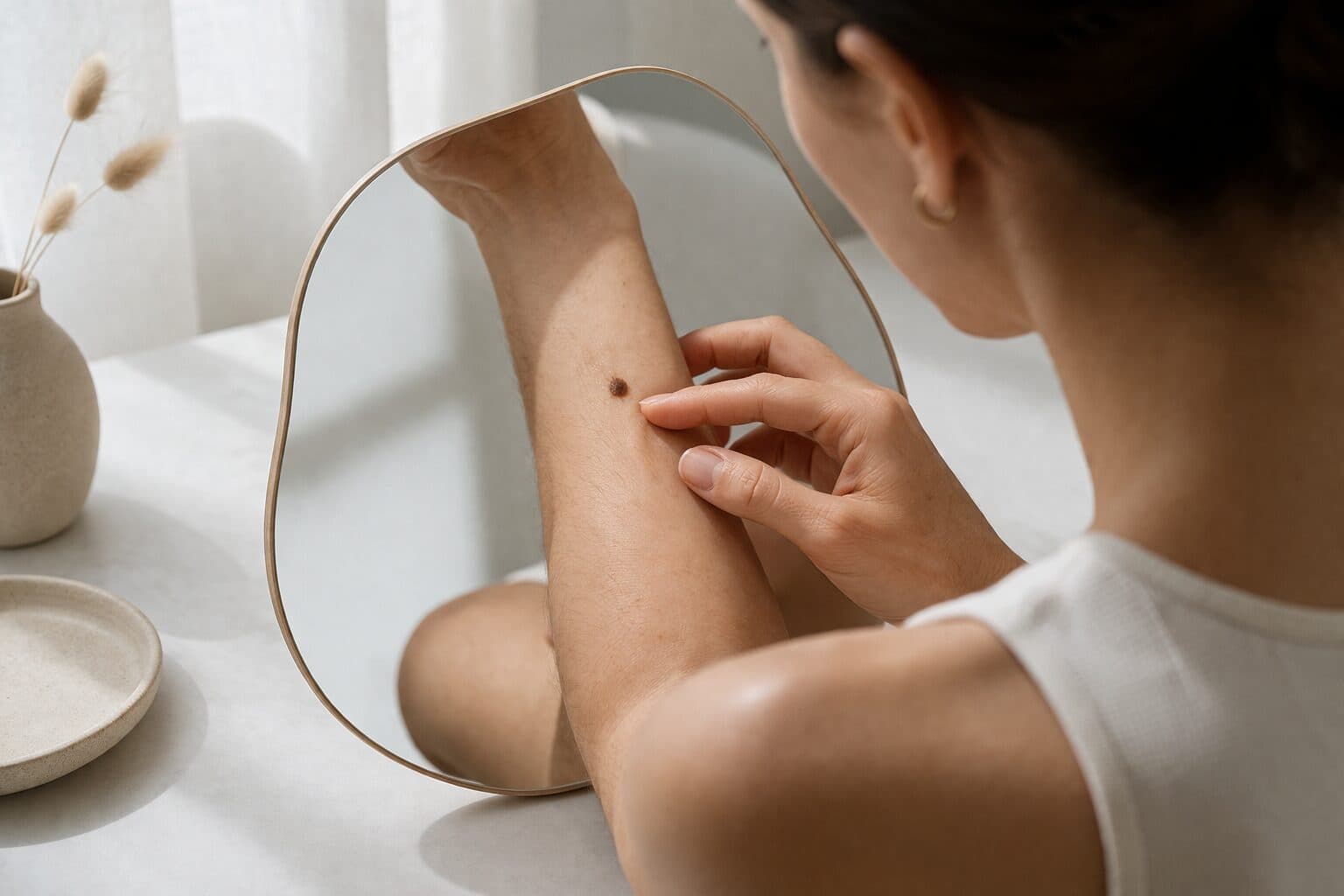
Five skin changes that should be recognized early, without alarmism and without trivializing them.
Before you read: At Skinpaths, we distinguish between opinion and evidence. To write this content, we prioritized indexed medical sources and recommendations from scientific societies. You’ll find the complete bibliography at the end for your reference.
Important: This article is for informational purposes only and does not replace medical advice. If you have any questions, persistent symptoms, or your condition worsens, consult a healthcare professional.
Summary in 60 seconds
- Skin cancer doesn’t have a single appearance. It can look like a mole that changes, a sore that doesn’t heal, a shiny bump, or a rough, red patch.
- The most important clue, overall, is a persistent change in the skin . In melanoma, the ABCDE rule remains useful: asymmetry, irregular borders, uneven color, indicative diameter, and, above all, evolution.
- But not all skin cancers follow that pattern. Carcinomas, for example, can look like a bleeding wound, a recurring scab, or a pearly lesion.
- A lesion that seems «different» from the others also deserves attention. The absence of pain doesn’t mean it’s benign. If you notice a new, changing, bleeding, or non-healing lesion, it’s advisable to seek a specialist medical evaluation.
What is skin cancer and why does it occur?
Skin cancer encompasses several tumors that originate in skin cells. The most common are basal cell carcinoma and squamous cell carcinoma (epidermoid carcinoma) ; melanoma is less common, but it is the one that can most easily spread and cause serious complications. They don’t all look the same: some are pigmented, others pink, shiny, scaly, or resemble a wound (CDC 2024 ).
Excessive exposure to ultraviolet radiation from the sun or tanning beds plays a role in many cases. The risk depends not only on «getting a lot of sun in one day,» but also on the cumulative effect of exposures over time. And although certain skin types are at higher risk, anyone can develop skin cancer . CDC 2025 , CDC 2024 .
The 5 warning signs
1. A mole or spot that changes
Evolution is one of the most important indicators. A lesion that changes in size, shape, color, elevation, or overall appearance warrants review. In practice, change is often more important than an isolated «snapshot.» CDC 2024 , Garrison 2023 .
2. Asymmetry, irregular edges, or multiple colors
The ABCDE rule is particularly helpful for identifying melanoma. Signs to watch for include a lesion that is distinct from the other half, poorly defined borders, multiple shades within the same lesion, and a lesion that deviates from the usual pattern. Diameter can be a clue, but early melanomas can also be small. AAD 2025 .
3. A sore that does not heal, bleeds, or reopens
A wound that seems to heal and then recurs, a persistent scab, or a lesion that bleeds easily are classic warning signs, especially in skin cancers. It doesn’t have to be large to warrant evaluation. (American Cancer Society 2024 , CDC 2024 )
4. A new, shiny, pearly, or pinkish lump
Basal cell carcinoma may present as a shiny, translucent, or pearly papule or nodule, sometimes pink, sometimes with small visible vessels. It may sometimes appear minor, but it should not be ignored if it grows or bleeds. American Cancer Society 2024 .
5. A red, rough, scaly, or wart-like patch
Squamous cell carcinoma may appear as a red, scaly area, a rough, crusted plaque, or a wart-like lesion. Sometimes it itches, bleeds, or is tender; other times it causes little discomfort. American Cancer Society 2024 .
What can you do today?
Perform a thorough skin examination in good lighting, using a full-length mirror and, if possible, a handheld mirror. Also check your scalp, nails, soles of your feet, between your toes, back, and buttocks. If anything changes, itches, bleeds, or is clearly different from the rest of your skin, seek an evaluation by a dermatologist. AAD 2023 , AAD 2025 .
What NOT to do?
Don’t wait months for a suspicious lesion to «go away on its own» if it keeps changing. Don’t assume only dark spots are a concern: some skin cancers are pink, skin-colored, scaly, or wound-like. Don’t be reassured just because it doesn’t hurt. And don’t use tanning beds as a «safe» alternative: they also emit ultraviolet radiation. CDC 2025 , American Cancer Society 2024 .
When should I consult a specialist?
Consult a dermatology specialist if you notice:
- a new injury that grows or changes;
- a mole with asymmetry , irregular edges , or uneven colors ;
- a wound that does not heal ;
- an injury that bleeds , scabs over, and returns;
- a spot that itches , hurts, or is clearly different from the others ;
- A dark line under a nail or new pigment around the nail. CDC 2024 , AAD 2025 .
Frequently Asked Questions
Is every unusual mole cancerous?
- No. Many moles and spots are benign. The important thing is not to label them at home, but to recognize when a lesion warrants evaluation: changes, bleeding, persistent crusting, multiple colors, or an appearance clearly different from the rest. If you have any doubts, consult a dermatologist. CDC 2024 , AAD 2025 .
Does the ABCDE rule apply to all skin cancers?
- It is most useful for melanoma . Skin carcinomas, on the other hand, often present as a non-healing wound, a pearly bump, or a rough, red patch. CDC 2024 , American Cancer Society 2024 .
If it doesn’t hurt, can I rest easy?
- No. Some suspicious lesions cause almost no discomfort. The absence of pain does not rule out a significant skin problem. American Cancer Society 2024 .
Does it only appear in people with fair skin?
- No. Some people are at higher risk, but skin cancer can occur in any skin tone. That’s why surveillance shouldn’t be limited to a single profile. CDC 2024 , AAD 2025 .
Is a skin biopsy usually done in an operating room?
- Many skin biopsies are performed in the office, under local anesthesia. The goal is to obtain a sample for microscopic examination to confirm or rule out the diagnosis. AAD 2022 .
Bibliography and sources
- Centers for Disease Control and Prevention. Symptoms of Skin Cancer . 2024. CDC 2024 .
- Centers for Disease Control and Prevention. Skin Cancer Basics . 2024. CDC 2024 .
- Centers for Disease Control and Prevention. Skin Cancer Awareness . 2025. CDC 2025 .
- American Academy of Dermatology Association. Find skin cancer: How to perform a skin self-exam . 2023. AAD 2023 .
- American Academy of Dermatology Association. Start skin self-exams in your 20s . 2025. AAD 2025 .
- American Academy of Dermatology Association. What is a skin biopsy? . 2022. AAD 2022 .
- American Cancer Society. Basal and Squamous Cell Skin Cancer Symptoms . 2024. American Cancer Society 2024 .
- Fu S, Kim S. Dermatological guide for primary care physicians: full body skin checks, skin cancer detection, and patient education on self-skin checks and sun protection . 2024. Fu 2024 .
- Garrison ZR, et al. Advances in Early Detection of Melanoma and the Future of At-Home Testing . 2023. Garrison 2023 .
- Harrison K, et al. The Accuracy of Skin Cancer Detection Rates with the Implementation of Dermoscopy Among Dermatology Clinicians: A Scoping Review . 2024. Harrison 2024 .
Categories: For everyone · Skin cancer · Skin spots

Content reviewed by
Dr. Rodolfo Suárez
Médico Patólogo y Dermatólogo Master en Patología Cutánea Avanzada
- Published
- September 18, 2026
- Updated
- September 23, 2026
Medically reviewed by specialists
Our content is based on current scientific evidence and clinical protocols.