
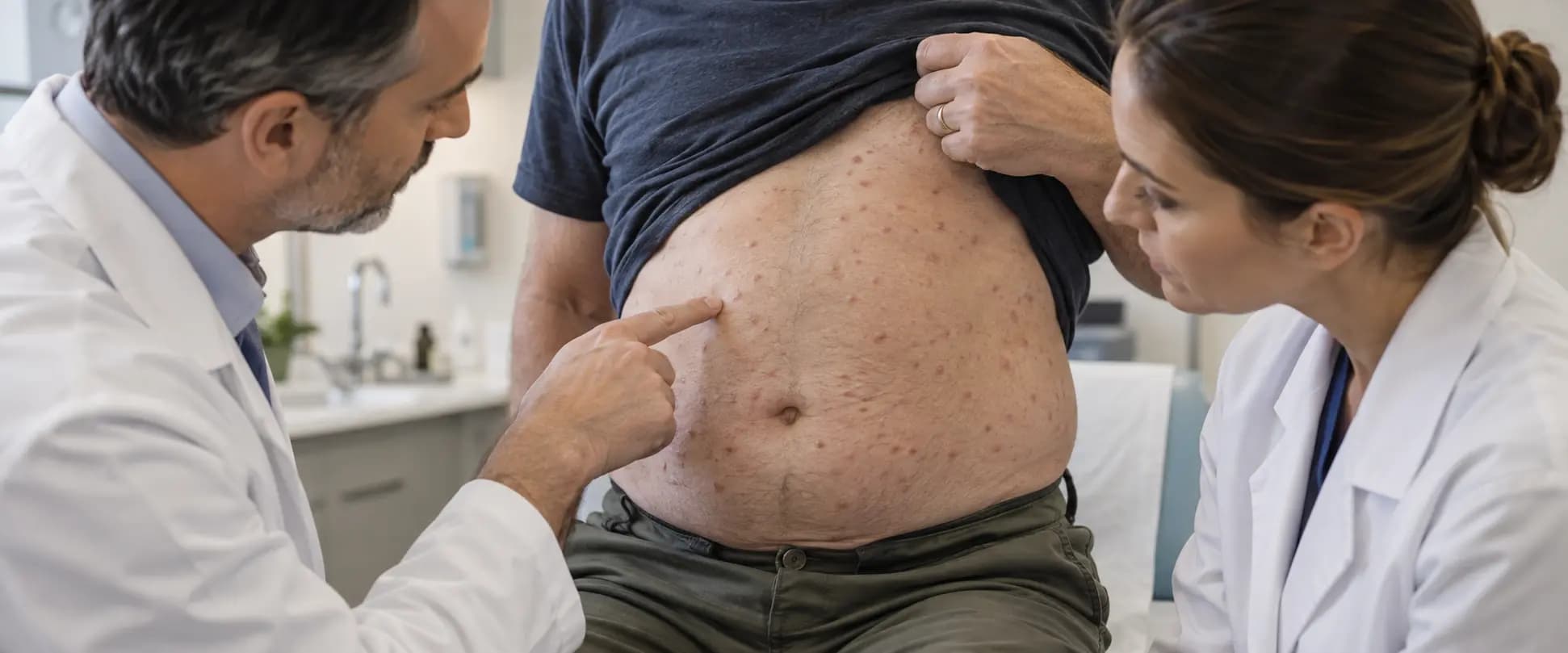
Pityriasis lichenoides is a rare inflammatory skin condition. It causes small bumps that may produce fine scaling, crust over, and leave discoloration as they heal. It can occur at any age, although it is more common in children and young adults.
Before you read: At Skinpaths, we distinguish between opinion and evidence. To write this content, we prioritized indexed medical sources and recommendations from scientific societies. You’ll find the complete bibliography at the end for your reference.
Important: This article is for informational purposes only and does not replace medical advice. If you have any questions, persistent symptoms, or your condition worsens, consult a healthcare professional.
Summary in 60 seconds
- Pityriasis lichenoides is a rare inflammatory skin disease.
- It produces small bumps that can flake, form crusts, or leave stains.
- The chronic form, called PLC , usually begins gradually.
- The acute form, known as PLEVA , appears more abruptly and can produce small wounds.
- It is not considered a contagious disease.
- Its exact cause is unknown and outbreaks can recur.
- The diagnosis may require a small skin biopsy.
- The treatment is tailored to the type of injury, its extent, and the discomfort.
- The spots may persist after the inflammation subsides.
- High fever, significant pain, or rapidly progressing wounds require urgent evaluation.
What is it?
Pityriasis lichenoides is a condition that causes outbreaks of small, raised lesions called papules . Some develop a fine scale; others become more inflamed and crust over. It can occur at any age, although it is most common in children, adolescents, and young adults. There are two main presentations: chronic pityriasis lichenoides (PLC) and acute pityriasis lichenoides et varioliformis (PLEVA) . These names describe differences in the appearance and progression of the lesions, not an identical duration for all individuals. British Association of Dermatologists, 2022 .
Both clinical forms are part of the same spectrum: a person can have lesions with characteristics of both. Cunliffe, 2022 .
Why does it appear?
The exact cause is still unknown. One hypothesis is that it involves a particular immune response to certain stimuli. In some patients, previous infections or a temporal relationship with medications have been identified. The role of lymphocytes, cells involved in the body’s defenses, is also being studied. These lines of research do not allow all cases to be attributed to the same cause. GARD, 2018 .
Finding an infection before the outbreak does not, in itself, prove that it caused the disease . A small trial investigated the possible link with streptococcal infections, but its results do not allow this explanation to be generalized to all patients. Elbendary, 2023 .
What does it look like and what symptoms does it cause?
Chronic form: small bumps with fine scaling
Polycystic dermatitis (PCD) typically presents as small pink, reddish, or brown bumps with a scale adhering to the surface. They appear mainly on the trunk, arms, and legs. It may cause little or no itching. The lesions appear in waves, so new bumps coexist with others that are already flattening. British Association of Dermatologists, 2022
Acute form: more inflamed lesions with crusts
PLEVA has a more abrupt onset. The bumps may develop into small blisters, bloody scabs, or superficial wounds. There may be itching, burning, or pain; some lesions leave small, sunken scars. It sometimes resembles chickenpox, but they are different diseases. Its appearance also does not allow for diagnosis to be confirmed solely through photographs. Cunliffe, 2022 .
Spots are not the same as active lesions
As the outbreak improves, lighter or darker areas may remain. A persistent spot does not, by itself, indicate ongoing inflammation. Pigmentation changes can last longer than pimples and should be distinguished from scarring. Zang, 2018 .
What can you do today?
Maintain a gentle routine
Use a fragrance-free moisturizer, especially after bathing. Avoid rubbing your skin and choose comfortable, non-chafing clothing. When itching occurs, a clean, cool compress for a few minutes can help relieve it. These are general measures for itchy skin: they aim for comfort, not a cure for pityriasis lichenoides . American Academy of Dermatology, 2024 .
Avoid manipulating the injuries
Avoid scratching or picking at scabs. If a lesion is open, ask your doctor for instructions on cleaning and covering it, rather than applying different products yourself. Scratching can further irritate already inflamed skin. American Academy of Dermatology, 2024 .
Record the changes for the query
Take photos under similar lighting and note when new lesions appear, whether they hurt or itch, and what treatments you are using. It’s also a good idea to record how the problem affects your sleep, the clothes you choose, or your activities.
A helpful question for follow-up is: «What remains are active lesions, residual spots, or scars?»
What NOT to do?
Do not self-medicate with antibiotics or corticosteroids. Their use depends on the diagnosis, age, and other factors. Furthermore, a cream that relieves itching does not necessarily change the course of outbreaks. British Association of Dermatologists, 2022 .
Do not replace phototherapy with tanning sessions or intense sun exposure. Medical phototherapy uses calculated doses and supervision; self-exposure does not offer this control. During light treatment, follow the team’s instructions regarding sun protection and products you can apply. British Association of Dermatologists, 2025 .
Do not increase treatments simply because spots are still present. First, it is necessary to assess whether inflammatory activity persists. Zang, 2018 .
When should I consult?
Seek evaluation by a dermatologist if a persistent or recurring rash appears, especially if it forms crusts, sores, or scars. It is not advisable to assume a diagnosis based on similarity to images found online: other diseases can present a similar appearance. Ngan, 2022.
Warning signs: seek urgent care
- High fever or severe malaise , especially along with extensive injuries.
- Significant pain or wounds that increase rapidly , merge together, or have dark areas.
- Mouth injuries that make it difficult to drink , or difficulty breathing.
There is a very rare and serious variant, called febrile necrotic ulcerative Mucha-Habermann disease, which can affect more than just the skin and may require hospitalization. These symptoms can also have other causes: they require urgent medical evaluation and should never be self-diagnosed or treated without medical supervision. Ngan, 2022.
What does a dermatologist usually do?
Confirm the diagnosis
The dermatologist examines the distribution of the lesions and asks how they started and how they have changed. They may use dermatoscopy, a magnifying and illuminated examination that allows for detailed observation of the skin. This tool provides information but does not replace a comprehensive evaluation. Alba-Rojas, 2025. A skin biopsy —a small sample examined under a microscope—is often needed. It helps distinguish pityriasis lichenoides from similar conditions. Ordering one does not, in itself, mean that cancer is suspected. British Association of Dermatologists, 2022
Choosing the right treatment
There is no single treatment that works equally well for everyone. Reviews show small studies, differences between patients, and limitations in comparing results. Therefore, treatment should weigh benefits, risks, and individual preferences. Jung, 2020.
Observation and symptom relief. In mild cases, monitoring may be necessary. Emollients and some topical treatments may improve comfort, although their effect on the occurrence of new outbreaks is limited. Cunliffe, 2022.
Oral antibiotics. Medications such as erythromycin or doxycycline are used in certain patients. In this context, the primary goal is their anti-inflammatory effect, not to treat a proven bacterial infection. Selection and duration always require medical supervision. Ngan, 2022.
Phototherapy. Narrowband ultraviolet B light is one of the most commonly used options, especially for the chronic form. It can improve lesions, but the response and the likelihood of relapse may vary. Bellinato, 2019.
Treatments for resistant or severe cases. The specialist may consider medications such as methotrexate. These treatments are not suitable for everyone and require specific monitoring. Bellinato, 2019.
Monitoring the evolution
Follow-up allows for assessment of whether new lesions are decreasing, whether the treatment is producing adverse effects, and whether the diagnosis continues to explain what is happening. Persistence or an unexpected change in the lesions may warrant reassessment. Borra, 2018 .
The treatment must be tailored to each individual: the available evidence does not allow us to guarantee the same response for everyone.
Frequently Asked Questions
Is pityriasis lichenoides contagious?
- It is not considered contagious. Everyday contact with a person who has lesions does not transmit the disease. Once the diagnosis is confirmed, isolation is not required for pityriasis lichenoides itself. GARD, 2018 .
Is it curable? How long can it last?
- It can improve and go into remission, but it’s not possible to promise a date of disappearance. Some people experience outbreaks for months, and others for years. The chronic form usually persists longer. Furthermore, the duration of a pimple does not equate to the duration of the disease: some lesions disappear while others appear. Zang, 2018 .
Do the light patches mean I have vitiligo?
- Not necessarily. Pityriasis lichenoides can leave pigmentation changes, including lighter shades, even when other signs of inflammation are no longer visible. A dermatologist can distinguish these marks from other causes of white patches. Zang, 2018 .
Is it a form of cancer?
- Common pityriasis lichenoides does not equate to a cancer diagnosis. Some lymphocyte diseases can resemble it, and atypical forms with associations requiring follow-up have been described. This does not mean that a person with pityriasis lichenoides will develop lymphoma. It does, however, explain why it is advisable to review atypical cases or those with an unexpected course. Borra, 2018 .
Why doesn’t someone else’s treatment work the same for me?
- The type of disease, its extent, and its spontaneous progression can vary. Furthermore, available research still has limitations in establishing a universal strategy. Therefore, medical evaluation should always be sought before starting any treatment. Jung, 2020 .
Bibliography and sources
- Ngan V, Punchihewa N, Keefe M. Pityriasis lichenoides [Internet] . DermNet; 2022 [citado 2 oct 2026] . Available at: DermNet .
- Genetic and Rare Diseases Information Center. Pityriasis lichenoides chronica [Internet] . National Center for Advancing Translational Sciences; 2018 [citado 2 oct 2026] . Available at: GARD .
- British Association of Dermatologists. Pityriasis lichenoides [Internet] . London: British Association of Dermatologists; 2022 [citado 2 oct 2026] . Available at: BAD Patient Hub .
- Cunliffe T. Pityriasis lichenoides [Internet] . Primary Care Dermatology Society; 2022 [citado 2 oct 2026] . Available from: Primary Care Dermatology Society .
- Elbendary A, Youssef R, Abdel-Halim MRE, Abdel Halim D, El Sharkawy DA, Alfishawy M, et al. Role of streptococcal infection in the etiopathogenesis of pityriasis lichenoides chronica and the therapeutic efficacy of azithromycin: a randomized controlled trial . Arch Dermatol Res. 2023;315(3):521-30. doi:10.1007/s00403-022-02398-0.
- Zang JB, Coates SJ, Huang J, Vonderheid EC, Cohen BA. Pityriasis lichenoides: long-term follow-up study . Pediatr Dermatol. 2018;35(2):213-9. doi:10.1111/pde.13396.
- American Academy of Dermatology. Stop itchy skin in its tracks [Internet] . Rosemont: American Academy of Dermatology; 2024 Sep 24 [citado 2 oct 2026] . Available from: American Academy of Dermatology .
- British Association of Dermatologists. Phototherapy—oral PUVA [Internet] . London: British Association of Dermatologists; 2025 [citado 2 oct 2026] . Available at: BAD Patient Hub .
- Alba-Rojas E, Guerra-Garza AS, Ocampo-Candiani J. Diagnostic dermoscopy in pityriasis lichenoides chronica and pityriasis lichenoides et varioliformis acuta: a case series . Dermatol Practice Concept. 2025;15(2):5078. doi:10.5826/dpc.1502a5078.
- Jung F, Sibbald C, Bohdanowicz M, Ingram JR, Piguet V. Systematic review of the efficacies and adverse effects of treatments for pityriasis lichenoides . Br J Dermatol. 2020;183(6):1026-32. doi:10.1111/bjd.18977.
- Bellinato F, Maurelli M, Gisondi P, Girolomoni G. A systematic review of treatments for pityriasis lichenoides . J Eur Acad Dermatol Venereol. 2019;33(11):2039-49. doi:10.1111/jdv.15813.
- Borra T, Custrin A, Saggini A, Fink-Puches R, Cota C, Vermi W, et al. Pityriasis lichenoides, atypical pityriasis lichenoides, and related conditions: a study of 66 cases . Am J Surg Pathol. 2018;42(8):1101-12. doi:10.1097/PAS.0000000000001093.
- Fatturi AL, Morgan MAP, Markus JR, Noguera-Morel L, Carvalho VO. Pityriasis lichenoides: assessment of 41 pediatric patients . J Pediatr (Rio J). 2024;100(5):527-32. doi:10.1016/j.jped.2024.03.011.
Tags
Categories: For everyone

Content reviewed by
Dr. Rodolfo Suárez
Médico Patólogo y Dermatólogo Master en Patología Cutánea Avanzada
- Published
- November 4, 2026
We care about the information we share
Choosing the right sources and shaping each topic takes judgment. Discover how we work on the content you read on Skinpaths.