
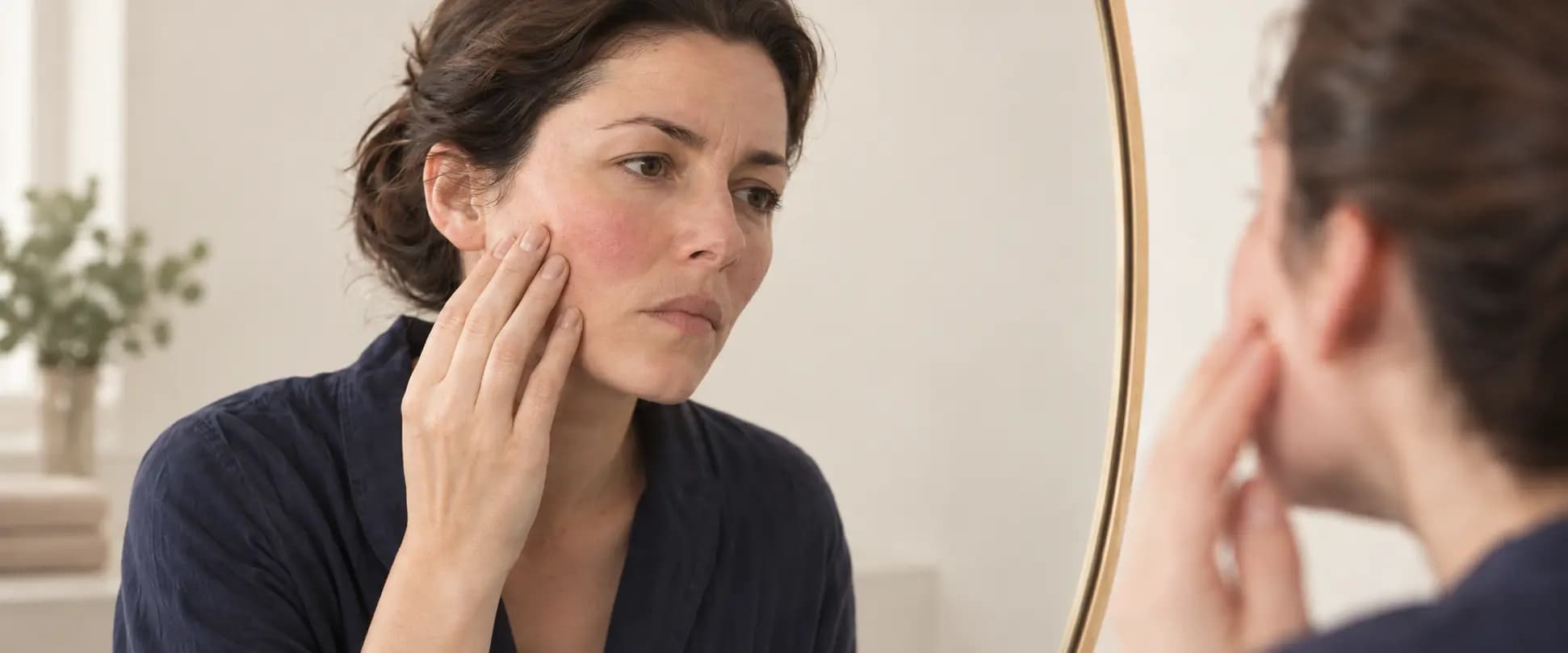
A very common sign that can be benign, inflammatory, or infectious, and that always needs context to be interpreted correctly.
Before you read: At Skinpaths, we distinguish between opinion and evidence. To write this content, we prioritized indexed medical sources and recommendations from scientific societies. You’ll find the complete bibliography at the end for your reference.
Important: This article is for informational purposes only and does not replace medical advice. If you have any questions, persistent symptoms, or your condition worsens, consult a healthcare professional.
Summary in 60 seconds
- Skin reddening is not a diagnosis: it is a clinical sign.
- It can appear due to irritation, allergy, inflammation, heat, sun, rosacea, eczema, hives, or infection.
- Location matters: it doesn’t mean the same thing on the face as on a leg or around the eyes.
- The accompanying symptoms are also important: itching, burning, heat, pain, peeling, hives (wheals) or blisters.
- In more pigmented skin, it is not always seen as «intense red»; sometimes it is perceived as purplish, grayish, or brown.
- Not all red skin is an infection, and not all red skin is an allergy.
- Trying many products, rubbing or scratching usually worsens the condition.
- If there is fever, significant pain, rapid progression, blisters, or involvement of the eyes, mouth, or genitals, it is advisable to consult a doctor without delay.
What is it?
Skin reddening, also called erythema in medical terminology, is a change in color related to increased blood flow in superficial capillaries. It is a common finding in inflammatory, irritative, allergic, vascular, and infectious processes; however, it does not indicate the cause on its own. BAD 2021 Finlay 2021 .
In brown or dark skin, it may not appear as bright red. Sometimes it takes on purplish, grayish, or dark brown tones, so the context and clinical examination are even more important. Ohanenye 2023 Finlay 2021 .
Skin reddening is a sign, not a diagnosis: the clinical context is what gives it meaning. BAD 2021 Ohanenye 2023 .
Why does it appear?
It usually appears when the skin responds to an injury or inflammation: an irritating cosmetic, a contact allergy, heat, ultraviolet radiation, an inflammatory condition such as rosacea or eczema, or a skin infection. Therefore, «red skin» can represent very different problems. AAD 2020 AAD 2024 NICE 2019 Merin 2022
In practical terms, four questions are very helpful: where is it, how long has it been present, does it itch or hurt, and is it getting worse? For example, chronic, tender facial redness suggests a different need for a patch after using a new product than a red, hot, and painful leg. AAD 2024 AAD 2020 NICE 2019
What does it look like?
It may appear as a localized patch or as a more diffuse redness. Sometimes the skin is only discolored; other times it is also warm, swollen, tender, burning, itchy, or scaly. Itching, swelling, a feeling of warmth, and, in some cases, cracks or blisters are common in contact dermatitis. AAD 2020 .
Morphology (shape) provides clues. Hive (wheals) that come and go suggest urticaria; well-defined plaques with scale suggest psoriasis; persistent redness in the center of the face with visible outbreaks or blood vessels points to rosacea; and a unilateral, hot, painful, and expanding area necessitates ruling out a skin infection. Schettini 2023, Badri 2023, AAD 2024, NICE 2019 .
In what diseases or conditions do they usually occur?
( This order is for guidance only. There is no universal ranking because it depends on age, the affected area, exposure to products, sun exposure, and the clinical context.)
1. Very frequent
- Contact dermatitis
- Rosacea Seborrheic dermatitis
- Eczema/atopic dermatitis.
These causes are especially common when redness is accompanied by itching, burning, scaling, or skin sensitivity. AAD 2020 AAD 2022 Jeskey 2024 .
2. Frequent
- Urticaria
- Psoriasis
- Sunburns
- Cellulitis/erysipelas.
The clue here usually comes from the shape of the lesions, the speed of onset, the context of sun exposure, or the presence of pain, heat, and progression. Schettini 2023 Badri 2023 NICE 2019 .
3. Infrequent
- Cutaneous lupus
- Erythema multiforme and other more complex or extensive inflammatory dermatoses.
Although less frequent, they are included in the differential diagnosis when the evolution, distribution, or symptoms do not fit with common causes. do Vale 2023 Hafsi 2024 Ohanenye 2023 .
When should I consult?
Consult a doctor immediately if any of these warning signs appear:
- Fever, general malaise or chills along with redness.
- Significant pain, marked heat, or rapid expansion.
- Blisters, erosions, «raw» skin or ulcers.
- Involvement of eyes, lips, mouth or genitals.
- Swelling of lips or eyes, difficulty breathing or swallowing.
- Pus, yellowish scabs, bad odor, or signs of infection.
- A leg or arm that is red, hot, swollen, and painful, especially if it is unilateral.
These «red flags» align with recommendations from the American Academy of Dermatology and NICE guidelines for conditions consistent with skin infection or potentially more serious rashes. AAD 2024 NICE 2019 .
Pain, heat, rapid progression, and fever suggest more than just a minor irritation and warrant medical evaluation. AAD 2024 NICE 2019 .
What NOT to do?
- If contact dermatitis is suspected: continue using the suspected product «to see if it clears up».
- Scratch, rub, or exfoliate the area
- Using many cosmetics, essential oils, or perfumed products on already irritated skin.
- Do not persist with toners, astringents, or aggressive routines if your face is red and sensitive.
- Repeat exposure to sunlight or heat if the condition appeared after a sunburn or sun exposure.
- Do not assume that all red skin is «allergy» or that all red skin is «infection»; both assumptions can delay the correct diagnosis.
These measures are based on dermatological recommendations for contact dermatitis, rosacea, and sunburn. AAD 2021 AAD 2024 AAD 2024b AAD 2024c
What does a dermatologist usually do?
First, contextualize the symptom: how long it has been present, whether it comes and goes, what products come into contact with the skin, whether there has been sun exposure, heat, insect bites, new medications, and whether there is also itching, burning, pain, scaling, or eye symptoms. Then examine the pattern and distribution of the lesions, because the way they present remains key to guiding the diagnosis. AAD 2024 AAD 2020 Ohanenye 2023
If necessary, dermatoscopy can be used to refine the diagnosis of some inflammatory dermatoses. When allergic contact dermatitis is suspected, epicutaneous patch testing can help identify the trigger. And, if the condition is persistent, atypical, or requires histological confirmation, skin biopsy remains a useful tool. Errichetti 2019 AAD 2021 AAD 2022
Frequently Asked Questions
Does skin redness always mean an allergy?
- No. It could be due to irritation, rosacea, eczema, hives, sun exposure, or infection, among other causes. Thinking only of «allergy» oversimplifies a symptom that has many possible diagnoses. AAD 2020 AAD 2024 NICE 2019
Can it appear without itching?
- Yes. Itching is very typical in dermatitis or urticaria, but rosacea can cause more of a burning or stinging sensation, and an infection can be more painful than itchy. Schettini 2023 AAD 2024 NICE 2019 .
Can it worsen with heat, sun, or stress?
- Yes, especially in rosacea. Common triggers include heat, sun, stress, and some cosmetic or hair products. AAD 2024 AAD 2024b
Does red always appear on brown or dark skin?
- No. In some cases, the inflammation may appear purplish, grayish, or brownish, which is why certain conditions go unnoticed or are mistaken for other symptoms. Finlay 2021 Ohanenye 2023 AAD 2023 .
Is it contagious?
- Many common conditions are not contagious. Contact dermatitis, rosacea, and seborrheic dermatitis are not contagious. The fact that an area is red is not enough to say that it is «contagious.» AAD 2020 AAD 2024 AAD 2022
Is a biopsy always necessary?
- No. Often the diagnosis is clinical. Biopsy is reserved for persistent or unclear cases, or when microscopic examination of the skin is necessary to confirm the cause. AAD 2022 AAD 2024
When should I go to the emergency room instead of waiting for a consultation?
- When redness is accompanied by fever, severe pain, rapid spread, blisters, involvement of the eyes or mucous membranes, or difficulty breathing or swallowing, the level of urgency changes. AAD 2024 NICE 2019 .
Bibliography and sources
- American Academy of Dermatology. 7 rosacea skin care tips dermatologists recommend [Internet] . 2024 [citado 19 de abril de 2026] . Available at: https://www.aad.org/public/diseases/rosacea/triggers/tips
- American Academy of Dermatology. Contact dermatitis: overview [Internet] . 2020 [actualizado 14 de diciembre de 2020; citado 19 de abril de 2026] . Available at: https://www.aad.org/public/diseases/eczema/types/contact-dermatitis
- American Academy of Dermatology. Contact dermatitis: signs and symptoms [Internet] . 2020 [actualizado 14 de diciembre de 2020; citado 19 de abril de 2026] . Available at: https://www.aad.org/public/diseases/eczema/types/contact-dermatitis/symptoms
- American Academy of Dermatology. How to treat sunburn [Internet] . 2024 [actualizado 20 de mayo de 2024; citado 19 de abril de 2026] . Available at: https://www.aad.org/public/everyday-care/injured-skin/burns/treat-sunburn
- American Academy of Dermatology. Patch testing can find what’s causing your rash [Internet] . 2021 [actualizado 15 de marzo de 2021; citado 19 de abril de 2026] . Available at: https://www.aad.org/public/diseases/eczema/types/contact-dermatitis/patch-testing-rash
- American Academy of Dermatology. People with darker skin tones can get rosacea [Internet] . 2023 [citado 19 de abril de 2026] . Available at: https://www.aad.org/public/diseases/rosacea/what-is/skin-color
- American Academy of Dermatology. Rash 101 in adults: When to seek medical treatment [Internet] . 2024 [actualizado 22 de enero de 2024; citado 19 de abril de 2026] . Available at: https://www.aad.org/public/everyday-care/itchy-skin/rash/rash-101
- American Academy of Dermatology. Rosacea: diagnosis and treatment [Internet] . 2024 [actualizado 3 de abril de 2024; citado 19 de abril de 2026] . Available at: https://www.aad.org/public/diseases/rosacea/treatment/diagnosis-treat
- American Academy of Dermatology. Rosacea: overview [Internet] . 2024 [actualizado 3 de abril de 2024; citado 19 de abril de 2026] . Available at: https://www.aad.org/public/diseases/rosacea/what-is/overview
- American Academy of Dermatology. Rosacea: signs and symptoms [Internet] . 2024 [actualizado 3 de abril de 2024; citado 19 de abril de 2026] . Available at: https://www.aad.org/public/diseases/rosacea/what-is/symptoms
- American Academy of Dermatology. Seborrheic dermatitis: overview [Internet] . 2022 [actualizado 6 de diciembre de 2022; citado 19 de abril de 2026] . Available at: https://www.aad.org/public/diseases/az/seborrheic-dermatitis-overview
- American Academy of Dermatology. Triggers could be causing your rosacea flare-ups [Internet] . 2024 [citado 19 de abril de 2026] . Available at: https://www.aad.org/public/diseases/acne-and-rosacea/rosacea/triggers-could-be-causing-your-rosacea-flare-ups
- American Academy of Dermatology. What is a skin biopsy? [Internet] . 2022 [actualizado 4 de marzo de 2022; citado 19 de abril de 2026] . Available at: https://www.aad.org/public/diseases/az/what-is-skin-biopsy
- Badri T, et al. Plaque psoriasis [Internet] . Treasure Island (FL): StatPearls Publishing; 2023 [citado 19 de abril de 2026] . Available at: https://www.ncbi.nlm.nih.gov/books/NBK430879/
- British Association of Dermatologists. Erythema [Internet] . 2021 [citado 19 de abril de 2026] . Available at: https://www.skinhealthinfo.org.uk/symptoms-treatments/erythema/
- do Vale ECS, et al. Cutaneous lupus erythematosus: a review of etiopathogenic, clinical, diagnostic and therapeutic aspects [Internet] . 2023 [citado 19 de abril de 2026] . Available at: https://pmc.ncbi.nlm.nih.gov/articles/PMC10173173/
- Errichetti E, et al. Dermoscopy of inflammatory dermatoses (inflammoscopy) [Internet] . 2019 [citado 19 de abril de 2026] . Available at: https://pmc.ncbi.nlm.nih.gov/articles/PMC6659598/
- Finlay AY, et al. Why we should abandon the misused descriptor “erythema” [Internet] . 2021 [citado 19 de abril de 2026] . Available at: https://pmc.ncbi.nlm.nih.gov/articles/PMC9292979/
- Hafsi W, et al. Erythema multiforme [Internet] . Treasure Island (FL): StatPearls Publishing; 2024 [citado 19 de abril de 2026] . Available at: https://www.ncbi.nlm.nih.gov/books/NBK470259/
- Jeskey J, et al. Atopic dermatitis: a review of diagnosis and treatment [Internet] . 2024 [citado 19 de abril de 2026] . Available at: https://pmc.ncbi.nlm.nih.gov/articles/PMC11627575/
- Merin KA, et al. A review on sun exposure and skin diseases [Internet] . 2022 [citado 19 de abril de 2026] . Available at: https://pmc.ncbi.nlm.nih.gov/articles/PMC9971785/
- National Institute for Health and Care Excellence. Cellulitis and erysipelas: antimicrobial prescribing [Internet] . 2019 [citado 19 de abril de 2026] . Available at: https://www.nice.org.uk/guidance/ng141/chapter/Recommendations
- Ohanenye C, et al. Diagnosing disorders of facial erythema [Internet] . 2023 [citado 19 de abril de 2026] . Available at: https://pubmed.ncbi.nlm.nih.gov/37236708/
- Schettini N, et al. Urticaria: a narrative overview of differential diagnosis [Internet] . 2023 [citado 19 de abril de 2026] . Available at: https://pmc.ncbi.nlm.nih.gov/articles/PMC10136346/
Categories: Common symptoms · For everyone · Skin redness

Content reviewed by
Dr. Rodolfo Suárez
Médico Patólogo y Dermatólogo Master en Patología Cutánea Avanzada
- Published
- September 18, 2026
- Updated
- September 23, 2026
Medically reviewed by specialists
Our content is based on current scientific evidence and clinical protocols.