
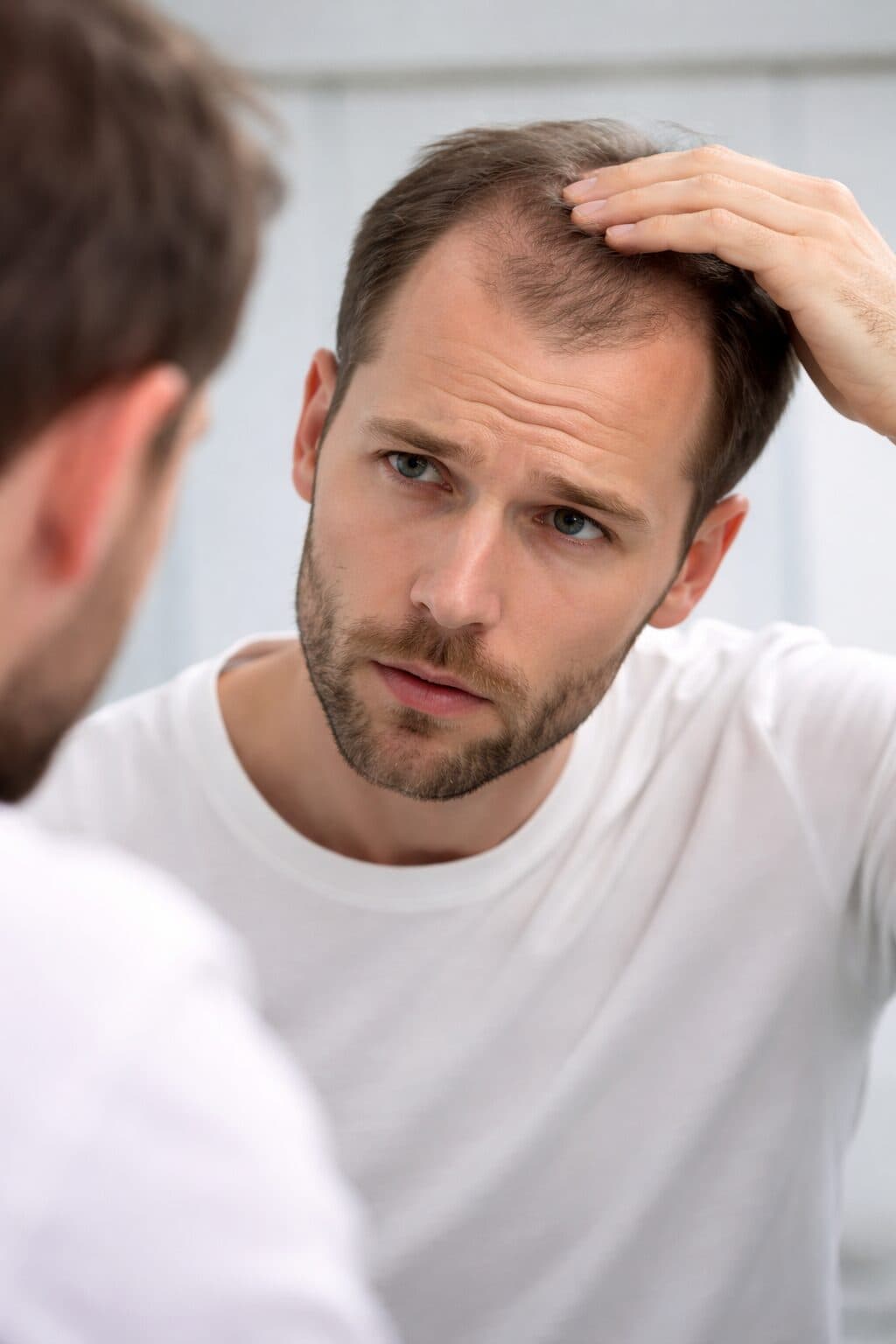
Hair loss can be temporary or persistent, and it doesn’t always mean the same thing. Understanding the pattern, how long it’s been going on, and the warning signs helps you decide when to watch for it and when to seek medical advice.
Before you read: At Skinpaths, we distinguish between opinion and evidence. To write this content, we prioritized indexed medical sources and recommendations from scientific societies. You’ll find the complete bibliography at the end for your reference.
Important: This article is for informational purposes only and does not replace medical advice. If you have any questions, persistent symptoms, or your condition worsens, consult a healthcare professional.
Summary in 60 seconds
- Hair loss is not a single disease, but a symptom or clinical pattern with very different causes.
- Sometimes it is temporary, such as after fever, surgery, childbirth, significant weight loss, or certain medications.
- Other times it is progressive, as in androgenetic alopecia, where the hair gradually thins.
- It can also appear suddenly in round patches, as in alopecia areata.
- The important data is not just «how much» hair falls out, but how it falls out: diffuse, in areas, with widening of the implantation line, with receding hairlines, with inflammation or with flaking.
- If there is pain, burning, scabs, redness or loss of eyebrows and eyelashes, it is advisable to consult a specialist.
- The diagnosis is usually made with a medical history, examination of the scalp and, in some cases, dermatoscopy (trichoscopy), laboratory tests or biopsy.
- Recovery, when it occurs, is usually measured in months, not days.
What is it?
“Hair loss” is a broad term that can describe anything from an increase in daily hair loss to progressive thinning or the appearance of areas with less density. In practice, it is useful to distinguish between two situations: diffuse hair loss or “shedding,” in which hair falls out more than usual but may grow back, and alopecia , in which there is also a real reduction in density or miniaturization of the hair follicle. This distinction is important because not all causes have the same prognosis or the same treatment. Rebora 2019 , Singh 2021 .
Why does it appear?
The most common causes are genetic and hormonal predisposition to androgenetic alopecia, abrupt changes in the hair growth cycle following a physical or metabolic trigger—such as fever, surgery, childbirth, or weight loss—and immunological processes like alopecia areata. Hairstyles that pull on the scalp, scalp inflammation, infections, thyroid disease, nutritional deficiencies, and certain medications can also contribute. In other words, hair loss occurs for a wide variety of reasons, which is why it’s important to avoid single explanations or universal solutions. Oiwoh 2024 , Sibbald 2023 .
Hair loss is a symptom and a clinical pattern ; it does not, by itself, explain the cause.
What does it look like?
Appearance is a great indicator. In female androgenetic alopecia, a progressive widening of the hairline and decreased density on the top of the head are common; in male androgenetic alopecia, receding hairlines and thinning at the crown are typical. Telogen effluvium usually manifests as diffuse hair loss rather than defined patches. Alopecia areata, on the other hand, typically presents with round or oval patches of relatively sudden onset. If redness, marked scaling, pustules, pain, or a burning sensation are also present, inflammatory or scarring causes should be considered, requiring earlier evaluation. BAD 2024a , BAD 2024b .
In what diseases or conditions does it usually occur?
As a guideline, these possibilities are usually considered first in consultations:
1. Very frequent
- Androgenetic alopecia : female or male pattern; slow and progressive course.
- Telogen effluvium : diffuse hair loss following childbirth, fever, surgery, physiological stress, weight loss, or some medications.
- Traction alopecia : related to very tight hairstyles, extensions, or repeated habits that pull on the hair.
2. Frequent
- Alopecia areata : round patches of relatively rapid onset; it can also affect eyebrows, eyelashes, or beard.
- Thyroid disorders or deficiencies such as iron : can promote diffuse hair loss or make underlying alopecia more evident.
- Hormonal changes : for example, menopause or polycystic ovary syndrome in some patients.
3. Infrequent
- Ringworm of the scalp : more common in children, but possible in adults.
- Inflammatory cicatricial alopecia : such as lichen planopillaris or frontal fibrosing alopecia.
- Trichotillomania and some systemic diseases : less frequent, but relevant in the differential diagnosis.
The important point is that the same symptom can correspond to very different problems, ranging from something reversible to conditions that require early treatment to avoid permanent damage. Singh 2021 , Sibbald 2023 .
When should I consult?
Consult a specialist if any of these signs appear:
- round plaques or sudden hair loss
- progressive widening of the implantation line or visible loss of density
- loss of eyebrows, eyelashes or beard
- pain, burning, intense itching, scabs, pus or marked flaking on the scalp
- hair loss after starting a new medication
- general associated symptoms such as marked fatigue, weight loss, fever, or menstrual irregularities
- hair that does not grow back in an area or scalp with a shiny/scarred appearance
These «red flags» do not necessarily signify severity, but they do warrant a more systematic review. AAD 2022 , BAD 2024c .
What NOT to do?
- Do not assume that every fall «is due to stress» without reviewing the pattern and context.
- Do not start using several products at once, because then it is difficult to know what helps and what irritates.
- Avoid putting strain on your hair with repeated hairstyles, extensions, or very tight updos.
- Don’t spend money on supplements or «miracle» formulas right away without understanding the cause.
- Do not discontinue medications prescribed for another illness on your own.
- Do not delay seeking medical advice if there is swelling, pain, scabs, or areas that look like scars.
A common mistake is to treat all hair loss as if it were the same thing. It’s not. AAD 2022 , BAD 2024b .
What does a dermatologist usually do?
The usual approach is to begin with a detailed medical history : when the hair loss occurred, whether it was sudden or gradual, and whether there was childbirth, fever, surgery, weight loss, physical stress, new medications, or a family history of hair loss. Next, the scalp is examined, noting the distribution of the hair loss, hair quality, and, if necessary, nails, eyebrows, eyelashes, and other hairy areas. (AAD 2022 , Singh 2021 )
Dermatoscopy or trichoscopy , a non-invasive technique that helps to better visualize the follicles and guide the diagnosis, is frequently used. If associated medical causes are suspected, tests may be ordered. And when the diagnosis is unclear, especially if scarring alopecia is suspected, a scalp biopsy may be indicated. Pirmez 2023 , Sperling 2023 .
The best decision is usually not to try more products, but to arrive at the correct diagnosis sooner . AAD 2022 , Singh 2021 .
Frequently Asked Questions
Is it normal to notice more hair loss when washing it?
It can happen. Sometimes it doesn’t mean that hair is «falling out all at once,» but rather that washing gathers hairs that were already going to fall out. What’s relevant is whether this perception is accompanied by less density, a wider hairline, or specific areas of hair loss. Rebora 2019 , AAD 2022 .
Can stress cause hair loss?
Yes, especially as a trigger for telogen effluvium. Typically, hair loss appears weeks or months after the triggering event, not necessarily on the same day as the stressful event. Rebora 2019 , AAD 2022 .
Is hair loss after childbirth usually temporary?
Often, yes. Many women notice increased hair loss a few months after giving birth, and in many cases, density gradually improves over time. Even so, if the hair loss is very significant or persistent, it’s advisable to check for other contributing factors. Rebora 2019 , AAD 2022 .
Is alopecia areata always permanent?
No. Spontaneous regrowth can occur in many people, but it is also a condition that can recur. Therefore, it warrants monitoring, especially if it spreads or affects eyebrows, eyelashes, or nails. Sibbald 2023 , BAD 2024c .
Does minoxidil work for all types of hair loss?
No. It may help in some situations, especially in androgenetic alopecia, but it is not a substitute for diagnosis. Furthermore, it usually requires continuous use, and results take months to assess. Evaluation and monitoring by a specialist physician will always be necessary. AAD 2022 , BAD 2024a .
How long does it take to see improvement?
It depends a lot on the cause. In telogen effluvium, recovery can take months once the trigger is resolved; with treatments like minoxidil, the response is usually also assessed in the medium term, not in a few weeks. Rebora 2019 , AAD 2022 .
Bibliography and sources
- American Academy of Dermatology Association. Hair loss: diagnosis and treatment [Internet] . Schaumburg (IL): AAD; 2022 [citado 2026 Abr 19] . Available in: AAD 2022 .
- British Association of Dermatologists. Hair loss female pattern (androgenetic alopecia): patient information leaflet [Internet] . London: BAD; 2024 Oct [citado 2026 Abr 19] . Available in: BAD 2024a .
- British Association of Dermatologists. Hair loss male pattern (androgenetic alopecia): patient information leaflet [Internet] . London: BAD; 2024 Jun [citado 2026 Abr 19] . Available in: BAD 2024b .
- British Association of Dermatologists. Alopecia areata: patient information leaflet [Internet] . London: BAD; 2024 Apr [citado 2026 Abr 19] . Available in: BAD 2024c .
- Oiwoh SO, Enitan AO, Adegbosin OT, Akinboro AO, Onayemi EO. Androgenetic alopecia: a review. Niger Postgrad Med J. 2024;31(2):85-92. Available in: Oiwoh 2024 .
- Rebora A. Telogen effluvium: a comprehensive review. Clin Cosmet Investig Dermatol. 2019;12:583-590. Available in: Rebora 2019 .
- Sibbald C. Alopecia areata: an updated review for 2023. J Cutan Med Surg. 2023;27(3):241-259. Available in: Sibbald 2023 .
- Singh S, Muthuvel K. Practical approach to hair loss diagnosis. Indian J Plast Surg. 2021;54(4):399-403. Available at: Singh 2021 .
- Pirmez R. The dermatoscope in the hair clinic: trichoscopy of scarring and nonscarring alopecia. J Am Acad Dermatol. 2023;89(2S):S9-S15. Available in: Pirmez 2023 .
- Sperling LC. The role of the scalp biopsy in the evaluation of alopecia. J Am Acad Dermatol. 2023;89(2S):S16-S19. Available in: Sperling 2023 .
- Xu L, Liu KX, Senna MM. A practical approach to the diagnosis and management of hair loss in children and adolescents. Front Med (Lausanne). 2017;4:112. Available in: Xu 2017
Categories: Common symptoms · For everyone · Hair loss

Content reviewed by
Dr. Rodolfo Suárez
Médico Patólogo y Dermatólogo Master en Patología Cutánea Avanzada
- Published
- September 18, 2026
- Updated
- September 23, 2026
Medically reviewed by specialists
Our content is based on current scientific evidence and clinical protocols.