
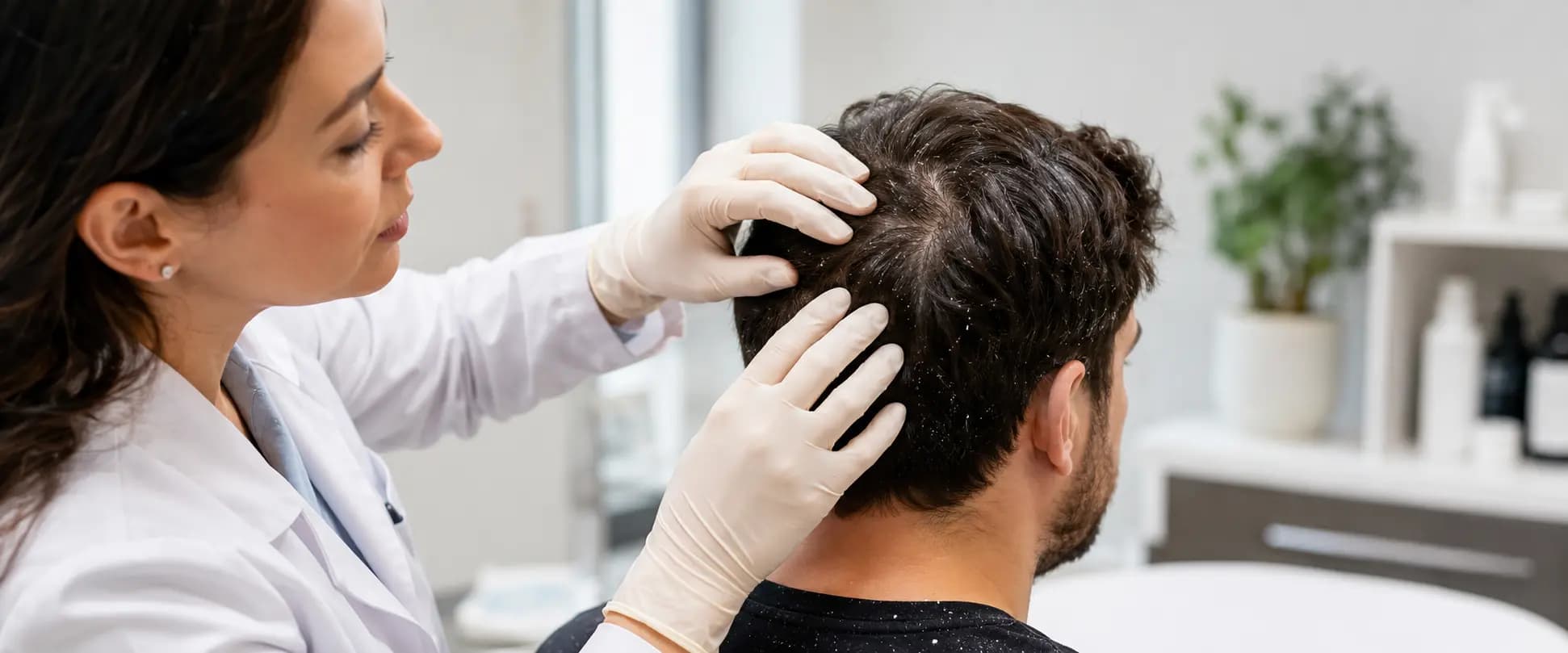
Dandruff is one of the most common scalp-related concerns. Although usually benign, it can be uncomfortable, visible, and persistent. Understanding its cause helps in treating it more effectively and avoiding irritating measures.
Before you read: At Skinpaths, we distinguish between opinion and evidence. To write this content, we prioritized indexed medical sources and recommendations from scientific societies. You’ll find the complete bibliography at the end for your reference.
Important: This article is for informational purposes only and does not replace medical advice. If you have any questions, persistent symptoms, or your condition worsens, consult a healthcare professional.
Summary in 60 seconds
- Dandruff is a visible flaking of the scalp.
- It is not usually a sign of poor hygiene.
- It is frequently part of the spectrum of seborrheic dermatitis.
- It may be accompanied by itching, a greasy feeling, or mild irritation.
- It is related to sebum, individual sensitivity, skin barrier, and yeasts of the Malassezia genus.
- It is not usually considered contagious.
- Medicated shampoos can help when used consistently.
- The realistic goal is usually to control outbreaks, not to promise a definitive cure.
- It is advisable to consult a doctor if there is pain, scabs, discharge, patchy hair loss, or lack of improvement.
What is dandruff?
Dandruff is a flaking of the scalp that can appear as white, grayish, or yellowish scales. In many people, it is considered a mild form of seborrheic dermatitis limited to the scalp, especially when there is no severe inflammation or lesions on other parts of the body. (Borda 2015)
Seborrheic dermatitis is a broader condition. It can affect the scalp, eyebrows, folds around the nose, beard, ears, chest, or other skin folds. When, in addition to flaking, there is redness, greasy plaques, significant itching, or lesions outside the scalp, it is advisable to consider whether it is seborrheic dermatitis and not just common dandruff. BAD 2023
Why does it appear?
Dandruff does not have a single cause. Current evidence understands it as a multifactorial phenomenon: sebum production, individual sensitivity, alteration of the skin barrier, scalp microbiota, and the presence of yeasts of the Malassezia genus. Dall’Oglio 2022
Malassezia normally lives on the skin. The problem isn’t simply «having a fungus,» but rather how each person’s scalp responds to that ecosystem. Therefore, dandruff shouldn’t be automatically interpreted as a lack of hygiene or a contagious infection.
Several factors can trigger or worsen breakouts, such as stress, fatigue, cold or dry weather, hormonal changes, irritating hair products, or routines that aren’t well-suited to your scalp type. AAD 2024
There are also diseases that can resemble or accompany dandruff, such as seborrheic dermatitis, scalp psoriasis, contact dermatitis from hair products, atopic eczema, and tinea capitis.
What does it look like and what symptoms does it cause?
Dandruff usually appears as visible flakes in the hair or on clothing. It may be accompanied by itching, a greasy feeling, tightness, or mild irritation.
When seborrheic dermatitis predominates, the scales may be more yellowish or oily, with redness, tenderness, or plaques in areas such as the eyebrows, nasolabial folds, beard, or ears. DermNet 2024
In darker skin tones, inflammation doesn’t always appear red. It can manifest as lighter or darker areas, or with visible scaling. This is important because the absence of redness doesn’t rule out inflammation.
There are findings that point to other diagnoses. Thick, well-defined plaques may suggest psoriasis; patchy hair loss, blackheads, or painful lymph nodes may suggest tinea pedis; and marked burning after using a new product may point to contact dermatitis.
What can you do today?
A sensible first step is to simplify your routine. Wash your scalp regularly, taking into account your hair type, activity level, oiliness, and tolerance. The goal is to cleanse your scalp without irritating it.
For mild to moderate dandruff, anti-dandruff shampoos may be sufficient. Medically backed ingredients include ketoconazole, selenium sulfide, zinc pyrithione, ciclopirox, and salicylic acid. Topical antifungals, such as ketoconazole and ciclopirox, have shown utility in seborrheic dermatitis. Okokon 2015
A prudent way to use it is to apply the shampoo to the scalp, not just the hair, leave it on for the time indicated on the label or as directed by your doctor, and rinse well. Many people use it two or three times a week initially. For curly, dry, or highly textured hair, the frequency may need to be adjusted to avoid dryness. AAD 2024
When it improves, some people require maintenance once a week or intermittently. This does not mean dependency; it means the scalp has a tendency to relapse and needs monitoring.
If there is a lot of scale buildup, a shampoo with salicylic acid can help loosen it. If there is significant inflammation, burning, sores, or lesions outside the scalp, it’s best not to try to treat it yourself and consult a specialist.
What NOT to do?
Do not scratch or pick at the scales forcefully. This can increase irritation, cause wounds, and lead to secondary infection.
Do not apply heavy oils as a universal treatment. In some people, they can worsen the oily feeling or flaking, especially if the underlying problem is seborrheic dermatitis.
Do not use vinegar, lemon, baking soda, alcohol, or irritating homemade mixtures. Although popular, they can disrupt the skin barrier and worsen inflammation.
Do not use topical corticosteroids repeatedly without medical advice. In certain cases they are helpful for short periods, but improper use can cause adverse effects.
Don’t change shampoos every few days expecting immediate results. Many treatments require several weeks of correct use before their effect can be assessed.
When should I consult?
Consult a dermatologist or healthcare professional if any of these signs appear:
- Pain, intense burning, discharge, pus, bad odor, or thick scabs.
- Hair loss in patches, round areas without hair, or blackheads on the scalp.
- Intense itching that interferes with sleep or daily life.
- Injuries to eyebrows, beard, ears, face, chest, armpits or groin.
- Very thick scaling, well-defined plaques, or suspicion of psoriasis.
- Lack of improvement after 3 to 4 weeks of correct use of medicated shampoo.
- Severe dandruff in children, immunocompromised individuals, or patients with relevant neurological disease.
- Rapid worsening, fever, or general malaise.
These signs do not necessarily mean something serious, but they do warrant a medical evaluation to confirm the diagnosis and avoid inappropriate treatments.
What does a dermatologist usually do?
The dermatologist usually begins by asking questions about the duration of the itching, hair products used, washing frequency, family history, medications, and previous illnesses. They then examine the scalp and may check the eyebrows, face, ears, beard, chest, and skin folds.
In many cases, the diagnosis is clinical: it is based on the appearance, location, and evolution of the lesions. If there is any doubt, the dermatologist may use dermatoscopy or trichoscopy to examine the scalp under magnification. Clark 2015
If tinea is suspected, a skin scraping, culture, or mycological examination may be ordered. If the lesions are atypical, do not respond to treatment, or resemble psoriasis, lupus, or another inflammatory condition, a skin biopsy may be considered.
Treatment may include medicated shampoos, scalp lotions or solutions, topical antifungals, keratolytics to loosen scales, and, if there is significant inflammation, topical anti-inflammatories for short periods.
The realistic goal is not to «eradicate dandruff forever,» but to control symptoms, reduce outbreaks, and keep the scalp comfortable.
Frequently Asked Questions
Is dandruff contagious?
- Generally, no. Dandruff and seborrheic dermatitis are not usually contagious. However, if the diagnosis is tinea capitis (ringworm of the scalp), the situation changes: that infection can be transmitted and requires medical treatment.
Does dandruff mean I have bad hygiene?
- Not necessarily. It can coexist with oil or product buildup, but dandruff is more related to sebum, individual susceptibility, microbiota, and inflammation than to «dirt.»
What is the best shampoo for dandruff?
- There is no one-size-fits-all treatment. Ketoconazole, selenium sulfide, zinc pyrithione, ciclopirox, and salicylic acid may all be helpful depending on the pattern of scaling, oiliness, itching, and inflammation.
How often should I wash my hair?
- It depends on the hair and scalp type. Some people benefit from more frequent washing; others, especially those with curly or dry hair, need less frequent washing and less drying products.
Is dandruff cured permanently?
- It can be very well controlled, but it tends to recur in predisposed individuals. In seborrheic dermatitis, flare-ups may improve with treatment and reappear when it is discontinued.
Does dandruff cause hair loss?
- Common dandruff doesn’t usually cause permanent baldness. However, inflammation, intense scratching, or conditions that mimic dandruff can be associated with hair loss. If you notice patchy hair loss, pain, or scabs, consult a specialist.
Can I use natural remedies?
- It’s wise to be cautious. «Natural» doesn’t mean safe for your skin. Vinegar, lemon, essential oils, and homemade mixtures can all cause irritation. If a product causes burning, intense itching, or worsening of the condition, discontinue use.
Bibliography and sources
- Borda LJ, Wikramanayake TC. Seborrheic dermatitis and dandruff: a comprehensive review. J Clin Investig Dermatol. 2015;3(2):10. doi:10.13188/2373-1044.1000019. Available at: https://pubmed.ncbi.nlm.nih.gov/27148560/
- Dall’Oglio F, Nasca MR, Gerbino C, Micali G. An overview of the diagnosis and management of seborrheic dermatitis. Clin Cosmet Investig Dermatol. 2022;15:1537-1548. doi:10.2147/CCID.S284671. Available at: https://pubmed.ncbi.nlm.nih.gov/35967915/
- Okokon EO, Verbeek JH, Ruotsalainen JH, Ojo O, Bakhoya VN. Topical antifungals for seborrhoeic dermatitis. Cochrane Database Syst Rev. 2015;(5):CD008138. doi:10.1002/14651858.CD008138.pub3. Available at: https://pubmed.ncbi.nlm.nih.gov/25933684/
- Leroy AK, Cortez de Almeida RF, Obadia DL. Scalp seborrheic dermatitis: what we know so far. Skin Appendage Disord. 2023;9(3):160-164. doi:10.1159/000529854. Available at: https://pubmed.ncbi.nlm.nih.gov/37325288/
- Tynes BE, Singh N, Kazi R, et al. Ketoconazole shampoo for seborrheic dermatitis of the scalp: a narrative review. Cureus. 2024;16(8):e67741. doi:10.7759/cureus.67741. Available at: https://pubmed.ncbi.nlm.nih.gov/39310465/
- Clark GW, Pope SM, Jaboori KA. Diagnosis and treatment of seborrheic dermatitis. Am Fam Physician. 2015;91(3):185-190. Available at: https://pubmed.ncbi.nlm.nih.gov/25822272/
- American Academy of Dermatology Association. Seborrheic dermatitis: diagnosis and treatment. American Academy of Dermatology Association; 2024. Available at: https://www.aad.org/public/diseases/az/seborrheic-dermatitis-treatment
- British Association of Dermatologists. Seborrhoeic dermatitis. Patient Information Sheetlet. British Association of Dermatologists; 2023. Available at: https://www.bad.org.uk/pils/seborrhoeic-dermatitis
- DermNet. Seborrhoeic dermatitis. DermNet NZ; 2024. Available at: https://dermnetnz.org/topics/seborrhoeic-dermatitis
- National Institute for Health and Care Excellence. Seborrhoeic dermatitis. NICE Clinical Knowledge Summaries. Available at: https://cks.nice.org.uk/topics/seborrhoeic-dermatitis/
Categories: Fungal infection of the skin · Seborrheic dermatitis

Content reviewed by
Dr. Rodolfo Suárez
Médico Patólogo y Dermatólogo Master en Patología Cutánea Avanzada
- Published
- September 18, 2026
- Updated
- September 23, 2026
Medically reviewed by specialists
Our content is based on current scientific evidence and clinical protocols.