
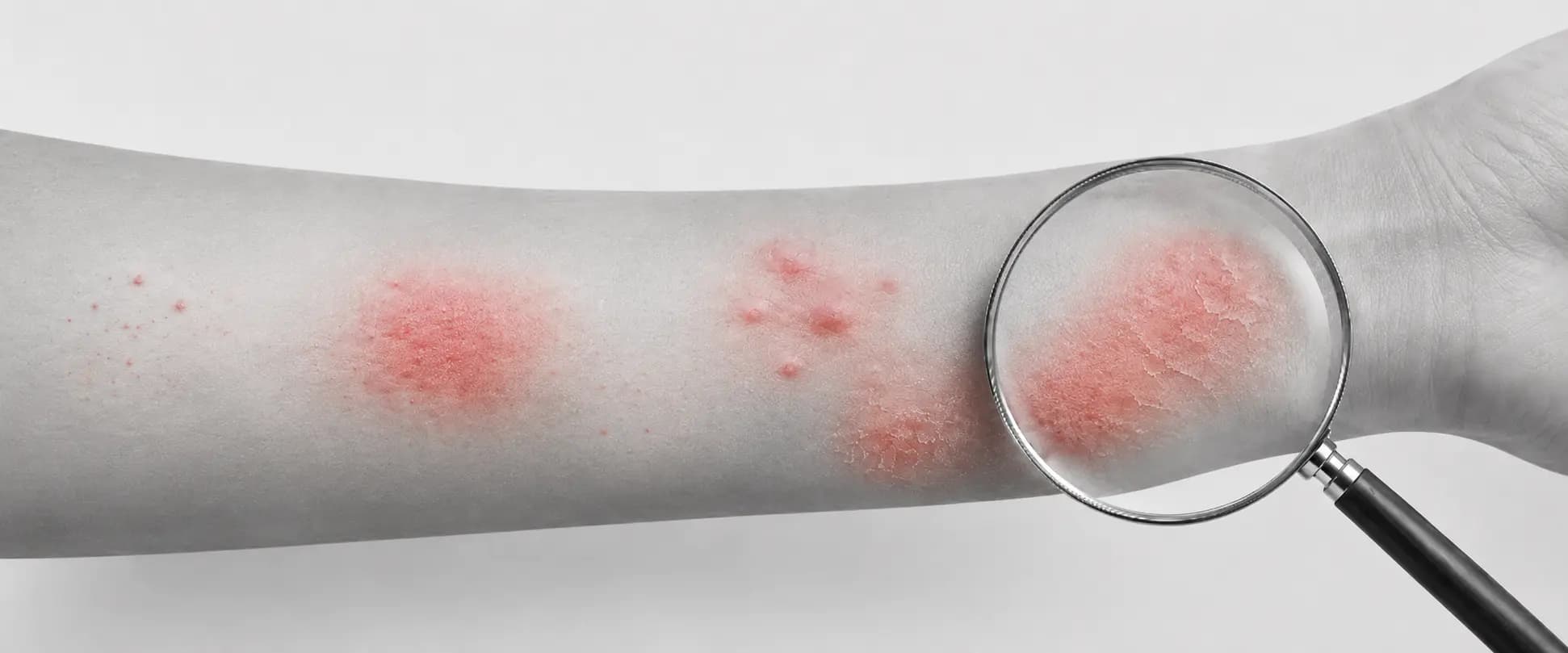
A guide to differentiating irritation, allergies, infections, vascular lesions and warning signs on the skin.
Before you read: At Skinpaths, we distinguish between opinion and evidence. To write this content, we prioritized indexed medical sources and recommendations from scientific societies. You’ll find the complete bibliography at the end for your reference.
Important: This article is for informational purposes only and does not replace medical advice. If you have any questions, persistent symptoms, or your condition worsens, always consult a healthcare professional.
Summary in 60 seconds
- Red spots on the skin are not a diagnosis: they are a way in which the skin expresses inflammation, irritation, infection, superficial bleeding, or vascular changes.
- Many causes are common and manageable, such as contact dermatitis, atopic eczema, urticaria, bites, miliaria, or ringworm.
- The initial key is to observe whether the spot itches, hurts, peels, blisters, rises, expands, or changes rapidly.
- An important distinction is whether the spot blanches when pressed or remains the same. Petechiae and purpura do not usually blanch because they correspond to blood outside of small vessels.
- It is advisable to consult a doctor as a priority if there is fever, general malaise, intense pain, blisters, peeling skin, involvement of the eyes, mouth or genitals, pus, local heat or rapid expansion.
- In dark, black, or tanned skin, redness may appear brown, purplish, grayish, or be less noticeable; that’s why texture, pain, heat, swelling, and general symptoms also matter.
- It’s unwise to assume that every red spot is an «allergy.» Some infections, drug reactions, or blood disorders can initially appear similar.
- The dermatologist usually combines medical history, physical examination, dermatoscopy when it adds value and, in selected cases, cultures, mycological scraping, blood tests or biopsy.
What are red spots on the skin?
“Red spots on the skin” is a common way to describe visible changes that can be flat or raised, small or extensive, itchy or painful, with or without scaling. In medicine, these lesions are described according to their morphology : macules, papules, plaques, wheals, vesicles, pustules, petechiae, or purpura. This classification helps to organize the possible causes and identify conditions that may require urgent attention. Santistevan 2017
In practical terms, a red spot can represent four broad processes: skin inflammation, dilation of blood vessels, infection, or superficial bleeding. For example, a hive welt is usually raised and itchy; a psoriasis plaque may scale; ringworm may form a more pronounced border; a petechia is usually pinpoint and does not blanch with pressure; a cherry angioma is usually a benign red spot of vascular origin (DermNet 2020).
A red spot is not a diagnosis; it is a sign that must be read together with symptoms, evolution and context.
Why do they appear?
Red spots appear because the skin reacts to a stimulus. This stimulus can be external, such as soaps, cosmetics, metals, plants, heat, sweat, friction, or insect bites. It can also be internal, such as a viral infection, an immune response, a reaction to medication, an inflammatory disease, or a clotting disorder.
A very common cause is contact dermatitis , which can be irritant or allergic. Contact dermatitis usually occurs after exposure to an irritant or allergen and can cause red, dry, cracked, itchy, or blistered skin (NHS 2022 ). Atopic eczema, hives, insect bites, and miliaria are also common causes.
Sometimes, the cause is infectious. Fungal infections, such as ringworm, can produce red or darker lesions with raised, scaly borders; bacterial infections can cause painful redness, warmth, swelling, crusting, pus, or fever. Ringworm, according to the CDC, typically causes a ring-shaped rash, although lesions may not look the same on all areas of the body. CDC 2024
There are also vascular or hemorrhagic causes. Petechiae and purpura occur when blood leaks from small vessels into the skin; this is why they do not disappear when pressed. Their significance depends on the context: they can appear due to exertion, minor trauma, or vascular fragility, but also due to serious infections, vasculitis, platelet disorders, medications, or coagulation disorders. Antonov 2020
What do they look like?
The appearance can vary greatly. Some patches are flat and diffuse; others are raised like welts; some form thick, scaly plaques; others are very small, red or purplish «pinpricks.» On fair skin, many lesions appear pink or red; on brown or black skin, they may appear brown, purplish, grayish, or leave dark stains after becoming inflamed.
A useful observation is the pressure test : when gently pressed with a finger or a clear glass, some lesions temporarily blanch. This usually suggests redness due to dilated vessels or inflammation. In contrast, petechiae and purpura do not blanch because they correspond to blood outside the vessel. RCH sf
Texture also matters. A red, scaly patch may suggest eczema, psoriasis, seborrheic dermatitis, or ringworm. A wheal that moves and itches suggests urticaria. A hot, painful, and spreading plaque suggests infection. A bright red, round, stable lesion may be a cherry angioma, which is usually benign, although it should be checked if it changes, bleeds without trauma, or causes diagnostic uncertainty. DermNet 2020
In what diseases or conditions do they usually occur?
The frequency varies depending on age, climate, medications, medical history, sun exposure, contact with animals, travel, and immune status. However, for the general public (and as a guideline), it can be ordered as follows:
1) Very frequent
- Irritant or allergic contact dermatitis: caused by soaps, fragrances, cosmetics, dyes, metals, plants, gloves, detergents, or repeated contact with water.
- Atopic eczema: is usually accompanied by dry skin, itching, and recurring outbreaks.
- Urticaria: raised, itchy welts that can change location and shape; international guidelines define it as hives, angioedema, or both. Zuberbier 2022
- Bites and papular urticaria: Itchy, red bumps, often in exposed areas; may persist for days or weeks. DermNet 2021
- Miliaria, or heat rash: small spots or bumps that feel itchy or stinging, more common in hot, sweaty conditions. NHS 2024
- Viral exanthems: especially in children, they are often accompanied by fever, malaise, respiratory or gastrointestinal symptoms.
2) Frequent
- Ringworm and other fungal infections: ring-shaped, scaly, or active-bordered lesions; may be mistaken for eczema.
- Rosacea: persistent redness or outbreaks on the face, with visible blood vessels, burning sensation, pimples, or eye involvement in some people. AAD 2024
- Psoriasis: red, pink, purple, or gray scaly plaques; may affect elbows, knees, scalp, trunk, palms, or soles. NHS 2023
- Folliculitis, impetigo, or cellulitis: bacterial infections that can produce pain, heat, scabs, pustules, pus, or fever.
- Drug reactions: from mild rashes to rare but serious conditions, especially if there is fever, blisters, peeling or affected mucous membranes.
3) Infrequent, but important
- Petechiae and purpura: spots or patches that do not blanch when pressed; they can be benign depending on the context, but can also indicate serious infection, platelet disorders, vasculitis, or clotting problems.
- Cutaneous vasculitis: can produce palpable purpura, pain, tenderness, or lesions on the legs.
- Meningococcemia, sepsis, or other serious infections: increased suspicion if fever, malaise, confusion, stiff neck, severe pain, mottled skin, cold extremities, or progressive non-blanchable lesions are present. NICE 2024
- Stevens-Johnson syndrome and toxic epidermal necrolysis: severe skin reactions, often related to medications, that can cause pain, blistering, skin peeling, and mucous membrane involvement. Frantz 2021
- Autoimmune diseases: lupus, dermatomyositis, or other inflammatory diseases may manifest with red spots in specific patterns.
- Blood or platelet disorders: may be accompanied by spontaneous bruising, bleeding gums, marked fatigue, paleness, or repeated infections.
When should I consult?
Seek specialist medical evaluation as a priority if any of these situations occur:
- Spots that do not blanch when pressed , especially if they are new, numerous, progressive, or accompanied by fever, weakness, severe headache, stiff neck, vomiting, confusion, or drowsiness.
- Fever or feeling of significant illness along with a rash.
- A rash that spreads rapidly or covers a large part of the body.
- Intense pain, hot, swollen or very sensitive skin , especially if the area increases in size.
- Blisters, peeling skin, open wounds, or raw skin.
- Involvement of eyes, lips, mouth, genitals or anus.
- Difficulty breathing, speaking or swallowing , tightness in the chest or throat, or swelling of the lips, tongue, face or eyelids: this requires emergency attention.
- Pus, yellow crusts, foul odor, red streaks, swollen lymph nodes, or fever , because they may suggest infection.
- Unexplained bruising, bleeding gums or nose, blood in urine or stool , or the appearance of many petechiae.
- New lesions that grow, bleed, change color, or do not heal.
- Young babies, immunocompromised individuals, pregnant women, older adults, or patients on anticoagulants: it is advisable to have a lower threshold for consultation.
The American Academy of Dermatology recommends medical attention for extensive, blistering, painful, rapidly progressing rashes with fever, signs of infection, or involvement of the eyes, lips, mouth, or genitals. AAD 2024
What NOT to do?
Avoid assuming that every red spot is an allergy. That idea can delay the diagnosis of infections, ringworm, vasculitis, drug reactions, or petechiae that require evaluation.
Do not apply potent corticosteroids without a diagnosis, especially to lesions with a ring-shaped border, pus, crusting, pain, heat, or rapid growth. In some fungal infections, corticosteroids can alter the appearance and make diagnosis more difficult.
Do not pop blisters, do not scratch them repeatedly, and do not use acids, home remedies, lemon, alcohol, garlic, irritating mixtures, or abrasive treatments. Inflamed skin loses its barrier and can become infected more easily.
Do not stop or restart important medications on your own. If the rash appeared after starting a medication, write down the name, dose, and start date, and consult your doctor. If blisters, mucous membranes, fever, or general malaise develop, seek urgent medical attention and bring your medication list with you.
Don’t use internet photos as your sole criterion. Two different diseases can look similar; moreover, skin color, lighting, camera angle, and the stage of the lesion can all change the appearance.
What does a dermatologist usually do?
The dermatologist begins by reconstructing the history: when the spot appeared, whether it itches or hurts, whether it is spreading, whether there was fever, new medications, travel, bites, contact with animals, new cosmetics, sun exposure, history of eczema, psoriasis, allergies, infections or autoimmune diseases.
Then evaluate the morphology: whether they are macules, papules, plaques, wheals, vesicles, pustules, petechiae or purpura; whether they blanch or not with pressure; whether there is scaling, active border, heat, pain, crusts, pus, blisters or involvement of mucous membranes, nails, scalp, palms and soles.
Dermatoscopy can be helpful in diagnosing vascular, pigmented, inflammatory, or suspicious lesions. It is a non-invasive technique that allows the observation of skin structures not visible to the naked eye and has expanded beyond pigmented lesions to include inflammatory, infectious, and adnexal disorders. Sonthalia 2023
Further tests depend on the case. A potassium hydroxide scraping or culture may be ordered if a fungal infection is suspected; a bacterial or viral culture if pus, crusts, or vesicles are present; patch tests if allergic contact dermatitis is suspected; and blood tests if petechiae, purpura, fever, malaise, suspected platelet disorder, coagulation disorder, vasculitis, or systemic disease are present.
A skin biopsy is not performed in all cases, but it may be useful if the lesion is persistent, atypical, unresponsive to expected management, blisters, appears to be vasculitis, raises doubt about skin cancer, or requires histological confirmation. MedlinePlus includes persistent rash, scaly lesions, non-healing wounds, blisters, and changing lesions among the possible indications for biopsy. MedlinePlus 2025
Frequently Asked Questions
Are red spots on the skin usually serious?
- They often aren’t, but it depends on the context. An isolated, stable, painless, feverless, and non-rapidly growing red spot is usually less worrisome than a large, painful rash with fever, blisters, or lesions that don’t blanch.
What does it mean when a red stain doesn’t disappear when pressed?
- It may indicate petechiae or purpura, which are small areas of bleeding on the skin. It doesn’t automatically mean there’s a serious illness, but it warrants further attention if it appears suddenly, spreads, or is accompanied by fever, malaise, bruising, bleeding, or neurological symptoms.
Are itchy red spots a sign of allergies?
- They may be, but not necessarily. Itching also occurs in eczema, contact dermatitis, urticaria, insect bites, ringworm, scabies, psoriasis, and some drug reactions. The distribution, duration, pattern, and associated symptoms help guide the diagnosis.
When can a red spot be an infection?
- If there is pain, heat, swelling, progressive increase in the affected area, pus, yellow crusts, foul odor, fever, or red streaks extending from the lesion, it is important to consult a specialist, as some infections require specific treatment.
What is the difference between petechiae and cherry angiomas?
- Petechiae are typically flat, non-blanchable spots of blood leaking from small vessels. Cherry angiomas are usually small, round, benign, red or purplish lesions made up of blood vessels. Even so, any red lesion that changes, bleeds for no apparent reason, or raises concerns should be examined.
Can I apply a corticosteroid cream?
- It’s not ideal to treat a lesion without a diagnosis if it’s new, painful, has pus, a ring-shaped border, scabs, blisters, or is growing rapidly. Corticosteroids can relieve inflammation, but they can also worsen or mask some infections.
How long can I observe before consulting?
- If the lesion is mild, localized, painless, and without fever, its progression can be monitored for a few days with gentle general measures. Consult a doctor sooner if it worsens, spreads, lasts longer than expected, recurs frequently, or affects the face, eyes, genitals, hands, feet, or mucous membranes.
Bibliography and sources
- Santistevan J, Long B, Koyfman A. Rash decisions: an approach to dangerous rashes based on morphology. J Emerg Med . 2017;52(4):457-471. Available in: Santistevan 2017 .
- Antonov D, Kamarashev J, Kazandjieva J, Tsankov N. The rash that becomes purpuric, petechial, hemorrhagic, or ecchymotic. Clin Dermatol . 2020;38(1):3-18. Available in: Antonov 2020 .
- Frantz R, Huang S, Are A, Motaparthi K. Stevens-Johnson syndrome and toxic epidermal necrolysis: a review of diagnosis and management. Medicine (Kaunas) . 2021;57(9):895. Available in: Frantz 2021 .
- Zuberbier T, Abdul Latiff AH, Abuzakouk M, et al. The international EAACI/GA²LEN/EuroGuiDerm/APAAACI guideline for the definition, classification, diagnosis, and management of urticaria. Allergy . 2022;77(3):734-766. Available in: Zuberbier 2022 .
- American Academy of Dermatology Association. Rash 101 in adults: when to seek medical treatment [Internet] . 2024 Jan 22 [citado 2026 Jul 1] . Available in: AAD 2024 .
- National Institute for Health and Care Excellence. Evidence review for symptoms and signs associated with meningococcal disease [Internet] . 2024 [citado 2026 Jul 1] . Available in: NICE 2024 .
- The Royal Children’s Hospital Melbourne. Clinical Practice Guidelines: Petechiae and purpura [Internet] . [citado 2026 Jul 1] . Available at: RCH sf .
- Ngan V, Oakley A. Purpura [Internet] . DermNet; updated 2015 Nov [citado 2026 Jul 1] . Available at: DermNet 2015 .
- Oakley A. Cherry angioma [Internet] . DermNet; revised 2020 Sep [citado 2026 Jul 1] . Available in: Oakley 2020 .
- National Health Service. Heat rash (prickly heat) [Internet] . 2024 May 9 [citado 2026 Jul 1] . Available at: NHS 2024 .
- National Health Service. Contact dermatitis [Internet] . [citado 2026 Jul 1] . Available from: NHS sf .
- Centers for Disease Control and Prevention. Clinical overview of ringworm [Internet] . 2024 Jul 15 [citado 2026 Jul 1] . Available at: CDC 2024 .
- American Academy of Dermatology Association. Rosacea: overview [Internet] . 2024 Apr 3 [citado 2026 Jul 1] . Available in: AAD 2024 .
- MedlinePlus. Skin biopsy [Internet] . 2025 Jun 30 [citado 2026 Jul 1] . Available at: MedlinePlus 2025 .
Categories: For everyone · Skin spots

Content reviewed by
Dr. Rodolfo Suárez
Médico Patólogo y Dermatólogo Master en Patología Cutánea Avanzada
- Published
- September 18, 2026
- Updated
- September 23, 2026
Medically reviewed by specialists
Our content is based on current scientific evidence and clinical protocols.