

This article explains what Mohs surgery is and why it is used for certain skin cancers, especially when maximum precision is needed to preserve healthy tissue (for example, on the face). It describes, in clear language, how the procedure is performed in stages with microscopic control of the margins, how long the day might take, what the recovery is typically like, what the expected effects are, and what warning signs should prompt a consultation.
Before you read: At Skinpaths, we distinguish between opinion and evidence. To write this content, we prioritized indexed medical sources and recommendations from scientific societies. You’ll find the complete bibliography at the end for your reference.
Important: This article is for informational purposes only and does not replace medical advice. If you have any questions, persistent symptoms, or your condition worsens, consult a healthcare professional.
Summary in 60 seconds
- Mohs surgery is a technique for treating certain skin cancers in which the tumor is removed in layers, and each layer is examined under a microscope during the procedure. This allows doctors to determine precisely whether any cancer cells remain at the edges/margins. American Academy of Dermatology-2021
- It is used primarily when it is important to preserve healthy skin (for example, the face) or when the tumor has higher-risk characteristics or has already recurred. Mayo Clinic-2024
- It’s common to spend several hours at the center: brief surgical procedures alternate with waiting periods while the tissue is processed and analyzed. Mayo Clinic-2024
What is it?
Mohs micrographic surgery is a surgical procedure designed to remove certain skin cancers with very detailed microscopic control of the margins. In practice, the goal is to remove the tumor while preserving as much surrounding healthy tissue as possible. Prickett-2023
What is it for?
It is used to treat (mainly) basal cell carcinoma and cutaneous squamous cell carcinoma , especially when:
- The injury is in areas where a millimeter matters (eyelids, nose, lips, ears, forehead, hands).
- The tumor has reappeared after previous treatment or has poorly defined borders.
- It is considered higher risk due to size, location, or histological subtype, among other factors. Schmults-2023
Mohs surgery seeks two goals at once: to remove skin cancer with microscopic control and to preserve as much healthy skin as possible.
How does it work?
Think of the tumor as a patch with irregular “roots.” In Mohs surgery, a thin first layer is removed and analyzed; if the microscopic map detects tumor at a specific point, another layer is removed only where necessary. This process is repeated until it is confirmed that there is no more cancer at the margins. American Academy of Dermatology-2021
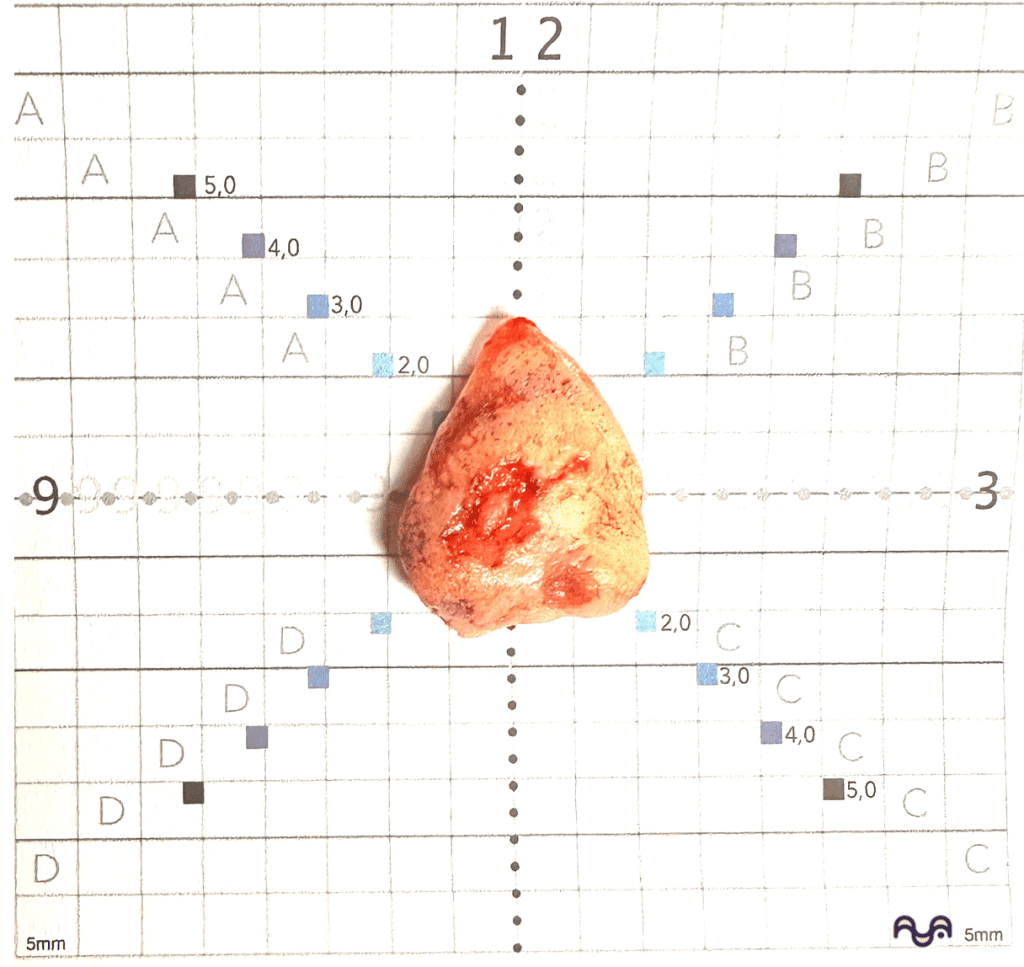
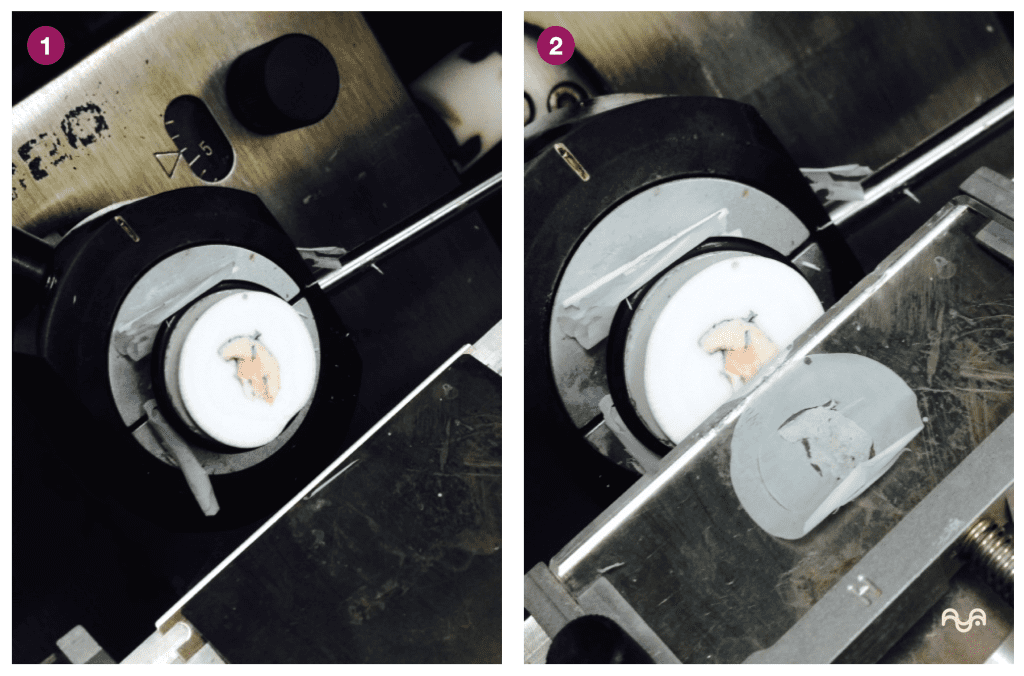
Mohs surgery / Histological sections: Once the sample is oriented and marked, thin sections are made in the cryostat to obtain «thin slices» from the margins and stained for evaluation under the microscope
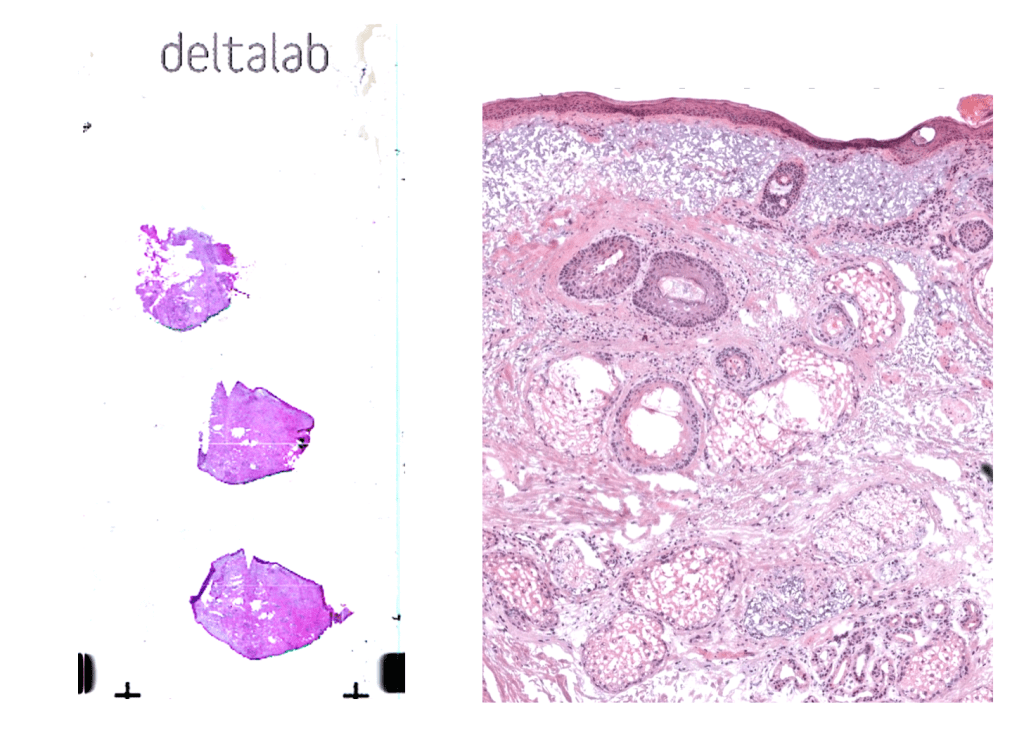
Mohs surgery/microscopic evaluation: Once the tissue slices are collected, they are stained and then examined under a microscope for neoplastic cells. If no tumor is identified at the margins, it means the resection was complete and no further tissue removal is necessary.
What to expect?
Before
- They will explain the diagnosis (type of cancer), the reason for indicating Mohs and the reasonable alternatives in your case.
- You will receive instructions on medication and preparation, tailored to your clinical situation. May Clinic-2024
During
- It is usually done with local anesthesia .
- The procedure occurs in stages: brief surgery → wait while the sample is analyzed → new stage if necessary.
- The total time is variable; therefore, it is recommended to plan your day with some leeway. Mayo Clinic-2024
After
- Closure can be achieved with simple stitches, reconstructive techniques (flaps or grafts), or, in selected cases, by allowing it to heal in a directed manner.
- It’s common to experience swelling, tightness, or bruising in the first few days (more so on the face). Mayo Clinic-2024
Aftercare
Exact care depends on the location and type of closure. Your team should provide you with written instructions on:
- bandage/wound care,
- time limits of activity,
- pain control
- Who to contact and what signs warrant early consultation. Mayo Clinic-2024
Expected vs. unexpected effects
Expected
- Local discomfort, feeling of tightness.
- Inflammation and bruising.
- Some slight bleeding/»staining» of the dressing.
Not expected (please consult your specialist)
- Bleeding that does not stop or repeatedly soaks through the bandage.
- Progressive redness, local heat, foul-smelling discharge, fever.
- Pain that increases markedly instead of improving. May Clinic-2024
Warning signs (emergency)
Seek immediate medical attention if the following occurs:
- Persistent heavy bleeding,
- severe allergic reaction (rapid swelling, difficulty breathing),
- high fever or general deterioration,
- Disproportionate, severe pain. Mayo Clinic-2024
How to choose a professional/center
Useful and reasonable questions to ask when choosing a specialist/medical center:
-
Who will perform the surgery and what specific Mohs training do they have? (structured training and supervised practice). American College of Mohs Surgery-2026
-
Why Mohs in my case and what are the alternatives?
-
What will the reconstruction look like, and who will carry it out?
-
What complications are most likely based on my location and medications?
-
What written instructions will they give me, and who do I call if there is bleeding or severe pain?
-
Does the service follow formal safety and traceability standards (mapping, sample control, documentation)? British Association of Dermatologists-2020
Frequently Asked Questions
How long does Mohs surgery take?
- It depends on the size of the tumor and whether one or multiple stages are needed. Therefore, the total time can vary and often takes several hours. Mayo Clinic-2024
Hurts?
- During surgery, local anesthesia usually controls the pain. Afterward, there may be discomfort and tightness for a few days.
Why isn’t Mohs treatment done on everyone?
- Because in low-risk tumors, other techniques may be sufficient. Mohs is reserved for situations where detailed margin control and tissue preservation offer a clear advantage.
How effective is it compared to conventional excision?
- In facial tumors (especially high-risk or recurrent ones), randomized trials with long-term follow-up have shown lower recurrence rates with Mohs surgery compared to standard excision in selected settings. Mosterd-2008 , vanLoo-2014
What does the scar look like?
- All surgery leaves a scar. The final appearance depends on the size, location, closure technique, and the normal maturation process (which can take months).
What happens if the tumor «comes out» clear in the first stage?
- This means that the margin was already free after the first layer, avoiding the removal of unnecessary additional fabric.
Bibliography and sources
- American Academy of Dermatology Association. What is Mohs surgery? [Internet] . Rosemont (IL): American Academy of Dermatology Association; 2021 May 17 [cited 2026 May 30] .
- Mayo Clinic Staff. Mohs surgery [Internet] . Rochester (MN): Mayo Foundation for Medical Education and Research; 2024 Sep 19 [cited 2026 May 30] .
- British Association of Dermatologists. Mohs micrographic surgery [Internet] . London: British Association of Dermatologists; 2025 Jun [cited 2026 May 30] .
- British Association of Dermatologists; British Society for Dermatological Surgery. Mohs Micrographic Surgery (MMS): UK surgical standards 2020 [Internet] . London: British Association of Dermatologists; 2020 [cited 2026 May 30] .
- Prickett KA, Ramsey ML. Mohs Micrographic Surgery [Internet] . In: StatPearls. Treasure Island (FL): StatPearls Publishing; 2026 Jan-. Updated 2023 Jul 25 [cited 2026 May 30] .
- Schmults CD, Blitzblau R, Aasi SZ, Alam M, Amini A, Bibee K, et al. Basal Cell Skin Cancer, Version 2.2024, NCCN Clinical Practice Guidelines in Oncology . J Natl Compr Canc Netw. 2023 Nov;21(11):1181-1203. doi:10.6004/jnccn.2023.0056.
- Mosterd K, Krekels GAM, Nieman FH, Ostertag JU, Essers BAB, Dirksen CD, et al. Surgical excision versus Mohs’ micrographic surgery for primary and recurrent basal-cell carcinoma of the face: a prospective randomized controlled trial with 5-years’ follow-up . Lancet Oncol. 2008 Dec;9(12):1149-1156. doi:10.1016/S1470-2045(08)70260-2.
- van Loo E, Mosterd K, Krekels GAM, Roozeboom MH, Ostertag JU, Dirksen CD, et al. Surgical excision versus Mohs’ micrographic surgery for basal cell carcinoma of the face: a randomized clinical trial with 10 year follow-up . Eur J Cancer. 2014 Nov;50(17):3011-3020. doi:10.1016/j.ejca.2014.08.018.
- Alsaif A, Hayre A, Karam M, Rahman S, Abdul Z, Matteucci P. Mohs Micrographic Surgery Versus Standard Excision for Basal Cell Carcinoma in the Head and Neck: Systematic Review and Meta-Analysis . Cureus. 2021 Nov 29;13(11). doi:10.7759/cureus.19981.
- Cancer Research UK. Mohs micrographic surgery (MMS) for skin cancer [Internet] . London: Cancer Research UK; 2023 [cited 2026 May 30] .
- American College of Mohs Surgery. For Patients [Internet] . Milwaukee (WI): American College of Mohs Surgery; 2026 [cited 2026 May 30] .
Categories: For everyone · Mohs surgery

Content reviewed by
Dr. Rodolfo Suárez
Médico Patólogo y Dermatólogo Master en Patología Cutánea Avanzada
- Published
- September 18, 2026
- Updated
- September 23, 2026
Medically reviewed by specialists
Our content is based on current scientific evidence and clinical protocols.