
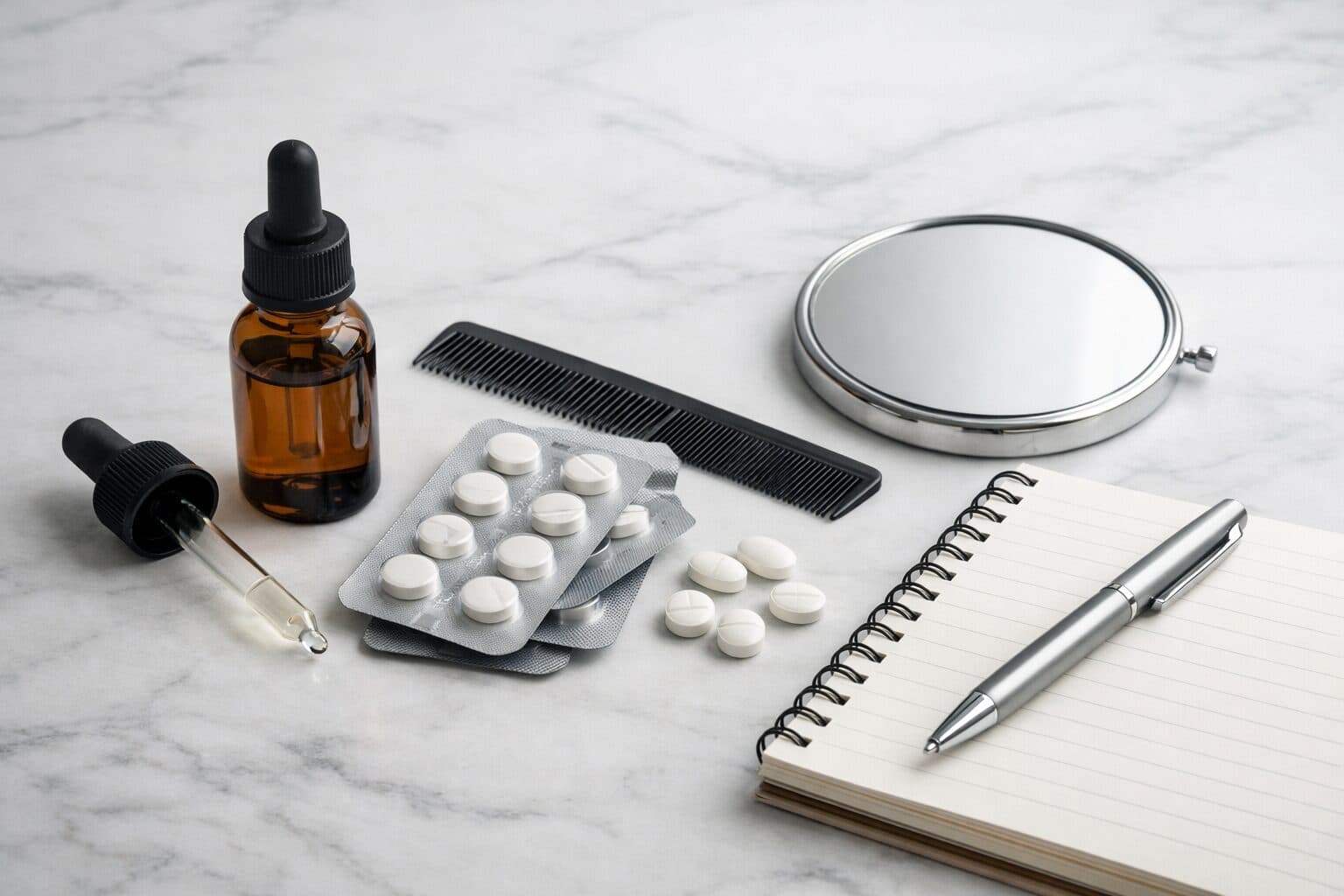
Treatments that do have scientific evidence to treat hair loss.
Before you read: At Skinpaths, we distinguish between opinion and evidence. To write this content, we prioritized indexed medical sources and recommendations from scientific societies. You’ll find the complete bibliography at the end for your reference.
Important: This article is for informational purposes only and does not replace a medical evaluation. Never self-medicate: the causes of hair loss are varied, and treatments are designed for specific types of alopecia. Every treatment has precise indications, side effects, and contraindications that only a dermatology specialist is qualified to assess.
Summary in 60 seconds
- The central idea is simple: not all hair loss is treated the same, and the treatments that work best depend on the diagnosis.
- When we talk about androgenic alopecia —the most common pattern in men and women—, the greatest practical support continues to be concentrated on minoxidil and, in selected men, finasteride .
- Topical minoxidil can help slow hair loss and promote some recovery, but it requires consistency and time.
- Oral finasteride can be effective in men, although it requires serious discussion with a specialist about benefits, limitations, and possible adverse effects.
- In women, in addition to minoxidil, some dermatologists use spironolactone and, in selected cases, low-dose oral minoxidil .
- PRP (Platelet-Rich Plasma) , low-intensity laser and microneedling may provide some benefit to certain patients, but they do not replace the basic treatments.
- Hair transplantation can be a good aesthetic option if the case is well chosen, but it does not always replace medical treatment.
- Improvements usually take months , not days or weeks.
One essential point: if the hair loss is sudden, patchy, accompanied by pain, burning, or inflammation, the diagnosis should be reconsidered before purchasing any products. Vañó-Galván 2024 , Adil 2017
What is it?
In practice, when people ask for “treatments that actually work,” they are almost always referring to androgenic alopecia : the progressive loss of density at the temples, crown, or part, depending on sex and pattern. It is important to clarify this because minoxidil and finasteride are not universal solutions for all hair loss . Diffuse postpartum hair loss, alopecia areata, nutritional deficiencies, some hormonal imbalances, or scarring alopecia require different strategies. AAD 2022 , Vañó-Galván 2024
Why does it appear?
Androgenic alopecia combines genetic susceptibility with the follicle’s response to androgens, especially dihydrotestosterone (DHT) . This is why hair doesn’t initially «fall out suddenly»: it usually miniaturizes , becoming thinner and slowly losing thickness. In women, hormonal factors and age—for example, around menopause—can also influence its progression. NHS 2023 , AAD 2022
What does it look like and what symptoms does it cause?
In men, it’s typical to see a receding hairline , thinning at the front, and loss of density at the crown. In women, a wider part and more diffuse thinning at the top of the scalp are more common, without necessarily causing complete hair loss. There is usually no significant pain; however, if burning, redness, marked flaking, crusting, or round plaques appear, other causes or underlying scalp problems should be considered. AAD 2022 , AAD 2022
The most important thing: getting the diagnosis right. That’s the most cost-effective step. A dermatologist usually starts with a medical history, a scalp examination, and often dermatoscopy ; if they suspect other causes, they may order blood tests or even a scalp biopsy. AAD 2022
The treatments
Topical minoxidil remains the most widely used option for androgenetic alopecia. It is effective for both men and women, requires continuous use, and typically takes 6 to 12 months to fully assess the results. It can irritate the scalp, and some people experience temporary hair loss initially. If it works, it must be continued to maintain the benefit. AAD 2022 , AAD 2022
Oral finasteride is of particular practical interest to men with androgenic alopecia. The Propecia product information in the United States indicates its use for men with androgenic pattern hair loss and advises that it typically takes at least 3 months before any benefit is seen; upon discontinuation, the effect reverses over time. Long-term trials show a sustained reduction in the progression of hair loss. (FDA 2022 , Kaufman 2008)
In women, minoxidil is usually still the primary treatment. In selected cases, some dermatologists use spironolactone or, depending on the clinical and reproductive context, other antiandrogens; the key here is not to copy a treatment found online or a neighbor’s recommendation, but rather a specialist assessment to weigh the risk of pregnancy, concomitant medication, and hormonal profile . The evidence for spironolactone is reasonable, although not perfect, and it is best interpreted as a treatment of choice, not automatic use. AAD 2022 , Aleissa 2023
Low-dose oral minoxidil has gained interest because it may be more convenient than topical minoxidil for patients with poor adherence or scalp irritation. However, it is important to remember that its use for alopecia is often off-label and is not harmless self-medication: recent studies have frequently described hypertrichosis and headache, although clinically relevant changes in blood pressure do not appear to be common in published series. (Gupta 2023 , Penha 2024 , Ong 2024)
Other medical options may be beneficial, but it’s important to consider their context. PRP shows promising results in some studies, although the overall quality of the evidence remains limited by heterogeneity and risk of bias. Low-intensity laser or light therapy has a positive signal in meta-analyses, but its effect is primarily complementary. And hair transplantation can offer a natural-looking result in suitable candidates, especially when hair loss is more stable. (Donnelly 2024 , Liu 2019 , Rosenthal 2024)
What NOT to do?
Starting any treatment without a specialist evaluation is not advisable. The causes can be varied, and medications that do work should be prescribed by a dermatology professional (who will assess each case and weigh the risks and benefits).
It’s not advisable to assume that all hair loss is androgenic alopecia . Changing products every few weeks is also not a good idea, because these treatments are slow and hasty judgments often lead to abandoning helpful therapies prematurely. AAD 2022 , AAD 2022
It is not worthwhile to base your strategy on «miracle» shampoos , «boosters,» indiscriminate biotin, or supplements without a proven deficiency. The AAD itself points out that many supplements do not show consistent benefit and that iron, zinc, or biotin should only be considered if there is a documented deficiency . AAD 2022 , AAD 2022
It is also unwise to purchase compounded topical finasteride thinking that “since it’s topical, it’s risk-free.” In April 2025 , the FDA issued a warning about adverse events and clarified that there is no FDA-approved topical formulation of finasteride in the United States; it also warned of the risk of inadvertent exposure to others, especially women. (FDA 2025 , Piraccini 2022)
Frequently Asked Questions
Does Minoxidil really work?
- Yes, especially when the hair loss is due to androgenic alopecia and the treatment is used consistently. The improvement is usually partial , not a «new head of hair,» and it takes months to fairly assess the results. Adil 2017 , AAD 2022
Is finasteride better than minoxidil?
- There is no single answer for everyone. In men, oral finasteride can be very effective in slowing progression , while minoxidil is a very useful base for stimulating and maintaining density; in practice, they are often combined when the patient’s profile allows . (Kaufman 2008 , AAD 2022)
How long does it take for them to take effect?
- It’s reasonable to think in terms of months . Minoxidil typically requires 6 to 12 months for a solid assessment; finasteride may begin to show benefit after 3 to 6 months , but true assessment also needs continuity. AAD 2022 , FDA 2022 , NHS 2023
What happens if I stop treatment?
- In general, the benefits gained over time are lost. This occurs with both minoxidil and finasteride, as well as with several complementary therapies, so it’s important to understand from the outset that this is usually a maintenance strategy. FDA 2022 , AAD 2022
Does finasteride have real risks?
- Yes, and they should be explained calmly. There are warnings about sexual effects , and in Europe, in May 2025, the EMA confirmed suicidal ideation as an adverse effect of unknown frequency for finasteride tablets, although it maintained that the benefit-risk balance remains favorable for its authorized uses. EMA 2025 , FDA 2022
Does hair transplantation replace medication?
- Not always. Transplantation redistributes follicles and can greatly improve appearance, but it does not, on its own, correct the biological tendency to continue losing native hair. Therefore, for many patients, the best approach combines surgery and medical treatment. (Rosenthal 2024 , AAD 2022)
Is there anything helpful if I don’t tolerate topical minoxidil?
- Yes, but it must be decided on a case-by-case basis: review the formulation, evaluate low-dose oral minoxidil, consider other medical options or complementary procedures, and confirm that the diagnosis is correct. Local intolerance does not mean that “there is nothing more that can be done.” Gupta 2023 , Rosenthal 2024
Bibliography and sources
-
Vañó-Galván S, Fernandez-Crehuet P, Garnacho G, et al. Recommendations on the Clinical Management of Androgenetic Alopecia: A Consensus Statement From the Spanish Hair Disorders Group of the Spanish Academy of Dermatology and Venereology (AEDV). Actas Dermosifiliogr. 2024. Full text .
-
Kaiser M, Tosti A, Piraccini BM, et al. Treatment of Androgenetic Alopecia: Current Guidance and Unmet Needs. Clin Cosmet Investig Dermatol. 2023. PMC .
-
Adil A, Godwin M. The effectiveness of treatments for androgenetic alopecia: a systematic review and meta-analysis. J Am Acad Dermatol. 2017;77(1):136-141.e5. PubMed .
-
Kaufman KD, Rotonda J, Shah AK, Meehan AG. Long-term treatment with finasteride 1 mg decreases the likelihood of developing further visible hair loss in men with androgenetic alopecia (male pattern hair loss). Eur J Dermatol. 2008;18(4):400-406. PubMed .
-
Piraccini BM, Blume-Peytavi U, Scarci F, et al. Efficacy and safety of topical finasteride spray solution for male androgenetic alopecia: a phase III, randomized, controlled clinical trial. J Eur Acad Dermatol Venereol. 2022;36(2):286-294. PubMed .
-
Penha MA, Miot HA, Kasprzak M, Müller Ramos P. Oral Minoxidil vs Topical Minoxidil for Male Androgenetic Alopecia: A Randomized Clinical Trial. JAMA Dermatol. 2024;160(6):600-605. PubMed .
-
Gupta AK, Talukder M. Low-Dose Oral Minoxidil for Alopecia: A Comprehensive Review. Skin Appendage Disord. 2023. PMC .
-
Ong M, Do H, Ho B, Lipner SR. Low-dose oral minoxidil for androgenetic alopecia is not associated with clinically significant blood-pressure changes: A retrospective study. J Am Acad Dermatol. 2024;90(2):425-427. PubMed .
-
Aleissa M, Alkahtani M, Alwunaiser M, et al. The Efficacy and Safety of Oral Spironolactone in the Treatment of Female Pattern Hair Loss: A Systematic Review and Meta-Analysis. 2023. PubMed .
-
Donnelly C, Barcaui C, Shiell K, et al. The role of platelet-rich plasma in androgenetic alopecia: A systematic review. J Cosmet Dermatol. 2024;23(5):1551-1559. PubMed .
-
Liu KH, Liu D, Chen YT, et al. Comparative effectiveness of low-level laser therapy for adult androgenic alopecia: a systematic review and meta-analysis of randomized controlled trials. Lasers Med Sci. 2019;34(6):1063-1069. PubMed .
-
Rosenthal A, Konia T, Luong M, et al. Management of androgenic alopecia: a systematic review of the literature. 2024. PubMed .
-
US Food and Drug Administration. PROPECIA (finasteride) tablets: prescribing information. 2022. Technical sheet .
-
US Food and Drug Administration. FDA alerts health care providers, compounders and consumers of potential risks associated with compounded topical finasteride products. April 22, 2025. FDA .
-
European Medicines Agency. Measures to minimize risk of suicidal thoughts with finasteride and dutasteride medicines. May 8, 2025. EMA .
-
American Academy of Dermatology Association. Hair loss: Diagnosis and treatment. 2022. AAD .
-
American Academy of Dermatology Association. What is male pattern hair loss, and can it be treated? 2022. AAD .
-
American Academy of Dermatology Association. Thinning hair and hair loss: Could it be female pattern hair loss? 2022. AAD
Categories: Hair loss

Content reviewed by
Dr. Rodolfo Suárez
Médico Patólogo y Dermatólogo Master en Patología Cutánea Avanzada
- Published
- September 18, 2026
- Updated
- September 23, 2026
Medically reviewed by specialists
Our content is based on current scientific evidence and clinical protocols.