
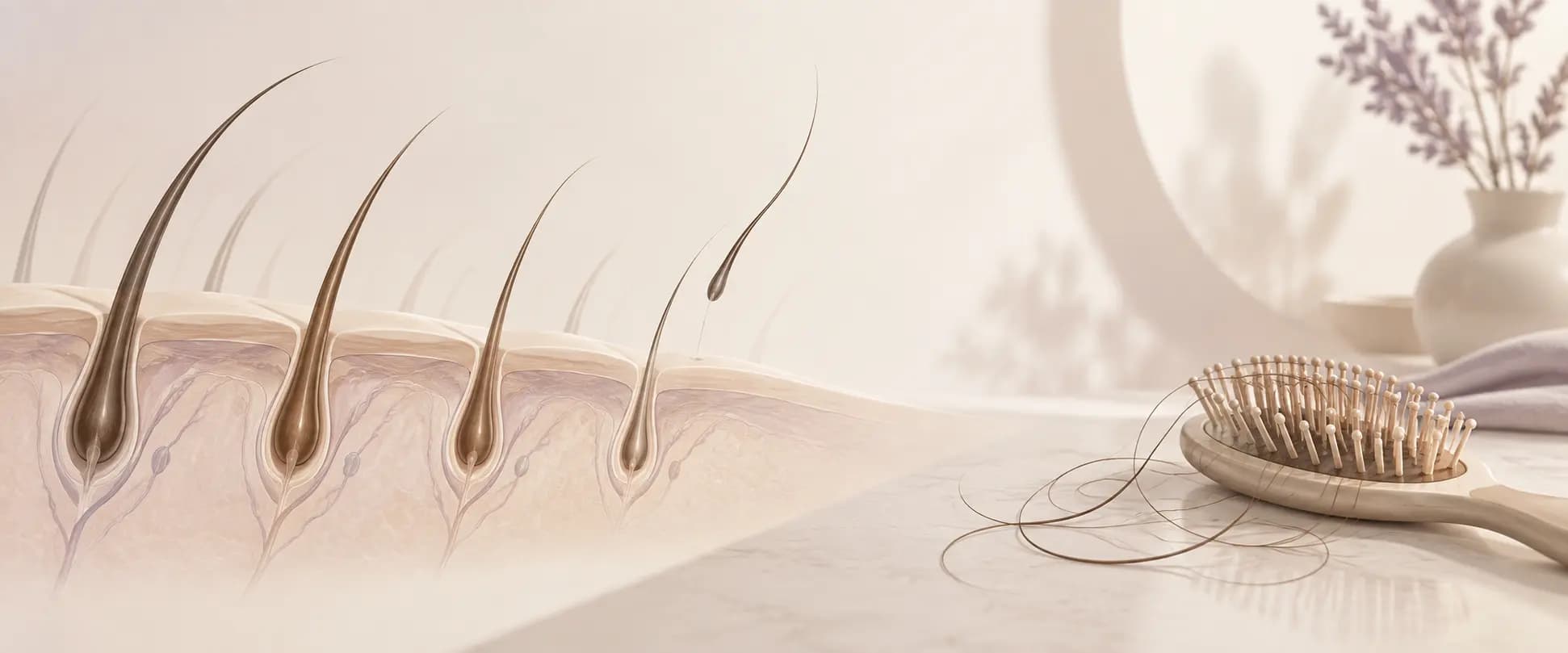
Finding more hair in the shower, on your pillow, or in your brush can be worrying. One possible explanation is telogen effluvium , a disruption of the hair cycle that increases hair shedding without damaging the follicle. Identifying it correctly helps avoid unnecessary treatments and understand its progression.
Before you read: At Skinpaths, we distinguish between opinion and evidence. To write this content, we prioritized indexed medical sources and recommendations from scientific societies. You’ll find the complete bibliography at the end for your reference.
Important: This article is for informational purposes only and does not replace medical advice. If you have any questions, persistent symptoms, or your condition worsens, consult a healthcare professional.
Summary in 60 seconds
- Telogen effluvium produces increased and distributed hair loss across the scalp.
- It usually begins between two and four months after a triggering event.
- It can appear after an illness, surgery, childbirth, or rapid weight loss.
- The follicle retains its ability to produce hair: it is not a scarring alopecia.
- The acute form lasts less than six months; if it persists longer, it is considered chronic.
- Identifying and correcting the cause is more important than accumulating anti-hair loss products.
- Many acute episodes improve without needing specific medications.
- Consult if the condition does not improve, if depopulated areas appear, or if other symptoms are present.
What is telogen effluvium?
Telogen effluvium , also called telogen effluvium , is a disruption of the hair renewal cycle. A greater proportion of follicles enter a resting phase in a relatively short period, and subsequently, shedding increases.
To understand this, it’s helpful to know the three stages of the hair cycle: anagen , when the hair grows; catagen , a brief transition; and telogen , a resting phase. Hair shedding is part of its renewal, but during effluvium it becomes more abundant and visible (Grover and Khurana 2013 ).
A classic feature of this condition is that hair loss often appears after the triggering event . For example, a person may have recovered from an illness and notice increased hair loss two or three months later. (Harrison and Bergfeld 2009)
Why does it appear?
There is no single cause. Telogen effluvium is a response of the capillary cycle to various changes in the body.
It can appear after an infection with fever, surgery, a serious illness, or significant blood loss. It is also linked to hormonal changes, such as those after childbirth, thyroid disorders, and certain medications.
Emotionally intense events may play a role, but attributing every fall to stress can overlook other explanations . In some people, no clear trigger is identified either (Harrison and Bergfeld 2009) .
Nutrition warrants attention when there has been rapid weight loss, very restrictive diets, or insufficient energy and protein intake. Iron deficiency and other deficiencies may contribute in certain contexts; this does not mean that every weight loss requires supplementation. Guo and Katta 2017 .
What does it look like and what symptoms does it cause?
The characteristic feature is a diffuse hair loss , not limited to a specific area. You may notice more hair when washing or styling, a less full ponytail, or a general reduction in volume.
The scalp usually maintains a normal appearance, without scarring or obvious inflammation. Some people experience sensitivity, pain, or an uncomfortable sensation known as trichodynia .
Hair loss alone does not usually cause complete baldness. However, it can coexist with androgenetic alopecia , which causes progressive hair thinning, or make it more noticeable. Therefore, the amount of hair that falls out is not enough to establish a diagnosis (Chang 2019 ).
What can you do today?
- Reconstruct what happened before the hair loss: Note when it started and what happened in the preceding months: illnesses, surgeries, childbirth, weight changes, medication changes, or particularly difficult situations. Also, keep a list of any supplements you use. This information can be more helpful than trying to count every hair lost (Mysore et al. 2019 ).
- Maintain a sufficient and varied diet. Avoid extreme diets: Try to meet your energy and protein needs; when there is a risk of deficiency, a medical or nutritional assessment will determine if tests or supplementation are needed (Guo and Katta 2017) .
- Care for your hair without adding damage: Detangle gently, avoid tight hairstyles, and limit excessive heat and harsh chemical treatments. These measures reduce further damage to the hair fiber, although they do not, on their own, correct the underlying cause of hair loss.
Emotional distress also deserves attention. Seeking support when worry interferes with daily life is part of care, even if hair loss usually has a favorable outcome (British Association of Dermatologists 2025 ).
What NOT to do?
- Do not discontinue medication on your own: The fact that hair loss began after treatment does not prove that the treatment is the cause. The healthcare professional should review the temporal relationship, other explanations, and available alternatives before changing the medication (Hughes et al. 2024 ).
- Don’t take vitamins or iron «just in case»: Supplementation should only be used when necessary. Excessive amounts of certain nutrients, such as vitamin A or selenium, can actually contribute to hair loss. More does not necessarily mean more growth (Guo and Katta 2017 ).
- Do not consider biotin a universal treatment: There is no solid evidence that biotin improves hair in people without a deficiency. Furthermore, high doses can interfere with certain laboratory tests, including some hormonal and cardiac tests. Important: Inform your healthcare provider before any tests. The healthcare professional or laboratory will advise if and for how long you should temporarily discontinue biotin, depending on the dose and the test (Yelich et al. 2024 ).
- Do not confuse a cosmetic effect with a treatment: A shampoo may improve the cleanliness, conditioning, or appearance of hair, but it does not have an established role as a direct treatment for effluvium. When another problem is present, such as seborrheic dermatitis, a medicated shampoo for that condition may be necessary (Mysore et al. 2019 ).
A supplement should address a need, not become the automatic response to every instance of hair loss . Guo and Katta 2017
When should I consult?
You don’t have to wait six months to request an evaluation. A significant, persistent, or worrying hair loss warrants a consultation.
Signs to advance the assessment
- Clearly depopulated patches , loss of eyebrows, or a different distribution of diffuse hair loss.
- Inflammation, severe scaling, crusting, or scar-like areas on the scalp.
- Significant fatigue, unexplained weight changes, or very heavy periods may point to associated problems.
- Hair loss that continues to worsen or persists for more than six months , especially without a confirmed diagnosis.
These findings may require investigation of other causes or coexisting conditions; they should not be automatically attributed to an effluvium (Chang 2019 ; Hughes et al. 2024 ).
If severe pain, fever, discharge, or a rapid worsening of your general condition occur, seek prompt medical attention. These symptoms are not typical of an isolated effluent.
What does a dermatologist usually do?
Confirming the pattern of hair loss: The evaluation begins with a medical history and physical examination. The dermatologist may perform a gentle pull test and use trichoscopy , i.e., dermatoscopy of the hair and scalp. This magnified examination helps to recognize signs of other types of alopecia and to assess whether there is associated progressive thinning (Mysore et al. 2019 ).
Order tests when warranted: Depending on the history and findings, a complete blood count , ferritin and other iron studies , or TSH ( thyroid-stimulating hormone), a test related to thyroid function, may be ordered. Not everyone needs the same set of tests. Scalp biopsy is usually reserved for situations where diagnostic uncertainty persists (Hughes et al. 2024 ).
Addressing the trigger and evaluating treatment: Management focuses on treating the identified causes and explaining the expected outcome. Many acute episodes resolve without specific medication; when falls persist, the diagnosis and contributing factors should be reviewed (Mysore et al. 2019 ).
Minoxidil is not a universal necessity . Its potential use should be individualized and evaluated by a specialist physician, because specific evidence for its use in hepatitis remains limited.
A trial published in 2025, with 12 participants, observed improvement during the use of topical minoxidil. However, lacking a control group, it is not possible to definitively determine how much of the improvement was due to the medication and how much to natural hair regrowth. The product may also cause irritation and an initial increase in hair shedding (Ohyama et al. 2025 ).
Oral minoxidil has been studied in chronic cases, but it should not be started without medical advice . It can produce side effects such as facial hair growth, dizziness, or ankle swelling, and always requires specialized medical evaluation (Perera and Sinclair 2017 ).
Frequently Asked Questions
How long does telogen effluvium last?
- In many acute episodes, hair loss decreases during the three to six months following its onset, especially once the trigger has resolved. This does not mean regaining full volume within that same timeframe. New hair needs to grow, and cosmetic recovery can take many months, sometimes more than a year (Malkud 2015 ).
Does hair that falls out grow back?
- Usually, yes, because telogen effluvium does not destroy the follicle. Recovery may be less complete than expected when the trigger persists or another type of alopecia is present. Therefore, an atypical course warrants specialized medical re-evaluation (Grover and Khurana 2013 ).
Does washing your hair worsen hair loss?
- Seeing more hair during washing does not prove that the shampoo is causing the effluvium. Washing and styling make the shedding of hairs that are already at the end of their cycle more visible. Maintain hygiene adapted to your scalp and handle your hair gently; avoiding washing it does not correct the disruption of the hair cycle (Grover and Khurana 2013 ).
How does it differ from androgenetic alopecia?
- Hair loss is characterized by increased shedding. Androgenetic alopecia is characterized by progressive thinning that can make the part, crown, or temples more visible. These conditions are not mutually exclusive: they can coexist. Examination and trichoscopy help to differentiate between them (Grover and Khurana 2013 ).
Is it common after childbirth?
- Yes. Postpartum hormonal changes can cause noticeable hair loss, which usually peaks around the fourth month after birth. Many women regain their pre-pregnancy hair volume within the first year. If recovery doesn’t occur, the hair loss is particularly severe, or other symptoms are present, it’s advisable to consult a doctor to rule out other causes (American Academy of Dermatology 2025 ).
Do I need biotin or a hair supplement?
- Not automatically. Biotin lacks solid evidence as a treatment for hair loss in people without a deficiency. Before starting any supplement, it’s important to consider its ingredients, the reason for needing it, and whether it might interfere with medical tests (Yelich et al. 2024 ).
Bibliography and sources
- Malkud S. Telogen effluvium: a review. J Clin Diagn Res. 2015;9(9):WE01-3. doi: 10.7860/JCDR/2015/15219.6492 .
- British Association of Dermatologists. Telogen effluvium [Internet] . London: British Association of Dermatologists; 2025 [citado 14 sep 2026] . Available from: British Association of Dermatologists .
- Grover C, Khurana A. Telogen effluvium. Indian J Dermatol Venereol Leprol. 2013;79(5):591-603. doi: 10.4103/0378-6323.116731 .
- Harrison S, Bergfeld W. Diffuse hair loss: its triggers and management. Cleve Clin J Med. 2009;76(6):361-7. doi: 10.3949/ccjm.76a.08080 .
- Guo EL, Katta R. Diet and hair loss: effects of nutrient deficiency and supplement use. Dermatol Practice Concept. 2017;7(1):1-10. doi: 10.5826/dpc.0701a01 .
- Chang FLC. Telogen effluvium [Internet] . DermNet; 2019 [citado 14 sep 2026] . Available at: DermNet .
- Mysore V, Parthasaradhi A, Kharkar RD, Ghoshal AK, Ganjoo A, Ravichandran G, et al. Expert consensus on the management of Telogen Effluvium in India. Int J Trichology. 2019;11(3):107-12. doi: 10.4103/ijt.ijt_23_19 .
- Hughes EC, Syed HA, Saleh D. Telogen effluvium. In: StatPearls [Internet] . Treasure Island (FL): StatPearls Publishing; 2026 [actualizado 1 may 2024; citado 14 sep 2026] . Available at: NCBI Bookshelf .
- Yelich A, Jenkins H, Holt S, Miller R. Biotin for hair loss: teasing out the evidence . J Clin Aesthet Dermatol. 2024;17(8):56-61.
- Ohyama M, Irisawa R, Uchiyama M, Mori M, Aoki K, Ueda Y, et al. Use of 5% topical minoxidil application for telogen effluvium: an open-label single-arm clinical trial. J Dermatol. 2025;52(9):1351-9. doi: 10.1111/1346-8138.17844 .
- Perera E, Sinclair R. Treatment of chronic telogen effluvium with oral minoxidil: a retrospective study. F1000Res. 2017;6:1650. doi: 10.12688/f1000research.11775.1 .
- American Academy of Dermatology. Hair loss in new moms: dermatologist tips [Internet] . American Academy of Dermatology; 2025 [citado 14 sep 2026] . Available from: American Academy of Dermatology .
Categories: For everyone · Hair loss

Content reviewed by
Dr. Rodolfo Suárez
Médico Patólogo y Dermatólogo Master en Patología Cutánea Avanzada
- Published
- September 18, 2026
- Updated
- September 23, 2026
Medically reviewed by specialists
Our content is based on current scientific evidence and clinical protocols.