
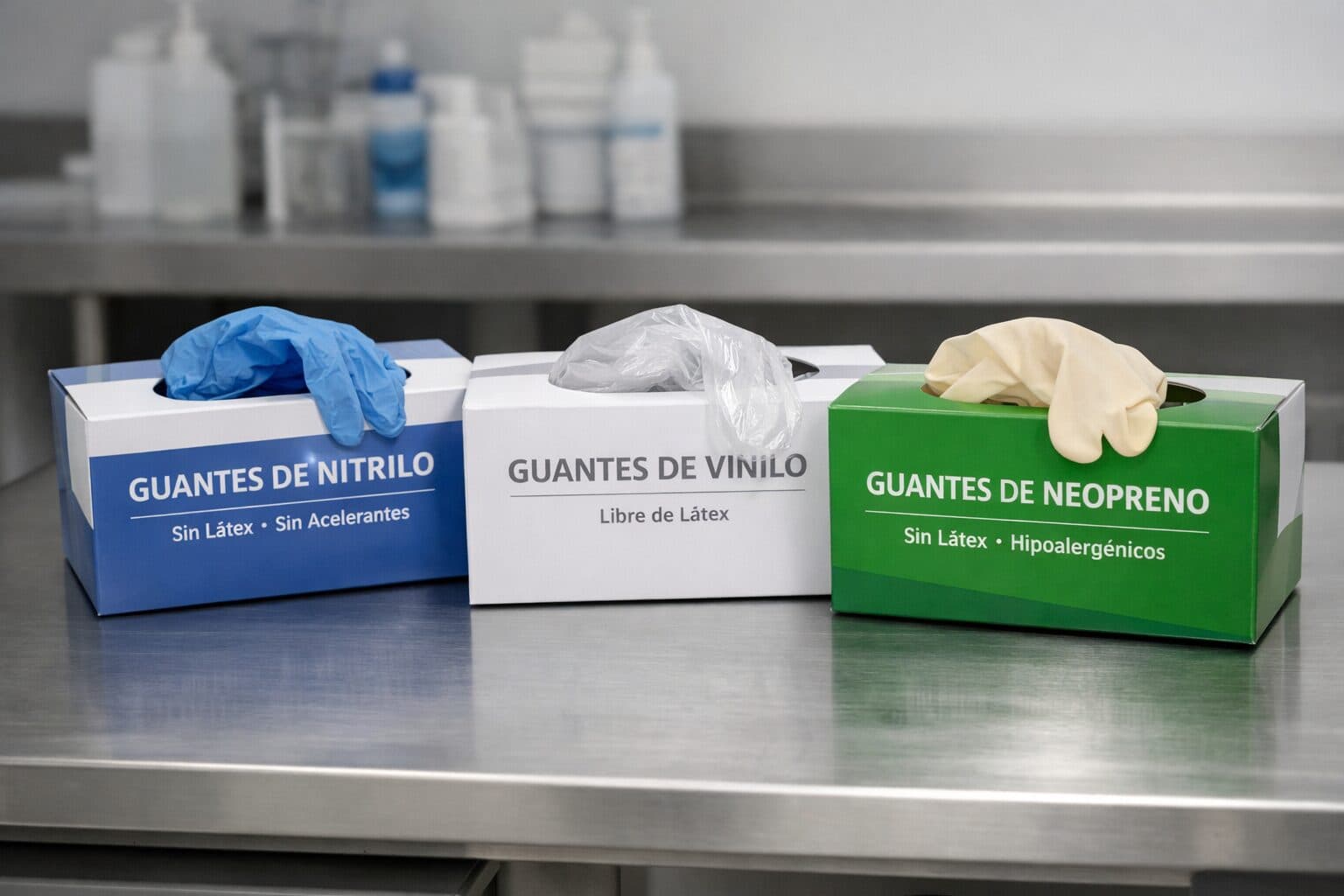
Not all materials behave the same on skin with eczema. The actual barrier, degree of occlusion (sweat), friction, and risk of reacting to certain additives vary between nitrile, neoprene, and PVC. In this post, you’ll find a practical guide to choosing gloves based on use (cleaning, kitchen, bathroom, home), identifying when the glove is triggering a flare-up, and making simple adjustments—glove type, usage time, and layering—that often make a difference.
Before you read: At Skinpaths, we distinguish between opinion and evidence. To write this content, we prioritized indexed medical sources and recommendations from scientific societies. You’ll find the complete bibliography at the end for your reference.
Important: This article is for informational purposes only and does not replace medical advice. If you have any questions, persistent symptoms, or your condition worsens, consult a healthcare professional.
Summary in 60 seconds
- In hand eczema, gloves help when there is «wet work» (water, soaps, disinfectants, cleaning), chemicals, or friction; however, they can worsen the condition due to sweat/occlusion, irritation, or contact allergy to glove components, according to European guidelines. Thyssen 2022
- Nitrile : good balance of barrier and resistance. Main risk: additives (especially accelerators) in some models.
- Neoprene : good barrier and comfort in many tasks; may also contain accelerators depending on manufacturing.
- PVC (vinyl) : Useful if you have an allergy to accelerators (it often doesn’t contain them), but it’s usually less durable and doesn’t fit as well in demanding applications. Hansen 2021
What is hand eczema?
Hand eczema is an inflammation of the skin on the hands that can cause intense dryness, redness, itching, cracking, and sometimes blisters. It can be triggered by irritants (water/soap, detergents, friction) and/or allergic contact dermatitis (allergens from the environment or the glove itself). Thyssen 2022
What are gloves for?
Gloves act as a barrier to reduce contact with irritants and certain chemicals, and to limit «wet work.» In healthcare settings, they also provide additional protection depending on the type of task.
The key point: the right glove can help; the wrong glove (or wearing it for too long) can perpetuate the outbreak due to occlusion or allergy to material components. Thyssen 2022
Think of the glove as a raincoat:
-
It constitutes a barrier that blocks what comes «from outside» (water, detergents, dirt, some chemicals).
-
However, if you wear it for hours, heat and sweat accumulate «inside», the skin becomes macerated and more fragile (causing eczema to worsen).
In addition, some gloves contain manufacturing chemicals (e.g., accelerators) that can cause allergic contact dermatitis in sensitized individuals. Hansen 2021
Nitrile, neoprene and PVC: pros, cons and indications
1) Nitrile gloves
- Pros
- Good fit and good resistance to tearing/punctures in many models (depends on thickness and quality).
- They tend to work well for precision tasks and common wet exposure.
- Cons
- Some contain rubber accelerators or other additives: if there is an allergy, eczema may worsen despite the «protection» from water. Hansen 2021
- Prolonged use promotes maceration from sweat.
- Typical indications
- General handling, sanitary/laboratory and light to moderate cleaning.
- If you suspect an allergy: specifically look for « accelerator-free», and consider confirmation with patch testing.
2) Neoprene (polychloroprene) gloves
- Pros
- Good balance between comfort, elasticity and barrier; useful in wet tasks and some chemical exposures (if certified for it).
- It can be an alternative when looking for a robust glove with good individual tolerance.
- Cons
- May contain accelerators or other sensitizing components: “neoprene” does not guarantee “non-allergenic”. Hansen 2021
- Occlusion/sweating with continued use.
- Typical indications
- Tasks with repeated exposure to water/detergents or environments that require a more robust glove, always guided by certification/compatibility according to the risk.
3) PVC (vinyl) gloves
- Pros
- In general, a reasonable option when it is necessary to avoid rubber accelerators (common in «rubber» gloves). Hansen 2021
- Useful for short, low-demand tasks where a perfect fit is not critical.
- Cons
- Less elasticity and worse fit: can increase friction and decrease dexterity.
- In demanding jobs, it tends to break or fail sooner, which is a problem if there is significant exposure. Phalen 2014
- Typical indications
- Short tasks, with low chemical risk and low mechanical demands, especially if there is a suspected/confirmed allergy to accelerators.
How to decide which one to use
-
If your main problem is irritation from «wet work» : prioritize well-fitting gloves and limit continuous use; nitrile or neoprene often work best for fit and durability. Thyssen 2022
-
If you suspect an accelerator allergy : switch to «accelerator-free» gloves or consider PVC for compatible tasks and confirm with patch testing. Johansen 2015
-
If chemicals are involved : choose based on certification and compatibility (not just «material»). For gloves against chemicals, the standard reference is ISO 374-1. ISO 2016
Additional care
-
Avoid prolonged continuous use whenever possible: alternate with short breaks to ventilate.
-
Use a cotton glove liner if irritation occurs due to sweat, occlusion, or prolonged wear. For healthcare workers with irritation, the CDC recommends considering cotton liners and following washing/replacement guidelines. CDC 2024
-
Planned hydration : fragrance-free emollient after wet tasks and at the end of the day; allow to absorb before putting on gloves to reduce maceration.
Frequently Asked Questions
Why do my hands get worse when I wear gloves?
- Due to occlusion (sweat and maceration), friction, or allergic contact dermatitis to glove components. Thyssen 2022
Is PVC (vinyl) better for sensitive skin?
- It can be useful if there is an allergy to accelerators, but it is not always suitable for demanding tasks due to inferior adjustment and resistance.
What are rubber “accelerators”?
- These are chemicals used in the manufacture of some gloves to accelerate the vulcanization process; they can cause allergic contact dermatitis. Hansen 2021
Does “latex-free” mean “allergy-free”?
- No. “Latex-free” does not exclude allergies to accelerators or other additives present in nitrile or neoprene.
Do cotton gloves work underneath?
- Yes, especially if the problem is sweat/occlusion and you need to wear gloves for extended periods. CDC 2024
Does thickness and certification matter?
- A lot. For chemicals, the standard/test (e.g., ISO 374-1) and compatibility with the specific chemical are paramount. ISO 2016
Bibliography and sources
- Thyssen JP, Schuttelaar MLA, Alfonso JH, Andersen KE, Angelova-Fischer I, Arents BWM, et al. Guidelines for diagnosis, prevention and treatment of hand eczema. Contact Dermatitis. 2022;86(5):357-378. doi:10.1111/cod.14035.
- Hansen A, Brans R, Sonsmann F. Allergic contact dermatitis to rubber accelerators in protective gloves: problems, challenges, and solutions for occupational skin protection. Allergol Select. 2021;5:335-344. doi:10.5414/ALX02265E.
- Rundle CW, Presley CL, Militello M, Barber C, Powell DL, Jacob SE, et al. Hand hygiene during COVID-19: Recommendations from the American Contact Dermatitis Society. J Am Acad Dermatol. 2020;83(6):1730-1737. doi:10.1016/j.jaad.2020.07.057.
- Phalen RN, Le T, Wong WK. Changes in chemical permeation of disposable latex, nitrile and vinyl gloves exposed to simulated movement. J Occup Environ Hyg. 2014;11(11):716-721. doi:10.1080/15459624.2014.908259.
- Johansen JD, Aalto-Korte K, Agner T, Andersen KE, Bircher A, Bruze M, et al. European Society of Contact Dermatitis guideline for diagnostic patch testing: recommendations on best practice. Contact Dermatitis. 2015;73(4):195-221. doi:10.1111/cod.12432.
- Centers for Disease Control and Prevention. Clinical Safety: Hand Hygiene for Healthcare Workers [Internet] . Atlanta: CDC; 2024 Feb 27 [citado 2026 May 10] . Available at: https://www.cdc.gov/clean-hands/hcp/clinical-safety/index.html
- International Organization for Standardization. ISO 374-1:2024. Protective gloves against dangerous chemicals and micro-organisms — Part 1: Terminology and performance requirements for chemical risks [Internet] . 2nd ed. Geneva: ISO; 2024 [citado 2026 May 10] . Available at: https://www.iso.org/standard/83210.html
- American Academy of Dermatology Association. Eczema types: Contact dermatitis diagnosis and treatment [Internet] . Rosemont (IL): American Academy of Dermatology Association; 2020 Dec 14 [citado 2026 May 10] . Available at: https://www.aad.org/public/diseases/eczema/types/contact-dermatitis/treatment
- European Society of Contact Dermatitis. Guidelines, Papers & Books [Internet] . European Society of Contact Dermatitis; sf [citado 2026 May 10] . Available at: https://escd.org/guidelines-papers-books/
Categories: Contact dermatitis · For everyone

Content reviewed by
Dr. Rodolfo Suárez
Médico Patólogo y Dermatólogo Master en Patología Cutánea Avanzada
- Published
- September 18, 2026
- Updated
- September 23, 2026
Medically reviewed by specialists
Our content is based on current scientific evidence and clinical protocols.