
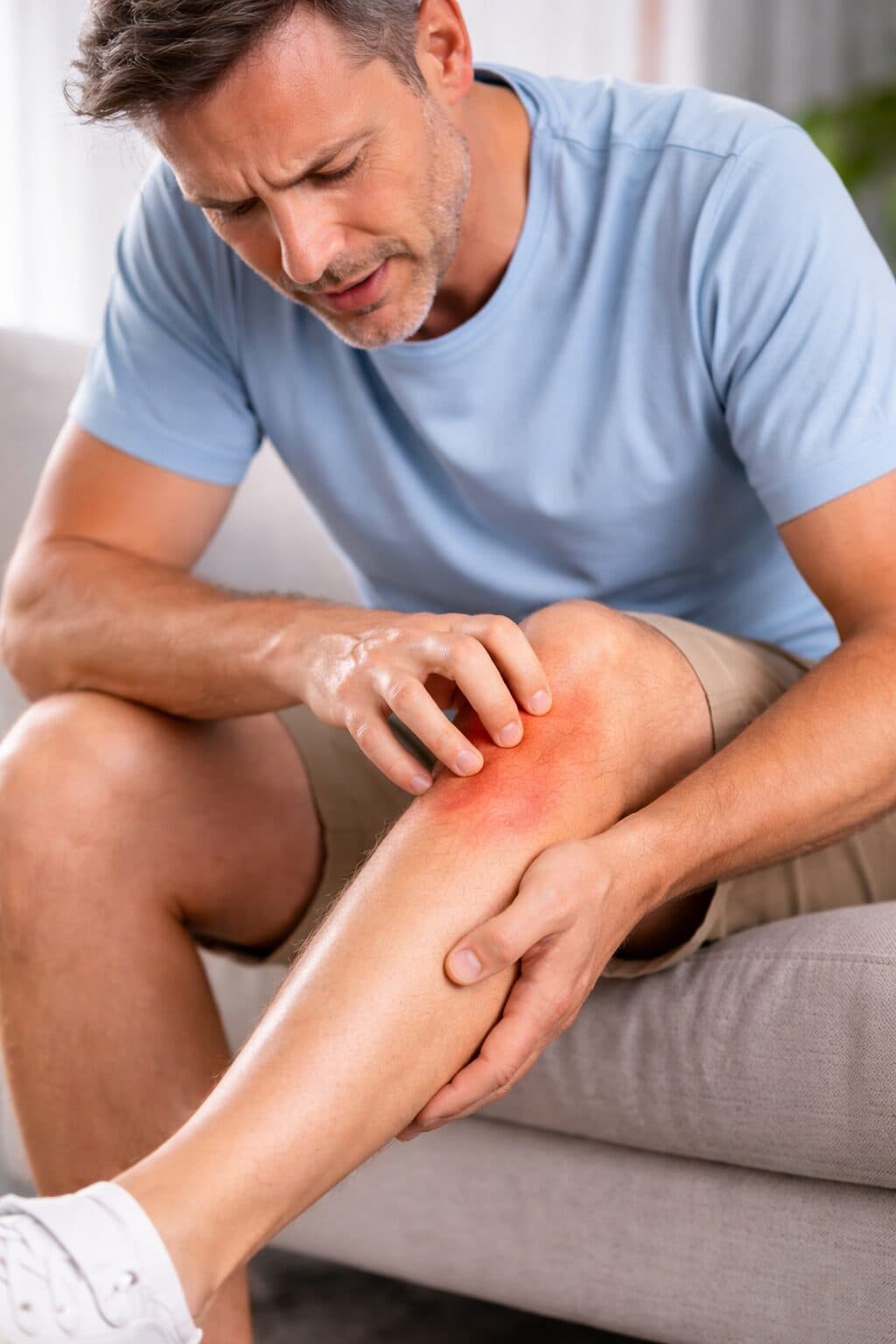
It’s a very common condition, and most of the time, it has simple explanations. But there are also cases where itching—especially if it’s widespread, occurs at night, or is persistent—acts as a warning sign that should be examined more closely. In this guide, I’ll explain what’s usually behind it, what you can safely do today, and which warning signs warrant a consultation with a dermatologist.
Before you read: At Skinpaths, we distinguish between opinion and evidence. To write this content, we prioritized indexed medical sources and recommendations from scientific societies. You’ll find the complete bibliography at the end for your reference.
Important: This article is for informational purposes only and does not replace medical advice. If you have any questions, persistent symptoms, or your condition worsens, consult a healthcare professional.
Summary in 60 seconds
- Experiencing itching without seeing welts, spots, or «pimples» is more common than it seems.
- It is often explained by dry skin , irritation from soaps/perfumes, changes in weather, hot showers, stress, or a very mild eczema that is not yet «clinically declared».
- In other cases, the itching is generalized and persistent, and it is advisable to rule out systemic causes (for example, liver or kidney disorders, thyroid problems or anemia).
The key information is not just «if something is seen», but how long it lasts , how intense it is , if it affects sleep (nighttime itching) and if warning signs appear such as jaundice (yellow skin or eyes), unexplained weight loss or fever.
What is it?
Pruritus is the itching sensation that compels scratching. It can manifest as:
-
No visible lesions at the beginning (apparently normal skin).
-
With secondary lesions from scratching (linear marks, fine scabs, thickened skin).
When itching lasts for more than 6 weeks , it is usually considered chronic pruritus and warrants further evaluation if there is no obvious cause. Clinical guidelines describe a stepwise approach for these cases, especially when there is no apparent dermatosis. Millington 2018
Why does it appear? (common causes)
Without going into endless lists, these are the usual causes when «nothing is visible»:
1) Dry skin (xerosis) and fragile skin barrier
Very common in winter, with air conditioning/heating, long showers, or harsh soaps. The skin may look «normal» at first glance, but feel tight or rough.
2) Irritation or contact dermatitis (without a large visible outbreak)
Perfumes, gels, detergents, fabric softeners, disinfectants, synthetic fabrics, or wool. Sometimes the first symptom is itching, before redness appears.
3) Mild or intermittent eczema
Eczema (including atopic dermatitis) can start with itching before clear patches appear.
4) Medications and supplements
Some medications can cause itching in certain people. Don’t stop taking it on your own: it’s wise to discuss it with your doctor, especially if it coincides with the same symptoms.
5) Systemic causes (less frequent, but important to rule out if it is generalized and persistent)
Liver abnormalities, chronic kidney disease, thyroid disorders, iron deficiency, among others. European and British guidelines recommend focusing the evaluation on medical history and physical examination, and ordering basic laboratory tests in selected cases. Weisshaar 2019
What does it look like and what symptoms does it cause?
In pruritus without lesions , the skin may appear normal, but clues usually appear:
- Diffuse or localized itching (scalp, legs, back).
- It worsens with heat , hot showers , sweat, or rough clothing.
- Nighttime itching : The silence, the warmth of the bed, and less distraction make it more noticeable. In some conditions (for example, scabies), nighttime is a typical pattern. CDC 2024
If “marks” appear, they are often a consequence of scratching (not the cause): lines, scabs, small bruises, or thickened skin.
What can you do today?
These measures are reasonable while you observe the evolution (and also accompany medical treatment when necessary):
-
«Kind» shower routine
-
Warm water, 5–10 minutes.
-
Gentle, fragrance-free cleanser; avoid exfoliants.
-
Pat dry, do not rub.
-
-
Intensive hydration, done right
-
Apply thick cream or balm within 3 minutes of showering.
-
If it’s very itchy, try simpler textures (no fragrance, no essential oils).
-
Repeat 1–2 times a day in critical areas.
-
-
Cool instead of scratching
-
Cold compresses for 5–10 minutes.
-
Keep your nails short; if you scratch yourself in your sleep, consider wearing thin cotton gloves.
-
-
Reduces common triggers
-
Perfumes, fabric softener, very tight or synthetic clothing.
-
Avoid excessive heat in the bedroom; consider using a humidifier if the environment is dry.
-
-
If the itching is widespread and wakes you up
-
Record 7 days of use: time, areas, exposure (shower, exercise), products used, recent medications, and any accompanying symptoms. This is very helpful during consultations.
-
What NOT to do? (common mistakes)
- Do not use topical corticosteroids «blindly» and without medical advice: they can mask diagnoses and cause adverse effects.
- Don’t use too many new products at once: if you get worse, you won’t know which one it was.
- Don’t «detox» or start restrictive diets as a first response: it’s rarely the cause and can worsen your overall condition.
- Do not overuse sedating antihistamines for sleep without medical supervision, especially if you drive or are elderly.
When should I consult a specialist?
Consult with priority (urgent if it is severe or of rapid onset) if any of these points appear:
-
Jaundice (yellow eyes or skin), very dark urine, or pale stools
-
Unexplained weight loss , marked lack of appetite
-
Fever , intense night sweats, extreme tiredness
-
Intense, widespread itching that prevents you from sleeping or lasts > 6 weeks
-
Persistent lumps (lymph nodes), easy bruising, or unusual bleeding
-
Recent onset in elderly patients, or those with a history of liver/kidney/thyroid disease
-
Nighttime itching with suspected contagion in cohabitants (possible scabies), even if «you don’t see anything» CDC 2024
These criteria align with recommended approaches for generalized pruritus without obvious dermatosis, where the aim is not to overlook treatable systemic causes. Millington 2018
What does a dermatologist usually do?
A consultation with a specialist usually includes:
- Targeted medical history: duration, nighttime pattern, areas, showers, products, work (irritants), travel, contacts, pets, and medications.
- Complete skin examination: including interdigital spaces, wrists, genital area, scalp and nails (places where there are sometimes subtle signs).
- Tests based on findings:
- If scabies is suspected: look for typical burrows/lesions; sometimes, confirmation with specific techniques.
- If there is no clear explanation and the itching is generalized/persistent, basic blood tests (complete blood count, liver and kidney function tests, thyroid function tests, iron, glucose, among others) may be ordered, and further testing may be necessary depending on the context. This approach is described in European and British guidelines. Weisshaar 2019
- Management plan: skin barrier measures, treatment of the cause if identified, and, where appropriate, strategies to break the “itch-scratch cycle”.
Frequently Asked Questions
Could it be an allergy even if I don’t see hives?
- It’s possible, but it’s not the most common explanation when there are no lesions. Many «allergies» turn out to be irritation, dry skin, or contact dermatitis. If there’s clear exposure (a new product) and it worsens after using it, it’s worth stopping and consulting a doctor.
Why does itching get worse at night (nocturnal pruritus)?
- Heat, dry air, and lack of distraction often contribute to itching. Additionally, some conditions (such as scabies) typically itch more at night. CDC 2024
If my whole body itches, do I have something «internal»?
- Not necessarily. Generalized dry skin is very common. But if the itching is persistent, intense, or accompanied by warning signs (jaundice, weight loss, fever), evaluation and, sometimes, targeted tests are advisable. Millington 2018
What tests do they usually order when there are no injuries?
- It depends on the case. It often begins with a complete blood count and liver/kidney/thyroid parameters, and is expanded based on symptoms, age, and medical history, as recommended by chronic pruritus guidelines. Weisshaar 2019
Do antihistamines help?
- They are especially helpful for hives or other histamine-related conditions. For itching due to dry skin or non-histamine causes, the effect may be limited; some produce drowsiness and can «help you sleep,» but caution is advised.
Can anxiety cause itching?
- Stress and anxiety can amplify the perception of itching and encourage scratching. Even so, if the symptom is new or persistent, it’s wise to rule out skin and medical causes before attributing it solely to emotional factors.
When is it considered chronic pruritus?
- In general, when it lasts more than 6 weeks . In that scenario, a thorough clinical evaluation is usually especially helpful. Weisshaar 2012
Bibliography and sources
- Millington GWM, Collins A, Lovell CR, Leslie TA, Yong ASW, Morgan JD, et al. British Association of Dermatologists’ guidelines for the investigation and management of generalized pruritus in adults without an underlying dermatosis, 2018 . Br J Dermatol. 2018;178(1):34-60. doi:10.1111/bjd.16117 .
- Weisshaar E, Szepietowski JC, Dalgard FJ, Garcovich S, Lambert J, Leslie TA, et al. European S2k Guideline on Chronic Pruritus . Acta Derm Venereol. 2019;99(5):469-506. doi:10.2340/00015555-3164 .
- Weisshaar E, Szepietowski JC, Darsow U, Misery L, Wallengren J, Mettang T, et al. European guideline on chronic pruritus . Acta Derm Venereol. 2012;92(5):563-581. doi:10.2340/00015555-1400 .
- Butler DC, Berger T, Elmariah S, Kim B, Chisolm S, Kwatra SG, et al. Chronic Pruritus: A Review . JAMA. 2024;331(24):2114-2124. doi:10.1001/jama.2024.4899 .
- Rajagopalan M, Saraswat A, Godse K, Shankar DSK, Kandhari S, Shenoi SD, et al. Diagnosis and Management of Chronic Pruritus: An Expert Consensus Review . Indian J Dermatol. 2017;62(1):7-17. doi:10.4103/0019-5154.198036 .
- Rupert J, Honeycutt JD. Pruritus: Diagnosis and Management . Am Fam Physician. 2022;105(1):55-64.
- Centers for Disease Control and Prevention. About Scabies . Atlanta: CDC; 2024 Sep 9 [cited 2026 May 10] .
- European Association for the Study of the Liver. EASL Clinical Practice Guidelines: The diagnosis and management of patients with primary biliary cholangitis . J Hepatol. 2017;67(1):145-172. doi:10.1016/j.jhep.2017.03.022 .
Categories: Contact dermatitis · Dry skin · For everyone · Itch · Welts

Content reviewed by
Dr. Rodolfo Suárez
Médico Patólogo y Dermatólogo Master en Patología Cutánea Avanzada
- Published
- September 18, 2026
- Updated
- September 23, 2026
Medically reviewed by specialists
Our content is based on current scientific evidence and clinical protocols.