

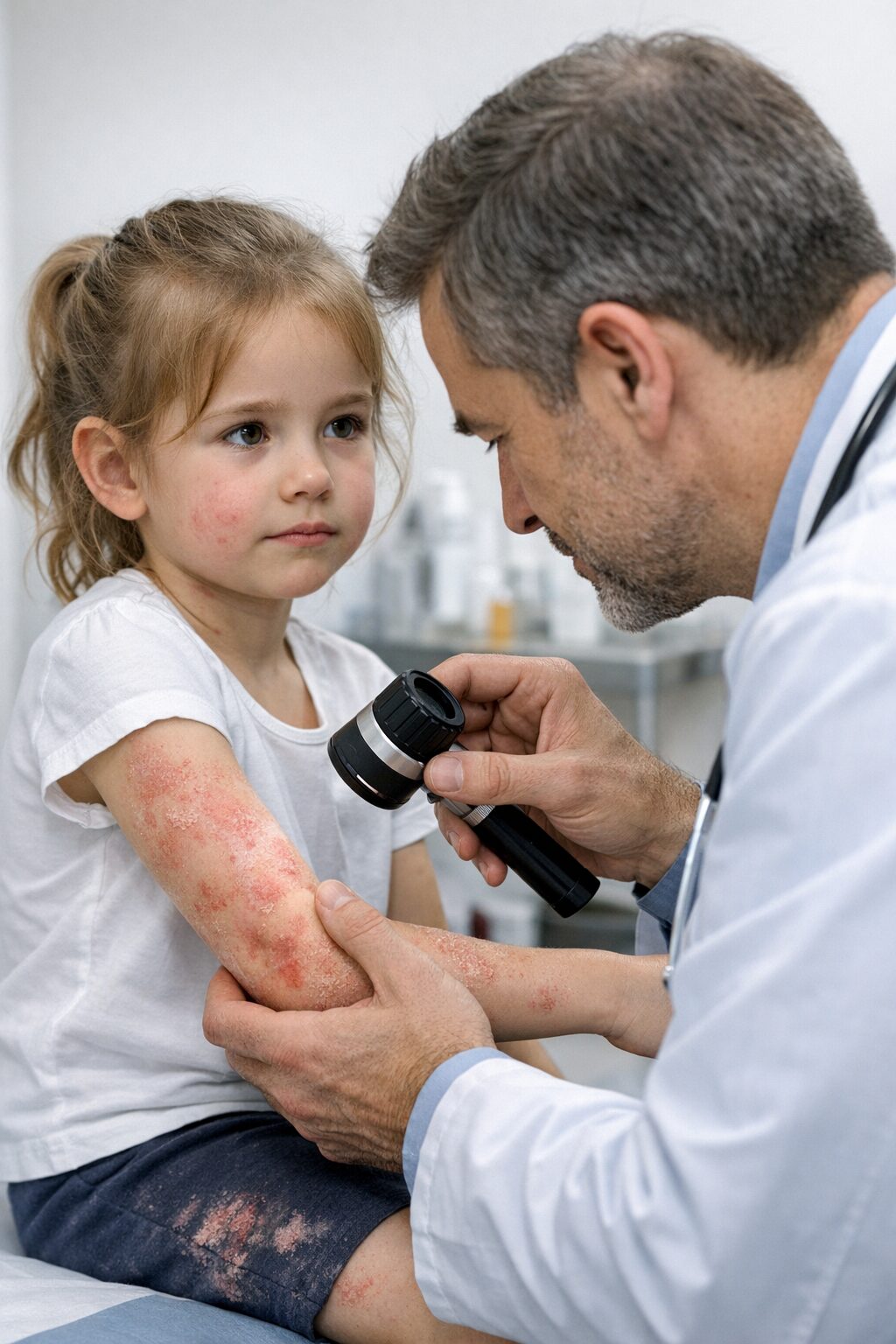
Dermatologists who treat atopic dermatitis
An inflammatory skin condition that can greatly improve with a consistent plan
Before reading: En skinpaths We distinguish between opinion and evidence. To write this content, we prioritized indexed medical sources and recommendations from scientific societies. At the end, you will find the complete bibliography for your reference.
Important: This article is for informational purposes only and does not replace medical advice. If you have any questions, persistent symptoms, or your condition worsens, consult a healthcare professional.
Atopic dermatitis is a chronic skin condition that typically progresses in flare-ups: periods of remission followed by periods of worsening. Its main characteristic is a skin barrier that is more vulnerable, inflamed, and itchy. It is not an infection, it is not contagious, and it cannot be explained by a single cause.
Summary in 60 seconds
- Atopic dermatitis is a chronic inflammatory skin disease.
- It usually causes dry skin, itching, redness, peeling, cracks, or thickened areas.
- It can appear in babies, children, teenagers, and adults.
- In many people it improves with age, although not in all cases.
- Atopic skin loses water more easily and reacts more to irritants.
- The basic treatment usually includes frequent moisturizing and avoiding harsh soaps.
- Topical corticosteroids, when properly indicated and used correctly, are useful tools for outbreaks.
- It is not advisable to eliminate foods, use unknown "natural" creams, or self-medicate.
- Consult if there is pain, fever, blisters, scabs, pus, eye involvement, or repeated outbreaks.
- The realistic goal is not to "cure forever", but to control outbreaks, itching and quality of life.
What is the atopic dermatitis?
Atopic dermatitis, also called atopic eczema, is an inflammatory skin disease characterized by dryness, itching, and lesions that may appear and disappear in flare-ups. It is one of the most common inflammatory skin diseases and usually begins in childhood, although it can also persist or appear in adults (Langan 2020 ).
In atopic dermatitis, the skin functions as a less efficient barrier: it loses water more easily and allows irritants, allergens, or microorganisms to trigger inflammation. This “barrier + inflammation” explanation is more accurate than attributing it all to a simple allergy (Ständer 2021).
Why does it appear?
There is no single cause. Atopic dermatitis usually arises from a combination of genetic predisposition, impaired skin barrier function, a particular immune response, and environmental factors. Some people have a personal or family history of asthma, allergic rhinitis, or food allergies, but that doesn't mean all flare-ups are caused by food.
Factors that can worsen flare-ups include harsh soaps, detergents, fragrances, sweat, wool or rough fabrics, sudden temperature changes, skin infections, and, in some people, specific allergens. NICE guidelines recommend assessing for irritants, infections, contact allergens, foods, or inhalants only when the medical history suggests it, not as an indiscriminate search (NICE 2025).
The evidence also distinguishes between factors that may accompany atopic dermatitis and factors that cause it. For example, stress can worsen itching or encourage scratching, but it should not be considered the sole cause of the problem.
What does it look like and what symptoms does it cause?
The main symptom is itching. In some cases it is mild; in others, it interferes with sleep, concentration, and daily life. The skin may appear dry, red, or darker depending on skin tone, rough, flaky, cracked, or crusted if scratched or infected.
The distribution changes with age. In babies, it can affect the cheeks, scalp, trunk, and outer surfaces of the arms or legs. In older children and adults, it commonly affects the creases of the elbows and knees, neck, hands, eyelids, and areas of friction. NICE notes that extensor, follicular, or discoid patterns may be more frequently seen in Asian and Black skin (Caribbean or African ethnicities), so not all atopic dermatitis looks the same (NICE 2025 ).
Changes in pigmentation may also appear after an outbreak: lighter or darker spots. These are generally not scars; they usually improve gradually once the inflammation is under control.
What can you do today? (concrete and safe measures)
The most important step is to consistently care for your skin barrier. Use a fragrance-free moisturizer with a comfortable texture every day, even when your skin is feeling better. Cochrane reviews show that moisturizers can reduce the severity and frequency of breakouts compared to not using them (van Zuuren 2017).
The bath should be brief and with lukewarm water. Avoid perfumed soaps, exfoliants, abrasive sponges, and products that leave a burning sensation. For cleansing, soap substitutes or gentle cleansers are generally preferred. After bathing, pat dry without rubbing and apply moisturizer.
If you are prescribed treatment, use it as directed. Topical corticosteroids should not be viewed as “enemies” of the skin when chosen for appropriate strength, area, and duration (and prescribed by professionals). Guidelines recommend adjusting the strength to the severity and body area; for example, the face and skin folds often require more caution than areas of thicker skin (Sidbury 2023 ).
Useful and safe measures:
- Keep your nails short to reduce scratching damage.
- Choose soft and breathable clothing.
- Avoid excessive heat and prolonged sweating if you identify that they worsen the itching.
- Wash clothes with mild detergents and avoid perfumed fabric softeners if they cause irritation.
- Keep a simple record of outbreaks: area, intensity, possible triggers, and treatments used.
The goal is not to pursue perfect skin every day, but to reduce breakouts, itching, and scratching damage.
What NOT to do?
It is not advisable to eliminate foods "just in case" without medical evaluation. Restrictive diets can lead to deficiencies, family anxiety, and delay appropriate treatment. Food allergy assessment is reserved for specific situations, such as immediate reactions to eating a food or moderate-to-severe dermatitis that is poorly controlled despite adequate treatment (NICE 2025 ).
Avoid allergy tests purchased online or from retailers without clinical indication. NICE states that there is no evidence of value for this type of test in the management of childhood atopic dermatitis (NICE 2025).
It is also wise to avoid:
- “Natural” creams with no clear composition.
- Powerful corticosteroids without a prescription and/or for long periods.
- Repeated topical antibiotics without signs of infection.
- Exfoliants, alcohol, lemon, baking soda, or other irritating remedies.
- Changing products every few days makes it difficult to know what helps and what irritates.
When to consult?
Consult a healthcare professional if any of these situations occur:
- Significant pain, local heat, swelling, pus, or yellowish crusts.
- Fever, general malaise, or rapid worsening.
- Clustered blisters, rounded erosions, or painful lesions, especially if they resemble herpes.
- Involvement around the eyes, very swollen eyelids or visual discomfort.
- Itching that repeatedly prevents sleep.
- Frequent outbreaks despite hydration and proper treatment.
- Extensive dermatitis in young babies.
- Questions about the use of corticosteroids, sensitive areas, or duration of treatment.
- Significant emotional, school, work or family impact.
Eczema herpeticum is a rare but significant complication: it can cause painful lesions, blisters, or erosions and requires prompt medical attention. NICE recommends same-day referral if suspected (NICE 2025).
What does a dermatologist usually do?
Diagnosis is usually clinical: history, skin examination, age of onset, distribution, intensity of itching, impact on sleep and quality of life, and response to previous treatments. There is no single blood test that "confirms" atopic dermatitis in all cases.
The dermatologist can assess whether it is truly atopic dermatitis or another similar condition, such as contact dermatitis, psoriasis, scabies, seborrheic dermatitis, ringworm, rare immunodeficiencies, or, in adults with atypical presentations, other diagnoses that require further investigation.
Depending on the case, it may indicate:
- Written hydration and outbreak management plan.
- Topical corticosteroids with specific potency and duration.
- Topical calcineurin inhibitors for sensitive areas or maintenance.
- Topical non-steroidal treatments when indicated.
- Culture if infection is suspected.
- Allergy testing or patch testing if the history warrants it.
- Phototherapy or systemic treatments in uncontrolled moderate-to-severe dermatitis.
A biopsy is not usually necessary in typical cases, but may be considered if the condition is unusual, does not respond as expected, or there are diagnostic doubts.
FAQ
Is atopic dermatitis curable?
- It can improve significantly, and some children even stop having outbreaks over time. However, in others, it persists or recurs in adolescence or adulthood. The realistic goal is to manage inflammation, itching, outbreaks, and quality of life.
It is contagious?
- No. Atopic dermatitis is not transmitted through contact, cohabitation, towels, or clothing.
Are topical corticosteroids dangerous?
- They can have adverse effects if misused: inadequate strength, for too many days, on sensitive areas, or without supervision. But when used correctly, they are an important tool for controlling flare-ups and reducing inflammation. The key is knowing which one to use, where, how much, and for how many days.
Should I get allergy tests?
- Not always. Testing makes sense if there's a specific suspicion: an immediate reaction to a food, outbreaks consistently linked to an exposure, associated rhinitis or asthma, or dermatitis that doesn't improve despite proper treatment. Testing without context can be misleading.
Does bathing worsen atopic dermatitis?
- Not necessarily. The problem is usually very hot water, long baths, harsh soaps, or not moisturizing afterward. A short, lukewarm bath with gentle cleansing can be part of your skincare routine.
Which moisturizer is best?
- The best moisturizer is the one you tolerate well, can use consistently, and doesn't contain irritating fragrances. Some skin types prefer rich creams; others tolerate lotions or gels better. Consistency is often more important than finding the "perfect" product.
Is atopic dermatitis a food allergy?
- Not in most cases. It can coexist with allergies, especially in young children with moderate-to-severe dermatitis, but not all atopic dermatitis is caused by food.
Bibliography and sources
- Sidbury R, Alikhan A, Bercovitch L, Cohen DE, Darr JM, Drucker AM, et al. Guidelines of care for the management of atopic dermatitis in adults with topical therapies. J Am Acad Dermatol. 2023;89(1):e1-e20. doi:10.1016/j.jaad.2022.12.029.
- Davis DMR, Drucker AM, Alikhan A, Bercovitch L, Cohen DE, Darr JM, et al. Guidelines of care for the management of atopic dermatitis in adults with phototherapy and systemic therapies. J Am Acad Dermatol. 2024;90(2):e43-e56. doi:10.1016/j.jaad.2023.08.102.
- AAAAI/ACAAI JTF Atopic Dermatitis Guideline Panel, Chu DK, Schneider L, Asiniwasis RN, Boguniewicz M, De Benedetto A, et al. Atopic dermatitis (eczema) guidelines: 2023 American Academy of Allergy, Asthma and Immunology/American College of Allergy, Asthma and Immunology Joint Task Force on Practice Parameters GRADE– and Institute of Medicine–based recommendations. Ann Allergy Asthma Immunol. 2024;132(3):274-312. doi:10.1016/j.anai.2023.11.009.
- Wollenberg A, et al. European Guideline (EuroGuiDerm) on atopic eczema: living update. J Eur Acad Dermatol Venereol. 2025;39(9):1537-1566. doi:10.1111/jdv.20639.
- National Institute for Health and Care Excellence. Atopic eczema in under 12s: diagnosis and management. Clinical guideline CG57. London: NICE; 2007. Updated 2025 Sep 22.
- Langan SM, Irvine AD, Weidinger S. Atopic dermatitis. Lancet. 2020;396(10247):345-360. doi:10.1016/S0140-6736(20)31286-1.
- Stand S. Atopic dermatitis. N Engl J Med. 2021;384(12):1136-1143. doi:10.1056/NEJMra2023911.
- Bylund S, von Kobyletzki LB, Svalstedt M, Svensson Å. Prevalence and incidence of atopic dermatitis: a systematic review. Acta Derm Venereol. 2020;100(12):320-329. doi:10.2340/00015555-3510.
- van Zuuren EJ, Fedorowicz Z, Christensen R, Lavrijsen APM, Arents BWM. Emollients and moisturizers for eczema. Cochrane Database Syst Rev. 2017;2(2):CD012119. doi:10.1002/14651858.CD012119.pub2.
- Lax SJ, Harvey J, Axon E, Howells L, Santer M, Ridd MJ, et al. Strategies for using topical corticosteroids in children and adults with eczema. Cochrane Database Syst Rev. 2022;3(3):CD013356. doi:10.1002/14651858.CD013356.pub2.
- Brenninkmeijer EEA, Schram ME, Leeflang MMG, Bos JD, Spuls PI. Diagnostic criteria for atopic dermatitis: a systematic review. Br J Dermatol. 2008;158(4):754-765. doi:10.1111/j.1365-2133.2007.08412.x.
- De Benedetto A, et al. Atopic Dermatitis (Eczema) Guidelines 2023: Highlights. J Allergy Clin Immunol Pract. 2024.

 |
|