
What is psoriasis, why can it appear, how to recognize it, and what steps usually help to control it safely.
Before you read: At Skinpaths, we distinguish between opinion and evidence. To write this content, we prioritized indexed medical sources and recommendations from scientific societies. You’ll find the complete bibliography at the end for your reference.
Important: This article is for informational purposes only and does not replace medical advice. If you have any questions, persistent symptoms, or your condition worsens, consult a healthcare professional.
Summary in 60 seconds
- Psoriasis is a chronic inflammatory skin disease
- It is not contagious
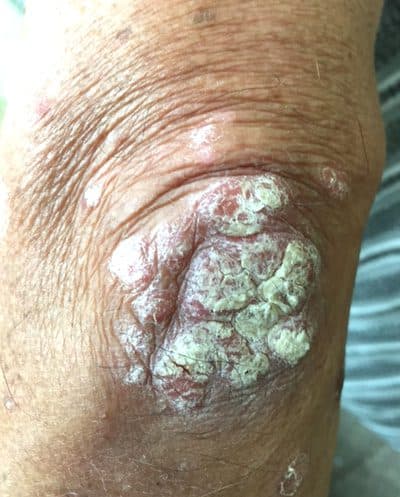
- It usually produces thickened plaques or patches with scaling.
- It frequently affects elbows, knees, scalp, and sometimes nails or skin folds.
- It may be accompanied by itching, burning, cracking, or significant cosmetic discomfort.
- Genetic factors, immune system factors, and environmental triggers all play a role.
- Outbreaks can worsen with stress, skin injuries, infections, or some medications
- There are effective treatments to control it, although there is no definitive cure.
- If there is joint pain or stiffness, it is advisable to consult a doctor because some people develop psoriatic arthritis.
What is psoriasis?
Psoriasis is a chronic disease in which the immune system is abnormally activated and accelerates the turnover of skin cells (Armstrong-2020 ). Instead of renewing itself at the usual rate, the skin produces cells faster, which causes them to accumulate on the surface and form inflamed, scaly areas (Raharja-2021 ).
It is not transmitted by contact: it is not «caught» by touching another person, sharing objects or living with someone who has it NPF-2025 .
Why does it appear? (common causes)
The exact cause is not fully understood, but evidence points to a combination of genetic predisposition, abnormal activation of the immune system, and environmental factors (Armstrong, 2020 ). Some people have a biological basis that makes them more prone, and certain triggers can promote outbreaks or worsen existing lesions (Raharja, 2021 ).
Among the most recognized triggers are stress, some infections, trauma or skin irritation, smoking, alcohol, and certain medications (NIAMS-2023 ). Not everyone shares the same triggers, so the pattern can vary greatly from case to case (Perry-2024 ).
What does it look like and what symptoms does it cause?
The most common form is plaque psoriasis . It usually appears as well-defined, thickened, reddish or darker areas, depending on the skin tone, with whitish or silvery scales on the surface (NIAMS-2023 ). It frequently appears on the elbows, knees, trunk, lower back, and scalp (Raharja-2021 ).
In addition to plaques, it can cause itching, burning, stinging, cracking, and even bleeding if the skin is broken or manipulated (Perry, 2024) . In some people, it also affects the nails, causing pitting, thickening, or partial separation of the nail (NPF, 2025 ).
Not all psoriasis looks the same. There are variants such as guttate , inverse or flexural , pustular , and erythrodermic , which is rare but can be more serious (NIAMS-2023 ).
What can you do today? (safe and concrete measures)
Keep your skin well moisturized , especially after bathing, as dryness and cracking often worsen discomfort (NIAMS-2023 ). Use gentle products and avoid harsh cleansers if you notice irritation (NICE-2012 ).
Try to identify your triggers : stress, friction, recent infections, sudden changes in weather, or products that irritate your skin (NIAMS-2023 ). Recognizing this pattern can help reduce breakouts (Perry-2024 ).
If you are already prescribed a treatment, use it as instructed. In psoriasis, consistency is often more helpful than applying a lot of product for a few days (NICE-2012 ).
What NOT to do? (common mistakes)
- Do not self-medicate with potent corticosteroids for prolonged periods, especially on the face, skin folds, or genitals (NICE-2012 ). Inappropriate use can irritate, thin the skin, or complicate the management of the condition (NICE-2025 ).
- Do not stop or change prescribed treatments without first discussing it with your doctor, especially if your psoriasis is extensive or has required more complex therapies NIAMS-2023 .
- Don’t confuse medical phototherapy with «sunbathing» on your own. Uncontrolled sun exposure can irritate or burn the skin and is not a substitute for a supervised treatment plan (NIAMS-2023 ).
- Don’t ignore joint pain, stiffness, or swelling just because «psoriasis is a skin condition» (NIAMS-2023 ). In some people, there may also be joint involvement (Armstrong-2020 ).
When should I consult a specialist?
- If the lesions are new, extensive, or rapidly progressing NIAMS-2023 .
- If there is significant pain, cracking, bleeding, or difficulty sleeping due to itching or burning , NPF-2025 .
- If it appears on your face, genitals, hands, feet, nails, or scalp and is affecting your daily life , NPF-2025 .
- If you notice pain, swelling, or joint stiffness, especially in your fingers, wrists, ankles, or back , NIAMS-2023 .
- If you have a fever, general malaise, or widespread redness , AAD-2025 .
- If it doesn’t improve, or you’re not sure it’s really psoriasis and not another skin condition (Johnson-2013 ).
What does a dermatologist usually do?
The first step is usually a clinical assessment: reviewing the lesions, their location, whether the scalp or nails are affected, whether there is itching or burning, and whether there is a family history, previous outbreaks, recent stress, infections, or medications that may influence them (NIAMS-2023 ).
In many cases, the diagnosis can be guided by the appearance and clinical history (Johnson-2013 ). If the presentation is atypical or resembles other diseases, the dermatologist may take a small biopsy for microscopic examination (NIAMS-2023 ).
Afterwards, treatment is adjusted according to the location, extent and impact on daily life: from creams or lotions, to phototherapy, tablets or injectable medications in moderate or severe cases NICE-2025 ; Menter-2019 .
If, in addition to skin problems, there is joint pain or stiffness, it is worth ruling out psoriatic arthritis.
Armstrong-2020 ; NIAMS-2023 .
Frequently Asked Questions
Is psoriasis contagious?
- No. It is not transmitted by touching skin, sharing objects, or living with a person with psoriasis NPF-2025 .
Is there a cure?
- Today it is not considered a disease with a definitive cure, but there are effective treatments to control it and reduce outbreaks NICE-2025 ; NIAMS-2023 .
Is it the same as eczema?
- No. They may look similar in some cases, but they are different diseases and sometimes a dermatological assessment is needed to differentiate them properly AAD-2025 ; Johnson-2013 .
Can it affect the scalp and nails?
- Yes. The scalp and nails are common sites and can greatly affect quality of life NPF-2025 .
Can stress make it worse?
- Yes, in many people stress acts as a trigger or promotes outbreaks, although it is not the only factor NIAMS-2023 .
Should I be worried if my joints hurt?
- Yes, it’s advisable to consult a specialist. Some people with psoriasis develop psoriatic arthritis, and early detection is important (NIAMS-2023 ).
Bibliography and sources
- National Institute of Arthritis and Musculoskeletal and Skin Diseases. Psoriasis . Bethesda (MD): National Institutes of Health; revised October 2023; cited May 10, 2026.
- National Institute of Arthritis and Musculoskeletal and Skin Diseases. Psoriasis: diagnosis, treatment, and steps to take . Bethesda (MD): National Institutes of Health; cited May 10, 2026.
- National Psoriasis Foundation. Psoriasis: symptoms, causes, images & treatment . National Psoriasis Foundation; updated March 24, 2026; cited May 10, 2026.
- National Institute for Health and Care Excellence. Psoriasis: assessment and management . NICE guideline CG153. London: NICE; 2012; last reviewed March 4, 2025; cited May 10, 2026.
- National Institute for Health and Care Excellence. Initial treatment with topical medication . In: Psoriasis: assessment and management. London: NICE; updated October 1, 2012; cited May 10, 2026.
- Armstrong AW, Read C. Pathophysiology, clinical presentation, and treatment of psoriasis: a review . JAMA. 2020;323(19):1945-1960. doi:10.1001/jama.2020.4006.
- Raharja A, Mahil SK, Barker JN. Psoriasis: a brief overview . Clin Med (London). 2021;21(3):170-173. doi:10.7861/clinmed.2021-0257.
- Perry M. Psoriasis: an overview . Br J Nurs. 2024;33(15):686-692. doi:10.12968/bjon.2024.0112.
- Johnson MAN, Armstrong AW. Clinical and histologic diagnostic guidelines for psoriasis: a critical review . Clin Rev Allergy Immunol. 2013;44(2):166-172. doi:10.1007/s12016-012-8305-3.
- Elmets CA, Korman NJ, Prater EF, Wong EB, Rupani RN, Kivelevitch D, et al. Joint AAD-NPF Guidelines of care for the management and treatment of psoriasis with topical therapy and alternative medicine modalities for psoriasis severity measures . J Am Acad Dermatol. 2021;84(2):432-470. doi:10.1016/j.jaad.2020.07.087.
- Menter A, Strober BE, Kaplan DH, Kivelevitch D, Prater EF, Stoff B, et al. Joint AAD-NPF guidelines of care for the management and treatment of psoriasis with biologics . J Am Acad Dermatol. 2019;80(4):1029-1072. doi:10.1016/j.jaad.2018.11.057.
- American Academy of Dermatology Association. What is psoriasis? . American Academy of Dermatology Association; cited May 10, 2026.
- American Academy of Dermatology Association. Psoriasis: signs and symptoms . American Academy of Dermatology Association; cited May 10, 2026.
Tags
Categories: For everyone · Psoriasis · Skin diseases · Stains on the nails

Content reviewed by
Dr. Rodolfo Suárez
Médico Patólogo y Dermatólogo Master en Patología Cutánea Avanzada
- Published
- September 18, 2026
- Updated
- September 23, 2026
Medically reviewed by specialists
Our content is based on current scientific evidence and clinical protocols.