
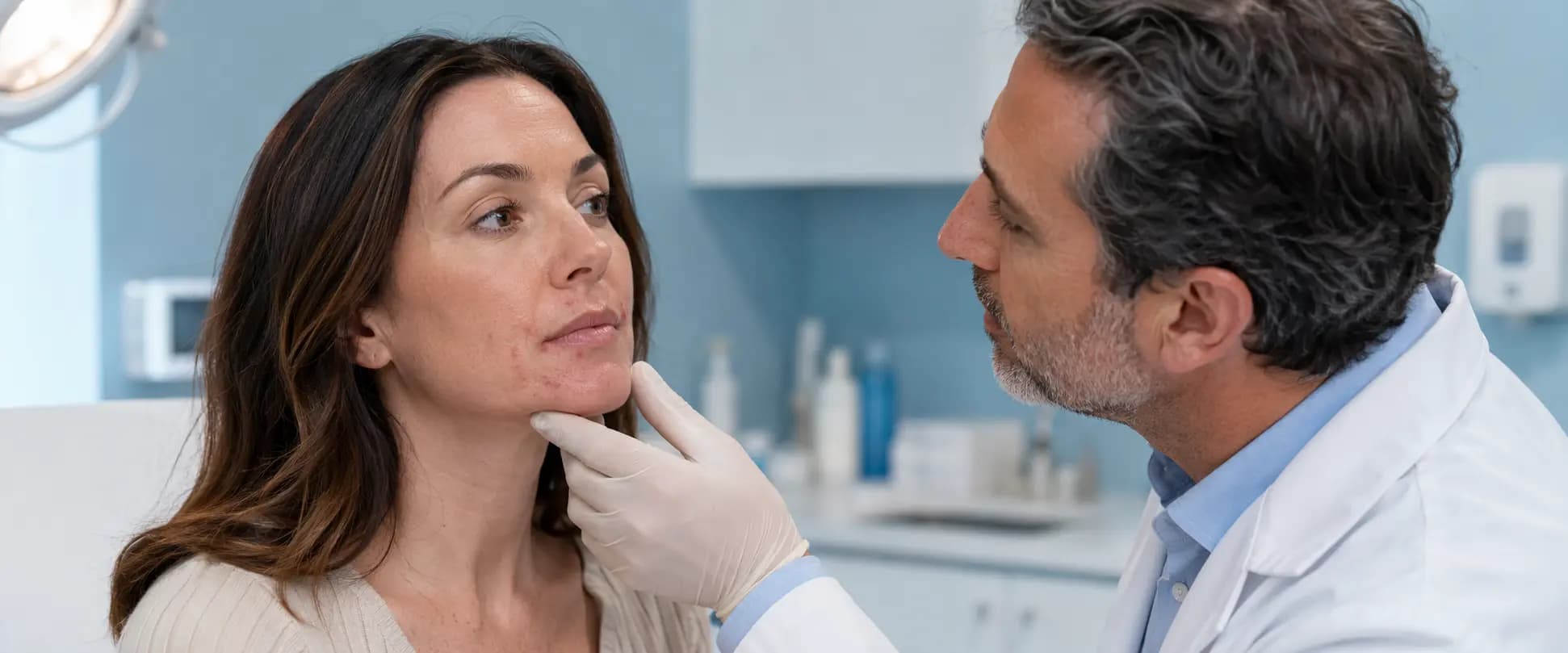
A clear and concise guide to understanding the pimples, redness, and irritation that appear around the mouth.
Before you read: At Skinpaths, we distinguish between opinion and evidence. To write this content, we prioritized indexed medical sources and recommendations from scientific societies. You’ll find the complete bibliography at the end for your reference.
Important: This article is for informational purposes only and does not replace medical advice. If you have any questions, persistent symptoms, or your condition worsens, consult a healthcare professional.
Summary in 60 seconds
- Perioral dermatitis is an inflammatory rash that frequently appears around the mouth.
- It can also affect the area near the nose or eyes; that’s why some specialists call it periorificial dermatitis.
- It usually appears as small pimples, redness, flaking, burning, or sensitivity.
- It may look like acne, but it doesn’t always behave like acne.
- One of the most recognized triggers is the use of corticosteroids on the face.
- Cosmetics, heavy creams, sunscreens, toothpaste, or local irritants can also have an effect.
- It is not contagious.
- The first step is usually to simplify your facial routine and avoid irritating products.
- If it does not improve, the dermatologist may prescribe topical or oral treatments.
What is perioral dermatitis?
Perioral dermatitis is an inflammatory skin rash that primarily affects the area around the mouth. It can present as small bumps, papules, pustules, areas of dry skin, or fine scaling. When it also affects the nose or eyes, the term periorificial dermatitis is often used. AAD sf
Although its name includes «dermatitis,» it doesn’t always behave like classic eczema. In the doctor’s office, it can be confused with acne, rosacea, contact dermatitis, saliva irritation, or a reaction to cosmetic products.
Why does it appear?
The exact cause is not always identified. Available evidence suggests that there is usually a combination of individual predisposition, local irritation, and disruption of the skin barrier. Searle 2021
One of the most important factors is the use of corticosteroids on the face. This includes creams, ointments, and, in some cases, inhaled or nasal corticosteroids that come into contact with the skin. They may provide initial improvement, but later contribute to relapses or more persistent outbreaks. Tolaymat 2025
Other possible triggers include cosmetics, highly occlusive moisturizers, heavy makeup, sunscreens, toothpastes, face masks, saliva irritation, and hormonal changes. This does not mean that all of these factors are the cause in every person; the pattern should be evaluated on a case-by-case basis. DermNet 2022
What does it look like and what symptoms does it cause?
It usually appears as small, clustered bumps around the mouth, sometimes accompanied by redness, burning, tightness, mild itching, or scaling. In many people, it spares the immediate border of the lips, a detail that can aid in diagnosis. BAD sf
On fair skin, it may appear predominantly red or pink. On darker skin, it may appear purplish, brown, darker than the surrounding skin, or simply as an area of uneven texture. It can also extend into the creases of the nose or around the eyes.
It does not usually cause fever or general symptoms. If there is severe pain, discharge, yellow crusts, or marked swelling, other causes should be ruled out.
What can you do today?
The safest approach is to start by simplifying your routine. Wash your face with lukewarm water or a gentle, fragrance-free cleanser. Avoid exfoliants, harsh toners, acids, cosmetic retinoids, oils, heavy balms, and heavy makeup while your skin is inflamed.
If you are using a corticosteroid on your face, do not extend its use on your own. In some people, stopping it abruptly can cause a temporary rebound effect; therefore, it is always advisable to consult with a specialist, especially if you have been using it for several days or weeks. PCDS 2023
Use sunscreen if you can tolerate it, ideally with a simple, fragrance-free formula. If a product burns or worsens the affected area each time you apply it, discontinue use and discuss it with your doctor.
What NOT to do?
Don’t treat it aggressively as if it were regular acne. Exfoliating, scrubbing, or combining too many active ingredients can further irritate the skin.
Do not use topical corticosteroids without a doctor’s prescription. It’s one of the most common mistakes: they may provide initial relief, but then perpetuate the cycle of flare-ups and relapses.
Don’t squeeze pimples. Besides causing irritation, it can increase the risk of scarring or secondary infection.
Do not cover the area with thick layers of occlusive creams. In perioral dermatitis, more product does not always mean better healing.
When should I consult?
Consult a healthcare professional if any of these situations occur:
- Rapid worsening or spread to eyes, nose, or cheeks.
- Significant pain, discharge, yellow crusts, or suspected infection.
- Swelling of the eyelids, tearing, burning eyes, or blurred vision.
- Pregnancy, breastfeeding, or occurrence in a young child.
- Recent or prolonged use of corticosteroids on the face.
- Lack of improvement after 2–4 weeks of gentle care.
- Injuries that leave persistent stains, scars, or significant emotional impact.
What does a dermatologist usually do?
The diagnosis is usually clinical. The dermatologist examines the distribution of the lesions, the type of pimples, the symptoms, and the products applied to the face. They also ask about corticosteroids, inhalers, nasal sprays, acne treatments, cosmetics, sunscreen, and toothpaste.
In typical cases, a biopsy is not usually required. Dermatoscopy can help in some differential diagnoses, but it is not essential in most patients. If the presentation is atypical, persistent, or does not respond as expected, a biopsy or tests to rule out rosacea, acne, contact dermatitis, impetigo, seborrheic dermatitis, or other conditions may be considered. Tolaymat 2025
Management may include “zero therapy,” which involves minimizing facial products for a defined period. If necessary, the dermatologist may prescribe topical treatments such as metronidazole, erythromycin, clindamycin, azelaic acid, or calcineurin inhibitors. In moderate or persistent cases, oral antibiotics with anti-inflammatory effects may be used, depending on age, pregnancy, breastfeeding, medical history, and severity. Gray 2022
Frequently Asked Questions
Is perioral dermatitis contagious?
- No. It is not transmitted by kissing, sharing glasses, or skin-to-skin contact. AAD sf
Is it the same as acne?
- Not exactly. It may resemble acne, but perioral dermatitis typically lacks comedones, the blackheads or whiteheads characteristic of acne. Furthermore, its distribution around the mouth is very distinctive.
Why does it get worse when you stop taking the corticosteroid?
- Because a rebound effect can occur. Corticosteroids reduce inflammation in the short term, but repeated use on the face can cause the outbreak to recur or become more persistent. Tolaymat 2025
How long does it take to get better?
- It depends on the severity of the flare-up and the triggers. Some mild cases improve by simplifying your routine; others require several weeks of medical treatment. It’s not usually an overnight change.
Can I use moisturizer?
- Yes, but it should be a simple, fragrance-free, and non-occlusive formula. If the skin is very reactive, the dermatologist may recommend a minimal routine and reintroducing products gradually.
Can it appear around the eyes?
- Yes. When it affects the mouth, nose, or eyes, the more accurate term is periorificial dermatitis. If there are eye symptoms, it’s advisable to consult a doctor.
Can he come back?
- Yes, it can recur, especially if facial corticosteroids, irritating cosmetics, or products that acted as triggers are reintroduced.
Bibliography and sources
- American Academy of Dermatology Association. Red rash around your mouth could be perioral dermatitis [Internet] . American Academy of Dermatology Association; sf [citado 2026 Jul 3] . Available at: https://www.aad.org/public/diseases/az/perioral-dermatitis
- Shah N. Periorificial dermatitis [Internet] . DermNet NZ; 2022 [citado 2026 Jul 3] . Available at: https://dermnetnz.org/topics/periorificial-dermatitis
- British Association of Dermatologists. Peri-oral dermatitis [Internet] . British Association of Dermatologists; sf [citado 2026 Jul 3] . Available at: https://www.bad.org.uk/pils/peri-oral-dermatitis
- Primary Care Dermatology Society. Perioral dermatitis / periocular dermatitis [Internet] . Primary Care Dermatology Society; 2023 Dec 17 [citado 2026 Jul 3] . Available at: https://www.pcds.org.uk/clinical-guidance/perioral-dermatitis-periocular-dermatitis-syn-periorifacial-dermatitis
- Tolaymat L, Hall MR. Perioral Dermatitis. In: StatPearls [Internet] . Treasure Island (FL): StatPearls Publishing; 2025 [citado 2026 Jul 3] . Available at: https://www.ncbi.nlm.nih.gov/books/NBK525968/
- Hall CS, Reichenberg J. Evidence based review of perioral dermatitis therapy. G Ital Dermatol Venereol. 2010;145(4):433-44. Available at: https://pubmed.ncbi.nlm.nih.gov/20823788/
- Gray NA, Tod B, Rohwer A, Fincham L, Visser WI, McCaul M. Pharmacological interventions for periorificial (perioral) dermatitis in children and adults: a systematic review. J Eur Acad Dermatol Venereol. 2022;36(3):380-90. doi:10.1111/jdv.17817. Available at: https://pubmed.ncbi.nlm.nih.gov/34779023/
- Searle T, Ali FR, Al-Niaimi F. Perioral dermatitis: diagnosis, proposed etiologies, and management. J Cosmet Dermatol. 2021;20(12):3839-48. doi:10.1111/jocd.14060. Available at: https://pubmed.ncbi.nlm.nih.gov/33751778/
- Lipozenčić J, Ljubojević Hadžavdić S. Perioral dermatitis. Clin Dermatol. 2014;32(1):125-30. doi:10.1016/j.clindermatol.2013.05.034. Available at: https://pubmed.ncbi.nlm.nih.gov/24314386/
- Tempark T, Shwayder TA. Perioral dermatitis: a review of the condition with special attention to treatment options. Am J Clin Dermatol. 2014;15(2):101-13. doi:10.1007/s40257-014-0067-7. Available at: https://pubmed.ncbi.nlm.nih.gov/24623018/
Categories: For everyone

Content reviewed by
Dr. Rodolfo Suárez
Médico Patólogo y Dermatólogo Master en Patología Cutánea Avanzada
- Published
- September 18, 2026
- Updated
- September 23, 2026
Medically reviewed by specialists
Our content is based on current scientific evidence and clinical protocols.