
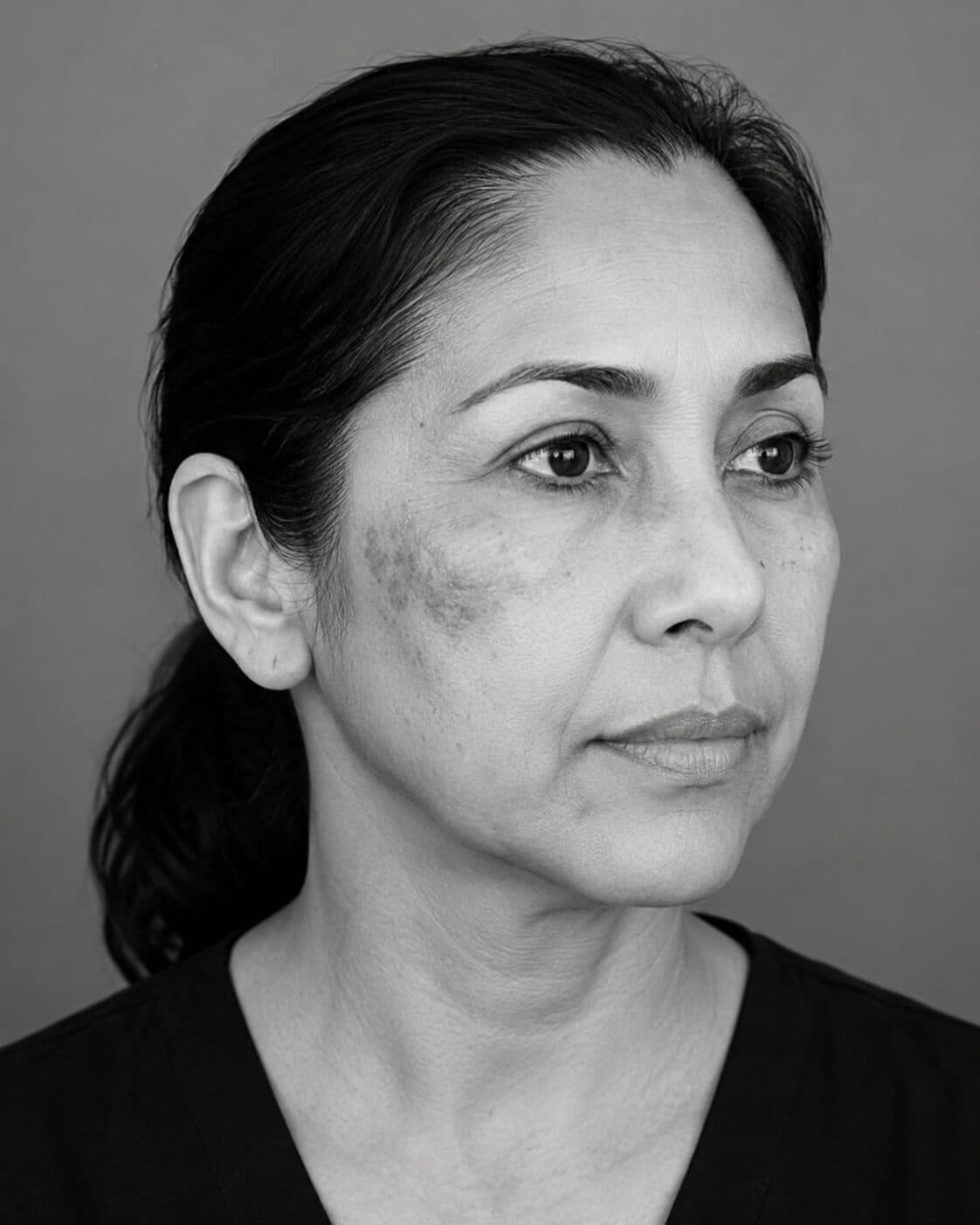
Information for patients: A practical guide to understanding melasma, protecting your skin, and knowing when to seek dermatological help.
Before you read: At Skinpaths, we distinguish between opinion and evidence. To write this content, we prioritized indexed medical sources and recommendations from scientific societies. You’ll find the complete bibliography at the end for your reference.
Important: This article is for informational purposes only and does not replace medical advice. If you have any questions, persistent symptoms, or your condition worsens, consult a healthcare professional.
Summary in 60 seconds
- Melasma is a common form of hyperpigmentation that produces brown, grayish, or bluish spots, especially on the face.
- It is not cancer, it is not contagious, and it usually does not hurt or itch.
- It usually appears on the cheeks, forehead, upper lip, nose or chin.
- It is related to genetic predisposition, sun, visible light, pregnancy, hormonal contraceptives, and some medications.
- It is more common in women and in people with medium or dark skin tones.
- Daily photoprotection is the basis of management, even when using creams or procedures.
- Sunscreens with color and iron oxides can be helpful because they help block some of the visible light.
- Treatments can improve the spots, but melasma tends to recur.
- The realistic goal is not to «cure it forever», but to control it consistently and safely.
- It is advisable to consult a dermatologist if the spots change quickly, are asymmetrical, bleed, hurt, or generate diagnostic doubts.
What is melasma?
Melasma is an acquired pigmentation disorder: the skin produces or deposits more melanin in certain areas, forming patches darker than the usual skin tone. It typically appears in sun-exposed areas, especially on the face. The American Academy of Dermatology describes it as spots or patches darker than the natural skin color, usually on the face, and clarifies that it is not contagious (AAD 2022 ).
Melasma is benign from an oncological perspective: it is not a form of cancer nor a direct sign of skin cancer. However, it can have a significant emotional impact because it affects visible areas of the face and can persist for years (PCDS 2025 ).
Although many people call them «spots,» not all facial spots are melasma. Solar lentigines, post-inflammatory hyperpigmentation, medication-induced spots, moles, and some lesions that require evaluation can look similar. Therefore, when in doubt, a professional should confirm the diagnosis.
Why does it appear?
Melasma rarely has a single cause. It is more accurately understood as a multifactorial condition: personal predisposition combines with external and internal stimuli that activate pigmentation.
The most recognized factors are sun exposure, visible light, genetic predisposition, and hormonal changes. DermNet notes that ultraviolet radiation and visible light promote melanin production, and that pregnancy, hormonal contraceptives, and hormone therapy can contribute to its appearance or worsening (DermNet 2024) .
Pregnancy is a classic scenario. That’s why melasma has been called the «mask of pregnancy» or «chloasma.» However, it doesn’t only appear during pregnancy, nor is it exclusive to women: it can also occur outside of pregnancy, in both women and men.
Some irritating cosmetics, perfumes, harsh soaps, ill-advised procedures, or medications that increase light sensitivity can worsen pigmentation. Low-grade inflammation also matters: when the skin is irritated, melasma can darken or become more resistant (PCDS 2025 ).
Current evidence also suggests that melasma is not just an “excess of surface pigment.” Recent reviews describe it as a more complex condition, related to photoaging changes, inflammation, vascularization, and dermal alterations, which helps explain why it can be persistent and recurrent (Jo 2024 ).
Melasma cannot be managed with a single cream: it requires correct diagnosis, constant photoprotection and realistic expectations.
What does it look like and what symptoms does it cause?
Melasma typically appears as flat, brown, gray, dark brown, or blue-gray patches. It often appears relatively symmetrically on both sides of the face.
The most affected areas are:
- Cheeks.
- Forehead.
- Nose bridge.
- Upper lip.
- Chin.
- Jaw.
It generally does not cause itching, pain, burning, or scaling. If a patch is painful, bleeds, crusts over, grows rapidly, or has very irregular borders, it should not be assumed to be melasma without medical evaluation.
DermNet describes centrofacial, malar, mandibular patterns and, less frequently, extrafacial forms on forearms, shoulders or sun-exposed areas DermNet 2024 .
What can you do today?
The first step is to protect the skin from ultraviolet radiation and visible light. In melasma, sun protection is not an add-on: it is the cornerstone of treatment. Without it, even well-prescribed treatments may yield poor or temporary results.
A safe routine may include broad-spectrum sunscreen, ideally SPF 30 or higher, applied daily and reapplied after prolonged sun exposure, sweating, or outdoor activity. The AAD recommends wide-brimmed hats, shade, and broad-spectrum sunscreen; for patients with melasma, it frequently mentions formulas containing zinc oxide, titanium dioxide, and iron oxides (AAD 2022 ).
Tinted sunscreen can be especially relevant. It’s not just about aesthetics: the iron oxides present in many tinted formulas help block some of the visible light, which can worsen melasma, particularly in skin more prone to pigmentation. The AAD recommends tinted sunscreen containing iron oxides to protect against visible light (AAD 2023 ).
Wearing a hat and sunglasses, seeking shade, and avoiding tanning beds also help. Artificial tanning can worsen melasma and reduce the effectiveness of treatments.
In your daily routine, it’s best to choose gentle cleansers, fragrance-free moisturizers, and products that don’t cause persistent burning. If a cream stings intensely, causes redness, or excessive flaking, it can irritate the skin and worsen pigmentation.
If melasma appeared after starting contraceptives, hormone therapy, or a photosensitizing medication, do not stop taking anything on your own. It’s best to discuss this with your doctor to explore alternative options.
What NOT to do?
It is not advisable to use depigmenting mixtures without supervision. Some over-the-counter creams may contain potent corticosteroids, hydroquinone in inappropriate concentrations, mercury, or other undeclared ingredients. This can irritate the skin, thin it, cause acne, dermatitis, visible blood vessels, or worsen pigmentation.
It’s also not recommended to exfoliate the skin aggressively, use acids cumulatively without guidance, scrub the spots with brushes, or resort to «at-home peels.» Repeated irritation can turn a pigmentation problem into a cycle of inflammation and more spots.
Lasers, pulsed light, microneedling, and chemical peels are not harmless treatments. In expert hands, they can have a place in selected cases, but when inappropriately indicated, they can worsen melasma, especially in medium or dark skin tones. The AAD points out that these procedures should be performed by board-certified dermatologists because they require careful patient selection and realistic expectations (AAD 2022 ).
Don’t expect immediate results. Melasma usually improves slowly. The AAD reports that, even with a treatment plan, results can take between 3 and 12 months, and sometimes longer if the melasma has been present for a long time (AAD 2022 ).
When should I consult?
Consult a dermatology specialist if any of these situations appear:
- The stain quickly changes size, color, or shape.
- It has several colors, very irregular edges, or an asymmetrical appearance.
- It bleeds, forms a scab, hurts, or ulcerates.
- A new lesion appears that doesn’t look like your other spots.
- There is intense itching, persistent burning, or inflammation.
- The melasma appeared after starting a medication.
- You are pregnant or breastfeeding and want to treat it with active products.
- You have used depigmenting creams that are not formulated or of uncertain origin.
- The appearance of blemishes affects your self-esteem or social life.
- You’re not sure if it’s melasma.
Consulting a specialist isn’t just about «removing blemishes.» It also helps confirm the diagnosis, rule out other causes of hyperpigmentation, and avoid unnecessary or irritating treatments.
What does a dermatologist usually do?
The dermatologist usually begins with a medical history: when the spots appeared, whether they change with sun exposure, pregnancy, contraceptives, medications, cosmetics, previous procedures, and family history.
Next, examine the skin. In many cases, the diagnosis is clinical. You may use dermatoscopy or a Wood’s lamp to better observe the pigment pattern and guide management. The AAD notes that if the melasma resembles another condition, the dermatologist may perform a small biopsy to rule out other diagnoses (AAD 2022 ).
Treatment typically combines several strategies: strict photoprotection, topical products, and, in selected cases, procedures. Topical agents used under medical supervision include hydroquinone, the triple combination of hydroquinone, tretinoin, and a mild corticosteroid, azelaic acid, kojic acid, vitamin C, cysteamine, and other agents. Evidence and consensus generally consider hydroquinone-based formulations, especially in combination, as effective options during induction phases, but they should not be used indefinitely or without medical supervision (González-Molina 2022 ).
Tranexamic acid, topical or oral, may be considered in selected cases. It is not for everyone. In its oral form, it requires medical evaluation because it may not be suitable for people with a history of thrombosis, certain risk factors, pregnancy, or use of estrogen-based contraception. Recent reviews consider it a useful tool in specific patients, within a supervised treatment plan (Gan 2024 ).
Regarding procedures, the dermatologist may consider chemical peels, laser, light therapy, microneedling, or platelet-rich plasma (PRP), but these are not the first-line treatments for everyone. The decision depends on skin type, severity, previous treatments, tendency toward hyperpigmentation, and expectations.
Frequently Asked Questions
Is melasma dangerous?
- Generally, no. Melasma is benign, not contagious, and not cancerous. The important thing is not to assume that every facial patch is melasma. If there are rapid changes, bleeding, pain, or marked asymmetry, it should be evaluated.
Is melasma permanently curable?
- It’s not common to talk about a «definitive cure.» It’s more realistic to talk about control. It can improve significantly, but it tends to reappear with sun exposure, visible light, hormonal changes, or irritation. The AAD clarifies that treatments can fade it, but they don’t permanently prevent its return (AAD 2022 ).
Which sunscreen is best for melasma?
- A broad-spectrum sunscreen with SPF 30 or higher, suitable for daily use, is generally preferred, ideally one that contains color and iron oxides. For many people with melasma, especially those with skin that pigments easily, this protection from visible light can make a significant difference.
Does melasma only appear in women?
- No. It’s more common in women, but it can also occur in men. In men, sun exposure and family history often play a significant role.
Can I treat melasma if I’m pregnant?
- Caution is advised during pregnancy. Some depigmenting treatments are not recommended during this time. Sun protection, hats, and a gentle skincare routine are usually the starting point. Any treatment strategy should always be reviewed with a dermatologist.
Is hydroquinone bad?
- Not necessarily. It’s a useful depigmenting medication when properly indicated, at appropriate concentrations, and for defined periods. The problem arises when it’s used without medical supervision, for extended periods, or in mixtures from unknown sources or brands.
Do natural treatments work?
- Evidence is limited for most “natural” remedies. Furthermore, some oils, citrus fruits, or homemade mixtures can irritate or sensitize the skin to the sun. With melasma, “natural” doesn’t always mean safe.
Bibliography and sources
- American Academy of Dermatology Association. Melasma: overview [Internet] . Rosemont: AAD; 2022 [citado 2026 May 10] . Available at: https://www.aad.org/public/diseases/az/melasma-overview
- American Academy of Dermatology Association. Melasma: diagnosis and treatment [Internet] . Rosemont: AAD; 2022 [citado 2026 May 10] . Available at: https://www.aad.org/public/diseases/az/melasma-treatment
- American Academy of Dermatology Association. Melasma: self-care [Internet] . Rosemont: AAD; 2023 [citado 2026 May 10] . Available at: https://www.aad.org/public/diseases/az/melasma-self-care
- Primary Care Dermatology Society. Melasma: patient information sheetlet [Internet] . PCDS; 2025 [citado 2026 May 10] . Available at: https://www.pcds.org.uk/patient-info-leaflets/melasma
- DermNet New Zealand. Melasma: facial pigmentation [Internet] . DermNet; 2024 [citado 2026 May 10] . Available at: https://dermnetnz.org/topics/melasma
- Das S, McKoy K. Melasma. MSD Manual, Consumer Version. [Internet] Available from : [citado 2026 May 10]
- Jo JY, Chae SJ, Ryu HJ. Update on melasma treatments. Ann Dermatol. 2024;36(3):125-134. doi:10.5021/ad.23.133. Available at: https://pubmed.ncbi.nlm.nih.gov/38816973/
- Ocampo-Candiani J, et al. Latin American consensus on the treatment of melasma. Int J Dermatol. 2025;64(3):499-512. doi:10.1111/ijd.17522. Available at: https://pubmed.ncbi.nlm.nih.gov/39415312/
- Gan C, Shumack S, Foley P, Frew JW. An update on new and existing treatments for the management of melasma. Am J Clin Dermatol. 2024;25(5):717-733. doi:10.1007/s40257-024-00863-2. Available at: https://pubmed.ncbi.nlm.nih.gov/38896402/
- Desai SR, Alexis AF, Elbuluk N, Grimes PE, Weiss J, Hamzavi IH, et al. Best practices in the treatment of melasma with a focus on patients with skin of color. J Am Acad Dermatol. 2024;90(2):269-279. doi:10.1016/j.jaad.2023.07.1045. Available at: https://pubmed.ncbi.nlm.nih.gov/37748556/
- González-Molina V, Martí-Pineda A, González N. Topical treatments for melasma and their mechanism of action. J Clin Aesthet Dermatol. 2022;15(5):19-28. Available from: https://jcadonline.com/topical-treatments-melasma-mechanism-of-action/
- Castanedo-Cazares JP, Hernández-Blanco D, Carlos-Ortega B, Fuentes-Ahumada C, Torres-Álvarez B. Near-visible light and UV photoprotection in the treatment of melasma: a double-blind randomized trial. Photodermatol Photoimmunol Photomed. 2014;30(1):35-42. doi:10.1111/phpp.12086. Available at: https://pubmed.ncbi.nlm.nih.gov/24313385/
- Fatima S, Braunberger T, Mohammad TF, Kohli I, Hamzavi IH. The role of sunscreen in melasma and postinflammatory hyperpigmentation. Indian J Dermatol. 2020;65(1):5-10. Available at: https://pmc.ncbi.nlm.nih.gov/articles/PMC6986132/
- Cassiano DP, Espósito ACC, Bagatin E, Hassun K, Lima PB, Miot LDB, et al. Update on melasma—part II: treatment. Dermatol Ther (Heidelb). 2022;12(9):1989-2012. Available at: https://pmc.ncbi.nlm.nih.gov/articles/PMC9464276/
Categories: For everyone · Melasma · Skin diseases · Skin spots

Content reviewed by
Dr. Rodolfo Suárez
Médico Patólogo y Dermatólogo Master en Patología Cutánea Avanzada
- Published
- September 18, 2026
- Updated
- October 9, 2026
Medically reviewed by specialists
Our content is based on current scientific evidence and clinical protocols.