

How to identify warning signs on the skin and why early assessment can change the prognosis.
Before you read: At Skinpaths, we distinguish between opinion and evidence. To write this content, we prioritized indexed medical sources and recommendations from scientific societies. You’ll find the complete bibliography at the end for your reference.
Important: This article is for informational purposes only and does not replace medical advice. If you have any questions, persistent symptoms, or your condition worsens, consult a healthcare professional.
Summary in 60 seconds
- Cutaneous melanoma is a type of skin cancer that originates in melanocytes, the cells that produce pigment.
- It is not the most common type of skin cancer, but it is one of the most worrying because of its ability to invade and spread.
- It can appear on a pre-existing mole or on skin that previously appeared normal.
- A key sign is change: a new spot or mole, different from the others, or that changes in size, shape, color, or symptoms.
- The ABCDE rule helps detect suspicious lesions, although some melanomas may be small or not exhibit all the ABCDE characteristics.
- Exposure to ultraviolet radiation and tanning beds increase the risk.
- Sun protection and regular self-monitoring are useful measures, but they do not replace medical check-ups when something changes.
- If a lesion bleeds, itches, grows, or looks «weird,» it’s worth consulting a doctor soon.
What is melanoma?
Cutaneous melanoma is a cancer that originates in melanocytes, the cells responsible for producing melanin (the skin’s pigment). It can occur in any area of the skin, even in less visible areas such as the scalp, back, palms, soles, or under the nails. Although many people associate it with a «black mole,» it doesn’t always have that classic appearance. American Academy of Dermatology 2025 National Cancer Institute 2025
A change in the skin’s appearance is often one of the first signs of melanoma, so it’s important to know your moles and notice when anything changes. American Academy of Dermatology 2025
Why does it appear? (common causes)
There is usually no single cause. In most cases, a combination of individual predisposition and cumulative damage from ultraviolet radiation is involved. Intense and intermittent sun exposure, sunburns, and the use of tanning beds are relevant factors. Having many moles, atypical moles, a personal or family history of melanoma, very sun-sensitive skin, or immunosuppression also increases the risk. (Conforti 2021, WHO 2017 )
What does it look like and what symptoms does it cause?
It often presents as a mole or spot that changes. It may become asymmetrical, have irregular borders, multiple colors, grow, or look different from other moles. Sometimes it itches, bleeds, crusts over, or feels tender. The ABCDE rule ( Asymmetry , Border , Color , Diameter , and Evolution ) is a helpful guide, but not all melanomas meet all of these criteria, and some are smaller than 6 mm. American Academy of Dermatology 2025 American Cancer Society 2025
–
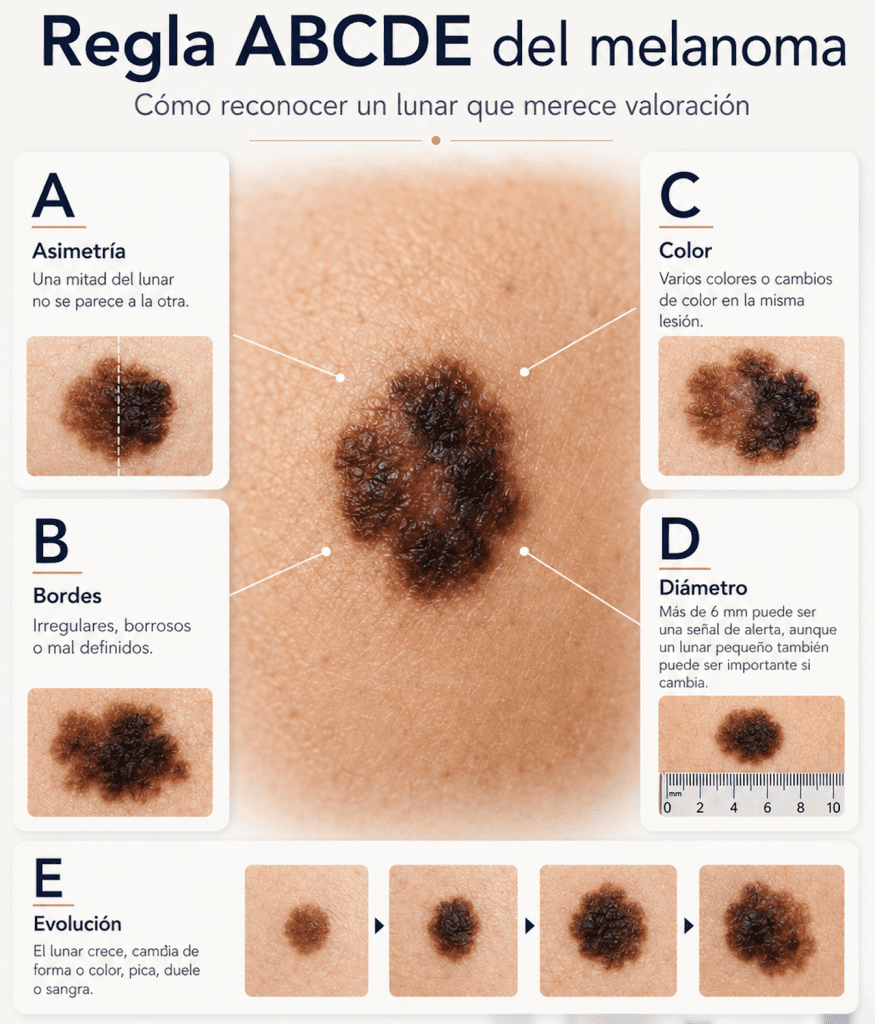
It can also appear as a new, distinct lesion, a dark line on a nail, or an irregular patch on the palms or soles. In other words, if something on your skin looks new, changing, or unusual, it deserves attention. American Cancer Society 2025
New moles, spots, or lesions, as well as changes in how an area looks or feels, can be signs of melanoma.”
American Cancer Society 2025
What can you do today? (safe and concrete measures)
The most effective approach today is to combine observation and protection. Check your skin regularly, especially if you have many moles or a family history of risk factors. Look for changes and pay attention to often-overlooked areas: your back, scalp, feet, nails, and hard-to-see areas. And of course, always seek professional advice from your dermatologist if you have any concerns. American Academy of Dermatology 2023
In addition, reduce ultraviolet exposure: seek shade when the sun is strongest, wear protective clothing, a hat, UV-protective sunglasses, and broad-spectrum sunscreen with SPF 30 or higher on exposed skin. Avoid tanning beds. These measures reduce risk, but they do not replace a consultation if a lesion changes. CDC 2024, American Academy of Dermatology 2025
Detecting and managing melanoma in its early stages improves treatment and prognosis.”
Nike 2021 Dixon 2024
What NOT to do? (common mistakes)
It is not advisable to wait months «to see if it goes away» when an injury clearly changes.
It’s not a good idea to assume that because it’s small it’s not important.
It is also not wise to try to «burn» it, scrape it, or treat it at home if it is suspected.
And it’s not advisable to use tanning beds thinking they are a safe alternative ( they are not ) . American Academy of Dermatology 2025 CDC 2024
When should I consult a specialist?
- A new mole or spot that looks different from the others
- A mole that changes size, shape, or color
- An injury that bleeds, itches, hurts, or forms a scab without a clear explanation.
- A new dark spot on a fingernail, palm, or sole
- An injury that doesn’t «seem normal» to you, even if it’s small.
- A quick change in a few weeks or months
- Any suspicious lesion if you have a personal or family history of melanoma. American Cancer Society 2025 American Academy of Dermatology 2025
What does a dermatologist usually do?
First, the dermatologist examines the lesion and the surrounding skin in context. Often, they use dermatoscopy, a tool that allows visualization of structures not visible to the naked eye and improves diagnostic accuracy. If the lesion remains suspicious, a biopsy may be ordered to confirm the diagnosis and determine the course of treatment. (Nazzaro 2022, Dixon 2024)
If melanoma is confirmed, treatment depends on the stage. In early stages, management often begins with surgery; in more advanced stages, other therapies may be considered on a case-by-case basis. National Cancer Institute 2025
Frequently Asked Questions
Is every irregular mole melanoma?
- No. Many benign moles can be asymmetrical or have striking features. What matters is not just «how it looks,» but whether it changes or stands out clearly from others. American Cancer Society 2025
Can it appear on brown or dark skin?
- Yes. It can appear in any skin type. In darker skin, some forms are seen more frequently in areas such as the palms, soles, or under the nails, so those areas should also be checked. American Academy of Dermatology 2025
Does it always grow on a mole that already existed?
- No. Some appear on pre-existing moles, but many lesions arise on skin that previously appeared normal. American Academy of Dermatology 2025
If it doesn’t hurt, can I rest easy?
- Not necessarily. A melanoma may not cause pain in its early stages. Visible changes are often a more helpful sign than pain. American Cancer Society 2025
Does sunscreen completely prevent melanoma?
- Not entirely. It helps reduce UV damage and is part of prevention, but it must be combined with shade, protective clothing, and avoiding intentional tanning. CDC 2024 WHO 2017
Can a photo be used to monitor a mole?
- It can help compare changes over time, but it does not replace a medical evaluation when a lesion is suspected. American Academy of Dermatology 2023 Dixon 2024
Bibliography and sources
- American Academy of Dermatology Association. Melanoma [Internet] . American Academy of Dermatology Association; 2025 [citado 2026 May 13] . Available at: https://www.aad.org/media/stats-melanoma
- American Academy of Dermatology Association. Find skin cancer: How to perform a skin self-exam [Internet] . American Academy of Dermatology Association; 2023 [citado 2026 May 13] . Available at: https://www.aad.org/public/diseases/skin-cancer/find/check-skin
- American Cancer Society. Signs of melanoma skin cancer [Internet] . American Cancer Society; 2025 [citado 2026 May 13] . Available at: https://www.cancer.org/cancer/types/melanoma-skin-cancer/detection-diagnosis-staging/signs-and-symptoms.html
- National Cancer Institute. Melanoma treatment (PDQ®)–Patient version [Internet] . Bethesda: National Cancer Institute; 2025 [citado 2026 May 13] . Available at: https://www.cancer.gov/types/skin/patient/melanoma-treatment-pdq
- Centers for Disease Control and Prevention. Reducing risk for skin cancer [Internet] . Atlanta: Centers for Disease Control and Prevention; 2024 [citado 2026 May 13] . Available at: https://www.cdc.gov/skin-cancer/prevention/index.html
- World Health Organization. Radiation: Ultraviolet (UV) radiation and skin cancer [Internet] . Geneva: World Health Organization; 2017 Oct 16 [citado 2026 May 13] . Available at: https://www.who.int/news-room/questions-and-answers/item/radiation-ultçraviolet-%28uv%29-radiation-and-skin-cancer
- Naik PP. Cutaneous malignant melanoma: a review of early diagnosis and management. World J Oncol. 2021;12(1):7-19. doi:10.14740/wjon1349. Available at: https://pmc.ncbi.nlm.nih.gov/articles/PMC7935621/
- Dixon AJ, Sladden M, Zouboulis CC, Popescu CM, Nirenberg A, et al. Primary cutaneous melanoma-management in 2024. J Clin Med. 2024;13(7):1913. doi:10.3390/jcm13071913. Available at: https://pmc.ncbi.nlm.nih.gov/articles/PMC10971470/
- Conforti C, Zalaudek I. Epidemiology and risk factors of melanoma: a review. Dermatol Practice Concept. 2021;11(Suppl 1):e2021161S. doi:10.5826/dpc.11S1a161S. Available at: https://pmc.ncbi.nlm.nih.gov/articles/PMC8366310/
- Nazzaro G, Passoni E, Pozzessere F, Maronese CA, Marzano AV. Dermoscopy use leads to earlier cutaneous melanoma diagnosis in terms of invasiveness and size? A single-center, retrospective experience. J Clin Med. 2022;11(16):4912. doi:10.3390/jcm11164912. Available at: https://pmc.ncbi.nlm.nih.gov/articles/PMC9410491/
Categories: For everyone · Melanoma · Mole that changes or grows · Stains on the nails

Content reviewed by
Dr. Rodolfo Suárez
Médico Patólogo y Dermatólogo Master en Patología Cutánea Avanzada
- Published
- September 18, 2026
- Updated
- September 23, 2026
Medically reviewed by specialists
Our content is based on current scientific evidence and clinical protocols.