

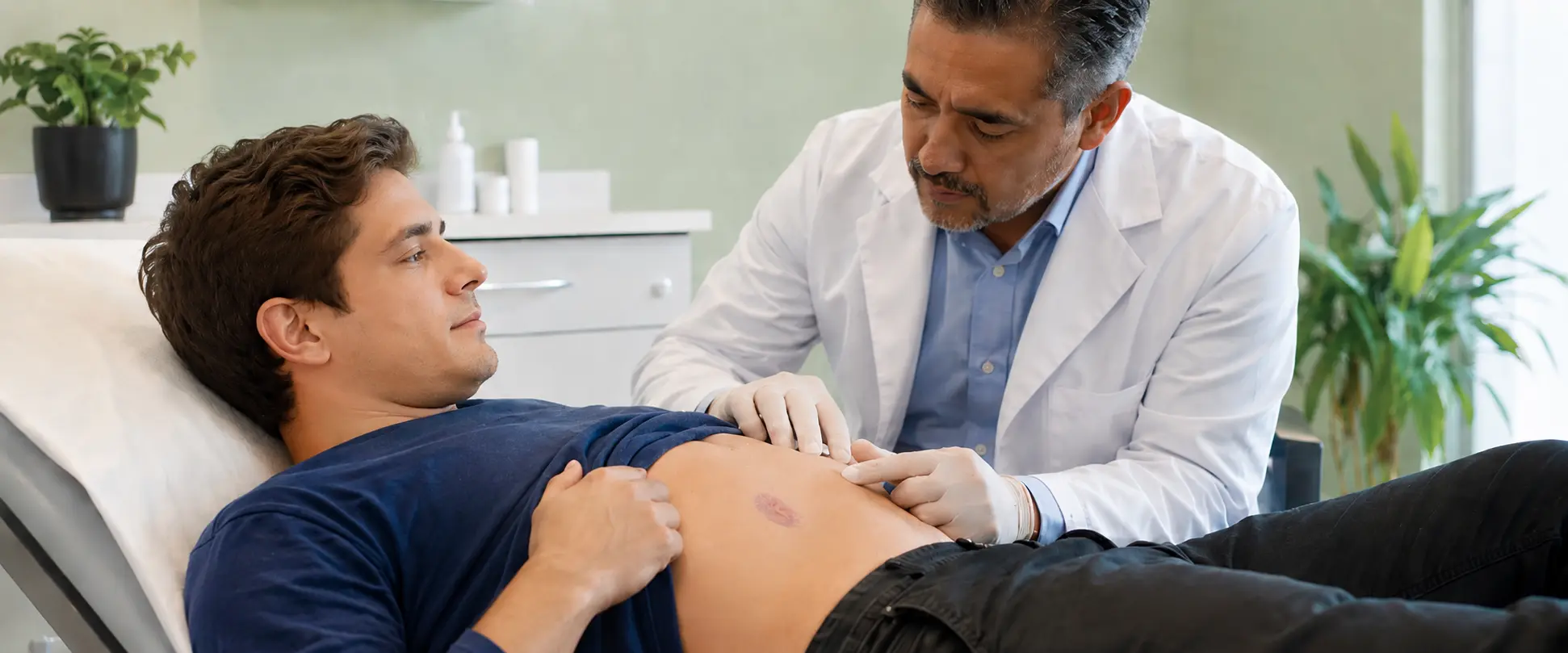
Dermatologists who treat localized scleroderma
A brief guide to recognizing hardened plaques on the skin and knowing when they require dermatological evaluation.
Before reading: En skinpaths We distinguish between opinion and evidence. To write this content, we prioritized indexed medical sources and recommendations from scientific societies. At the end, you will find the complete bibliography for your reference.
Important: This article is for informational purposes only and does not replace medical advice. If you have any questions, persistent symptoms, or your condition worsens, consult a healthcare professional.
Summary in 60 seconds
- La Morfea It is a form of localized scleroderma: produces inflammation, thickening and hardening of areas of the skin.
- It's not the same as the systemic sclerosis, which can affect internal organs.
- It usually starts as a reddish, purplish or bruise-like spot; later it may become hard, shiny, whitish or brown.
- It may cause itching, sensitivity, or mild pain, although some lesions are not bothersome.
- In some cases it affects deeper tissues, such as fat, muscle, joints or bone.
- In children, linear shapes can influence growth or movement if they cross joints.
- The treatment depends on the depth, extent, activity, and location.
- The realistic goal is slow down activity, reduce inflammation and prevent aftereffects, do not erase the skin immediately.
- Consult a dermatologist if the plaque grows, becomes painful, limits movement, appears on the face/scalp, or affects a child.
What is localized scleroderma or morphea?
Localized scleroderma , also called morphea , is an inflammatory skin disease in which excess collagen is produced, causing the affected area to become firmer or harder. It may be limited to the skin, but some deep subtypes can affect fat, fascia, muscle, or bone. Papara 2023
An important clarification: morphea is not the same as systemic sclerosis . In general, it does not cause fibrosis of internal organs, the typical changes in nail capillaries, or hardening of the fingers seen in systemic sclerosis; even so, a medical professional should make the correct diagnosis. Fett 2013
Why does it appear?
The exact cause is unknown. Evidence points to a combination of individual predisposition, immune activation, inflammation, and excessive collagen production. Onset has been described in some individuals following repetitive friction, trauma, injections, surgery, or radiotherapy, although this does not mean there is a single or predictable cause. DermNet 2023
It is not contagious and is not transmitted through contact. Some people with more severe forms may have a personal or family history of autoimmune diseases, but this does not allow us to predict with certainty who will develop it.
What does it look like and what symptoms does it cause?
Initially, it may appear as a pinkish, purplish, or bruise-like spot. Over time, the skin may become hard, shiny, smooth, whitish, or ivory , sometimes with a purplish border if the lesion is active. Later, it may leave brownish, lighter, or sunken areas due to atrophy. Papara 2023
It can cause itching, tightness, tenderness, or pain. If morphea crosses a joint, it can limit movement; if it appears on the face or scalp, especially in children, it requires more careful evaluation due to the risk of deep, ocular, dental, or neurological involvement in selected cases. Zulian 2019
What can you do today?
Monitor the lesion methodically: take a well-lit photograph every 3–4 weeks, measure its approximate diameter, and note if it grows, changes color, hardens, or becomes bothersome. Use a gentle moisturizer, avoid very hot baths, and reduce repeated friction on the area. Mayo Clinic recommends moisturizers and avoiding long, hot showers or baths because they can further dry out the skin. Mayo Clinic 2024
If the plaque is exposed to the sun, sun protection can help reduce color contrast and protect skin that is already inflamed or altered. The most important measure, however, is not to delay evaluation if there is growth, progressive hardening, or functional impairment.
What NOT to do?
Do not use strong corticosteroids for weeks or months without medical advice: they can thin the skin and mask changes that are useful for diagnosis. Do not try to break up the plaque with aggressive massage, cupping, acids, exfoliation, or intense heat. Also, do not assume it is "just a spot" if it grows or appears on the face, scalp, a child's limbs, or near a joint.
Morphea may improve over time, but it can also leave persistent changes in color, texture, or volume. Early treatment aims to prevent irreversible damage when the disease is active. AAD 2026
When to consult?
Consult a dermatologist if any of these signs appear:
- The stain or plaque it grows or new lesions appear.
- The skin becomes hard, shiny, sunken or taut.
- There is pain, intense itching, ulceration, or extreme sensitivity.
- It's in face, scalp, neck, genitals or near an eye.
- Cross a joint or limit movement of fingers, wrist, elbow, knee, ankle or jaw.
- It affects a child or adolescent.
- There is a difference in size between limbs, weakness, limping, or difficulty writing/walking.
- Fingers that change color in the cold, swelling of the hands, difficulty swallowing or shortness of breath appear; these data are not typical of simple morphea and require ruling out other diagnoses.
What does a dermatologist usually do?
The dermatologist usually begins with a medical history and a complete skin examination. They may photograph and measure the plaques to assess activity and progression. In cases of doubtful lesions, they may order a skin biopsy , ideally deep enough if involvement of tissues below the dermis is suspected. DermNet 2023
Depending on the case, dermatoscopy, ultrasound, magnetic resonance imaging, or blood tests may be used, especially if there are deep lesions, linear morphea, joint involvement, or a need for systemic treatment. Therapeutic options include topical treatments for limited and superficial forms, phototherapy in selected cases, and drugs such as methotrexate, systemic corticosteroids, or mycophenolate for more extensive, deep, or progressive forms ( Kreuter 2024 ; Knobler 2024 ).
FAQ
Is morphea contagious?
- No. Morphea is not contagious through skin-to-skin contact, sharing objects, or living with an affected person.
Is it the same as systemic sclerosis?
- No. They share the term "scleroderma," but they are distinct entities. Morphea is usually localized and cutaneous; systemic sclerosis can affect blood vessels and internal organs.
Is morphea curable?
- There is no single "cure" that guarantees complete disappearance. Some lesions become inactive over time, but changes in color, texture, or depression may persist. Treatment aims to slow activity and prevent further complications.
Do all plaques require strong treatment?
- No. Small, superficial, and stable forms can be managed with local treatments and follow-up. Deep, linear, extensive, progressive, or joint-related forms usually require a more active strategy.
Can it affect children?
- Yes. In children, it is especially important to assess linear morphea because it can affect growth, mobility, or deep structures. The American College of Rheumatology emphasizes the importance of monitoring inflammation and progression in the pediatric population.
Is a biopsy always necessary?
- Not always. Often the diagnosis is clinical. Biopsy is reserved for doubtful or atypical cases, or when it is necessary to confirm depth or rule out other diseases.
Bibliography and sources
- Papara C, De Luca DA, Bieber K, Vorobyev A, Ludwig RJ. Morphea: The 2023 update. Front Med (Lausanne). 2023;10:1108623. doi:10.3389/fmed.2023.1108623.
- Knobler R, Geroldinger-Simić M, Kreuter A, Hunzelmann N, Moinzadeh P, Rongioletti F, et al. Consensus statement on the diagnosis and treatment of sclerosing diseases of the skin, Part 1: Localized scleroderma, systemic sclerosis and overlap syndromes. J Eur Acad Dermatol Venereol. 2024;38(7):1251-1280. doi:10.1111/jdv.19912.
- Kreuter A, Moinzadeh P, Kinberger M, Horneff G, Worm M, Werner RN, et al. S2k guideline: Diagnosis and therapy of localized scleroderma. J Dtsch Dermatol Ges. 2024;22(4):605-620. doi:10.1111/ddg.15328.
- Zulian F, Culpo R, Sperotto F, Anton J, Avcin T, Baildam EM, et al. Consensus-based recommendations for the management of juvenile localized scleroderma. Ann Rheum Dis. 2019;78(8):1019-1024. doi:10.1136/annrheumdis-2018-214697.
- Albuquerque JV, Andriolo BN, Vasconcellos MR, Civile VT, Lyddiatt A, Trevisani VF. Interventions for morphea. Cochrane Database Syst Rev. 2019;7(7):CD005027. doi:10.1002/14651858.CD005027.pub5.
- Zwischenberger BA, Jacobe HT. A systematic review of morphea treatments and therapeutic algorithm. J Am Acad Dermatol. 2011;65(5):925-941. doi:10.1016/j.jaad.2010.09.006.
- Fett N, Werth VP. Update on morphea: Part II. Outcome measures and treatment. J Am Acad Dermatol. 2011;64(2):231-242. doi:10.1016/j.jaad.2010.05.046.
- Fett NM. Morphea (Localized Scleroderma). JAMA Dermatol. 2013;149(9):1124. doi:10.1001/jamadermatol.2013.5079.
- American Academy of Dermatology Association. Scleroderma: diagnosis and treatment [Internet].
- DermNet. Morphoea (localized scleroderma, morphea) [Internet].
- American College of Rheumatology. Localized Scleroderma (Juvenile) [Internet].
- National Scleroderma Foundation. Localized Scleroderma [Internet].

 |
|