

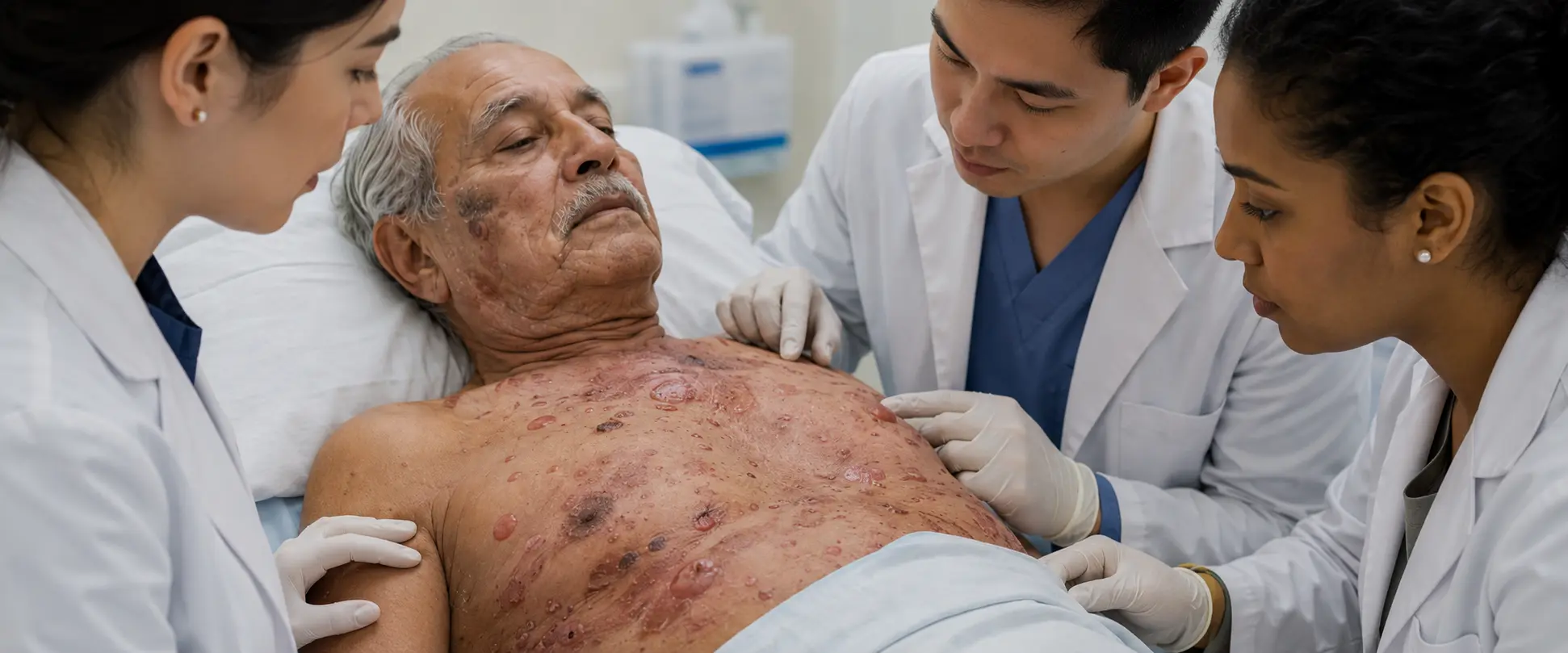
Dermatologists who treat flaccid blisters
A rare autoimmune disease that produces fragile blisters and painful erosions, especially in the mouth.
Before reading: En skinpaths We distinguish between opinion and evidence. To write this content, we prioritized indexed medical sources and recommendations from scientific societies. At the end, you will find the complete bibliography for your reference.
Important: This article is for informational purposes only and does not replace medical advice. If you have any questions, persistent symptoms, or your condition worsens, consult a healthcare professional.
Summary in 60 seconds
- Pemphigus vulgaris is a rare and potentially serious autoimmune blistering disease.
- It usually begins with painful erosions inside the mouth.
- It can also affect the skin, throat, genitals, nose, or eyes.
- Blisters are fragile and usually break before they can be observed in their entirety.
- It is not contagious and is not due to poor hygiene.
- Diagnosis usually requires biopsy, immunofluorescence, and antibody testing.
- Treatment may include corticosteroids, rituximab, and other immunosuppressants.
- Prolonged remissions are possible, although follow-up is needed for possible relapses and adverse effects.
What is pemphigus vulgaris?
Pemphigus vulgaris is a disease in which the immune system produces antibodies against proteins that hold together the cells of the skin and mucous membranes, mainly desmogleins 3 and 1. When this bond is lost —a phenomenon called acantholysis— superficial blisters appear that break easily and leave painful erosions.
It's not an infection, it's not contagious, and it can't be transmitted through physical contact, utensils, or saliva. Porro 2019
A persistent erosion inside the mouth is not always a canker sore: when it does not heal, it deserves evaluation.
Why does it appear?
There is usually no single identifiable cause. Evidence suggests a combination of genetic predisposition and alterations in the regulation of the immune system.
In susceptible individuals, certain medications, infections, physical trauma, or other stimuli may trigger or reactivate the disease. Many of these associations are based on isolated cases or observational studies and do not demonstrate causality. Therefore, no medication should be discontinued without medical evaluation. Moro 2023
What does it look like and what symptoms does it cause?
The most characteristic presentation is the appearance of painful and persistent erosions inside the mouth . These are sometimes initially misinterpreted as canker sores, fungal infections, or dental irritation.
Soft or flabby blisters that break quickly may appear on the skin. Therefore, many people directly notice moist, sensitive, crusty, or raw areas. These are common on the scalp, face, torso, and skin folds.
It can also produce:
- pain when eating, drinking, or brushing your teeth;
- difficulty or pain when swallowing;
- hoarseness;
- nasal or genital erosions;
- eye pain, redness, or discomfort;
- secondary wound infection.
The pain is usually more prominent than the itching. DermNet 2022
What can you do today?
Pemphigus vulgaris requires medical evaluation; home remedies are complementary and do not replace specialized medical control and treatment prescribed by a medical professional.
- Request a priority consultation if you have persistent blisters or erosions in your mouth or on your skin.
- Avoid rubbing, scratching, and activities that injure the skin.
- Clean the affected areas gently and use only the dressings indicated by the medical team.
- If oral lesions are present, prioritize soft, lukewarm, and low-acid foods.
- Maintain adequate hydration and careful oral hygiene, without rubbing the erosions.
- Bring a complete list of medications, supplements, and recent treatments to your appointment.
- Comply with the tests and controls indicated during immunosuppressive treatment. NIAMS 2024
What NOT to do?
- Do not pop, cut, or remove the skin from the blisters.
- Do not apply alcohol, hydrogen peroxide, acids, essential oils, or other irritating substances.
- Do not start oral corticosteroids, antibiotics, or immunosuppressants on your own.
- Do not abruptly stop a prescribed treatment.
- Do not eliminate entire food groups based solely on unverified information.
- Do not ignore an oral erosion that persists, spreads, or prevents eating.
Inappropriate treatment can delay diagnosis, promote infections, or cause significant adverse effects; therefore, medical assessment and follow-up are essential. NIAMS 2024
When to consult?
Any suspicion of pemphigus vulgaris warrants medical evaluation without unnecessary delay.
Seek urgent medical attention if any of these signs appear:
- fever, chills, or general deterioration;
- pus, foul odor, increased redness or pain;
- rapid spread of erosion;
- inability to eat or drink;
- scanty urine, dizziness, or signs of dehydration;
- difficulty breathing or swallowing;
- hoarseness of recent or progressive onset;
- eye pain, red eye, or changes in vision;
- symptoms of infection while receiving corticosteroids, rituximab, or another immunosuppressant.
Extensive erosions can lead to infection, fluid loss, and nutritional difficulties, and may occasionally require hospitalization. NIAMS 2024
What does a dermatologist usually do?
The dermatologist examines the skin and all affected mucous membranes, assesses the extent of the disease, and considers other diagnoses, such as mucosal pemphigoid, erosive lichen planus, drug reactions, or certain infections.
Typically, two different samples are obtained:
- A biopsy of the edge of a recent blister to study the structure of the skin.
- A skin or mucosal biopsy near the lesion to direct immunofluorescence, a fundamental test to demonstrate the deposition of antibodies.
Blood tests can measure antibodies against desmoglein 1 and 3. Dermatoscopy is not usually the definitive test for this disease. Murrell 2020
Treatment is tailored to the location, extent, severity, age, and comorbidities of the lesion. It may include local care, corticosteroids, and medications to reduce immune activity. In moderate to severe pemphigus vulgaris, guidelines consider rituximab , usually combined with a limited course of corticosteroids, a first-line option. Azathioprine or mycophenolate may be used in certain settings. Safety testing and infection surveillance are required before and during these treatments. Joly 2020
Controlling the disease and reducing treatment toxicity are inseparable goals
FAQ
Is pemphigus vulgaris contagious?
- No. It is an autoimmune disease and is not transmitted between people.
Do you have a cure?
- Currently, a definitive cure is not possible for all patients. However, treatment can control the disease and achieve prolonged remissions, sometimes without medication for certain periods.
Can it only affect the mouth?
- Yes. Some people have lesions exclusively on the oral mucosa for months before developing skin lesions; others maintain a predominantly mucosal form.
Do the injuries leave scars?
- Superficial erosions usually heal without permanent scarring. They may leave temporary discoloration, and infection or significant trauma can disrupt healing.
Does stress or diet cause it?
- Stress has been suggested as a possible trigger, but it is not a proven sole cause. Acidic, spicy, hard, or very hot foods can increase oral pain, although they do not, on their own, explain the condition.
How long does treatment take?
- It varies. Some people need treatment for months, and others for several years. Doses are gradually reduced depending on the response, antibody levels, relapses, and side effects.
Can I receive vaccines during treatment?
- It depends on the medication and the type of vaccine. Planning should be done with a dermatologist before starting rituximab or other immunosuppressants; some live vaccines may be contraindicated during certain treatments. NIAMS 2024 , DermNet 2022
Bibliography and sources
- Murrell DF, Peña S, Joly P, Marinovic B, Hashimoto T, Diaz LA, et al. Diagnosis and management of pemphigus: recommendations of an international panel of experts. J Am Acad Dermatol. 2020;82(3):575-585.e1. doi:10.1016/j.jaad.2018.02.021.
- Joly P, Horvath B, Patsatsi A, Uzun S, Bech R, Beissert S, et al. Updated S2K guidelines on the management of pemphigus vulgaris and foliaceus initiated by the European Academy of Dermatology and Venereology. J Eur Acad Dermatol Venereol. 2020;34(9):1900-1913. doi:10.1111/jdv.16752.
- Harman KE, Brown D, Exton LS, Groves RW, Hampton PJ, Mohd Mustapa MF, et al. British Association of Dermatologists' guidelines for the management of pemphigus vulgaris 2017. Br J Dermatol. 2017;177(5):1170-1201. doi:10.1111/bjd.15930.
- Joly P, Maho-Vaillant M, Prost-Squarcioni C, Hébert V, Houivet E, Calbo S, et al. First-line rituximab combined with short-term prednisone versus prednisone alone for the treatment of pemphigus: the Ritux 3 trial. Lancet. 2017;389(10083):2031-2040. doi:10.1016/S0140-6736(17)30070-3.
- Werth VP, Joly P, Mimouni D, Maverakis E, Caux F, Lehane P, et al. Rituximab versus mycophenolate mofetil in patients with pemphigus vulgaris. N Engl J Med. 2021;384(24):2295-2305. doi:10.1056/NEJMoa2028564.
- De D, Mehta H, Shah S, Ajithkumar K, Barua S, Chandrashekar L, et al. Consensus based Indian guidelines for the management of pemphigus vulgaris and pemphigus foliaceous. Indian Dermatol Online J. 2025;16(1):3-24. doi:10.4103/idoj.idoj_1059_24.
- Porro AM, Seque CA, Ferreira MCC, Enokihara MMSS. Pemphigus vulgaris. An Bras Dermatol. 2019;94(3):264-278. doi:10.1590/abd1806-4841.20199011.
- Moro F, Sinagra JLM, Salemme A, Fania L, Mariotti F, Pira A, et al. Pemphigus: trigger and predisposing factors. Front Med (Lausanne). 2023;10:1326359. doi:10.3389/fmed.2023.1326359.
- National Institute of Arthritis and Musculoskeletal and Skin Diseases. Pemphigus: diagnosis, treatment, and steps to take [Internet]. Bethesda (MD): NIAMS; 2024 [cited Jul 20, 2026].
- DermNet New Zealand Trust. Pemphigus vulgaris [Internet]. Auckland: DermNet; 2022 [cited Jul 20, 2026].

 |
|