
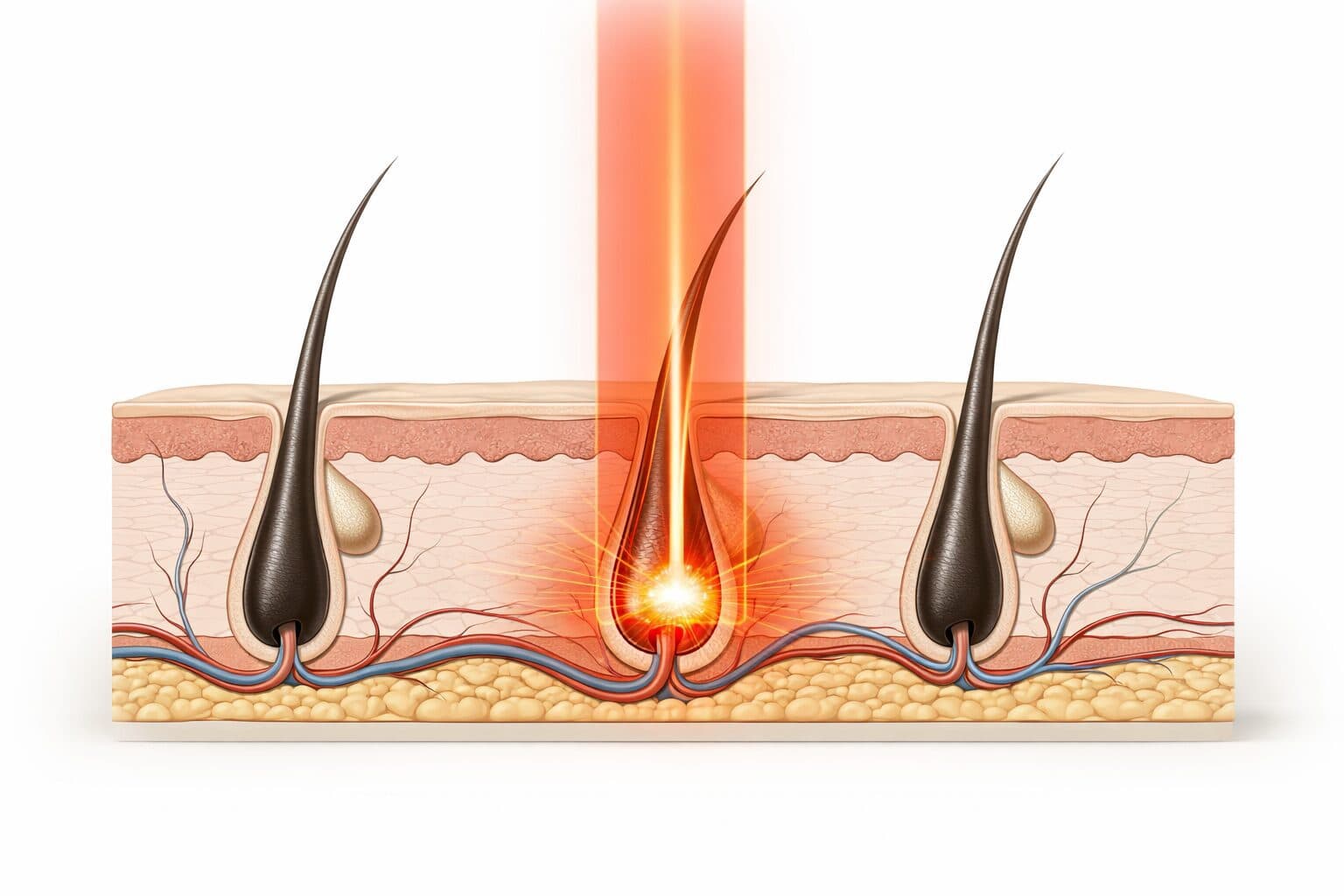
We explain how laser hair removal works, why it requires several sessions, what results to expect, and what risks you should be aware of.
Before you read: At Skinpaths, we distinguish between opinion and evidence. To write this content, we prioritized indexed medical sources and recommendations from scientific societies. You’ll find the complete bibliography at the end for your reference.
Important: This article is for informational purposes only and does not replace medical advice. If you have any questions, persistent symptoms, or your condition worsens, consult a healthcare professional.
Summary in 60 seconds
- Laser hair removal does not «pull out» the hair: it directs light energy towards the melanin in the hair, this energy is transformed into heat and selectively damages the follicle to reduce its ability to produce terminal hair.
- That’s why it usually works better when the hair has more pigment, and that’s also why it needs several sessions: not all follicles are in the same growth phase at the same time.
- The realistic goal is not to promise complete hair removal for life, but a lasting and clinically significant reduction, with the possibility of maintenance sessions for some individuals. Gan 2013 Vaidya 2023 Krasniqi 2022
What is laser hair removal?
It is a medical procedure for the long-term reduction of unwanted hair using light devices that selectively target the hair follicle. Lasers such as alexandrite, diode, and Nd:YAG are frequently used in clinics; it is also often mentioned alongside intense pulsed light (IPL), although technically IPL is not a laser, but rather a polychromatic light source with filters. Gan 2013 Gade 2024
It is used to reduce terminal hair in areas such as the face, armpits, groin, legs, chest, back, or neck. It can also be helpful when hair causes repeated discomfort during shaving.
It’s important to understand that the response will depend on the area treated, hair color and thickness, skin phototype, and hormonal factors; therefore, some people require more sessions or periodic touch-ups than others. AAD 2021 Vaidya 2023
How does it work?
The key idea is selective photothermolysis . Simply put: dark hair acts like an “antenna” that captures light; this light is converted into heat, and the heat damages structures within the hair follicle. The target is the melanin in the hair, not the skin. This is why the technical balance is so important: enough energy must be delivered to affect the follicle, but without overdoing it and damaging the surrounding skin. Gan 2013 Vaidya 2023
A helpful analogy is to think of a series of light bulbs that are on and off. The laser works best when the follicle is in the anagen phase, that is, in active growth. Since not all hairs are «on» at the same time, a single session is not enough: several sessions are scheduled to target different follicles when they are most sensitive. Vaidya 2023 Lask 1997
In darker skin tones, the procedure can be performed, but it requires greater care because the melanin in the epidermis also competes for energy absorption. In practical terms, this necessitates careful selection of the device, wavelength, cooling system, and parameters. Available literature suggests that, with appropriate protocols, hair reduction in skin phototypes III-VI is feasible and reasonably safe. Dorgham 2020 Fayne 2018
What can we expect from this procedure?
Before: The important thing is not just to «go and get it over with,» but a proper assessment of skin type, hair type, and relevant medical history. On the day of the procedure, the area is usually cleaned; topical anesthetic may be used in small and sensitive areas, and everyone present during the session must wear eye protection. AAD
During: Many people describe the sensation as warm pricks or like a rubber band snapping against the skin. An occasional smell of sulfur or «burnt hair» may occur because some of the hair is vaporized. AAD
Afterward: The most common symptoms are redness and some swelling similar to a mild sunburn, with a quick return to daily activities. Results vary from patient to patient: an initial reduction may be seen after one session, but treatment is usually organized into several sessions spaced weeks apart, and sometimes with subsequent maintenance. AAD, Vaidya 2023
Aftercare
After the session, the priority is to protect the skin from the sun. It is recommended to avoid direct sun exposure on the treated area, not to use tanning beds or tanning lamps, and to follow the individual instructions of the treating professional. If there is discomfort, a cold compress can provide relief. AAD
Expected vs. unexpected effects
Expected side effects: mild discomfort, redness, perifollicular swelling, and transient tenderness for 1 to 3 days. AAD Vaidya 2023
Unexpected or re-evaluating reactions include: blisters, prominent scabs, infection, scarring, noticeable changes in skin color, eye injury, or paradoxical hair growth around the treated area. This last effect is rare but has been described, particularly on the face and neck, and is more likely in certain skin types and hormonal contexts. Desai 2010 Vaidya 2023
Warning signs (emergency)
Seek medical evaluation without delay if you experience severe, persistent pain, extensive blistering, discharge, progressive crusting, marked changes in skin color, or any eye symptoms. These are uncommon occurrences, but should not be considered normal as «part of the process.» AAD Vaidya 2023
Frequently Asked Questions
Does laser hair removal eliminate hair permanently?
- The most accurate term is permanent hair loss. Many people experience significantly less hair for months or years, but regrowth is possible, and some may require maintenance. Krasniqi 2022 AAD
How many sessions are usually needed?
- It varies depending on the area, hair type, skin type, and hormonal context, but it usually requires several sessions, often around 4 to 6 or more, spaced weeks apart. Vaidya 2023 AAD 2021
Hurts?
- It may be uncomfortable, but the sensation is usually described as warmth, a brief prick, or a rubber band snap. The intensity depends on the area, the device, and individual sensitivity. AAD
Does it work on brown or dark skin?
- Yes, but not with the same technical margin as with fair skin. It requires careful selection of the device and appropriate parameters to minimize the risk of burns or dyschromia. Dorgham 2020 Fayne 2018
Does it work the same on all hair types?
- No. It responds better when the hair has sufficient melanin, which is why dark hair is usually a better target than very light, white, or low-pigment hair. Vaidya 2023 AAD
Is it the same as IPL?
- Not exactly. IPL can also reduce hair, but it emits filtered polychromatic light, not a monochromatic laser beam. In everyday conversation, they are often grouped together, although technically they are different technologies. Gade 2024 Gan 2013
Bibliography and sources
- Gan SD, Graber EM. Laser hair removal: a review . Dermatol Surg. 2013;39(6):823-838. doi:10.1111/dsu.12116. PubMed
- Krasniqi A, McClurg DP, Gillespie KJ, Rajpara S. Efficacy of lasers and light sources in long-term hair reduction: a systematic review . J Cosmet Laser Ther. 2022;24(1-5):1-8. doi:10.1080/14764172.2022.2075899. PubMed
- Dorgham NA, Dorgham DA. Lasers for reduction of unwanted hair in skin of color: a systematic review and meta-analysis . J Eur Acad Dermatol Venereol. 2020;34(5):948-955. doi:10.1111/jdv.15995. PubMed
- Vaidya T, Hohman MH, Kumar DD. Laser Hair Removal . In: StatPearls [Internet] . Treasure Island (FL): StatPearls Publishing; updated July 25, 2023. NCBI Bookshelf
- Fayne RA, Perper M, Eber AE, Aldahan AS, Nouri K. Laser and Light Treatments for Hair Reduction in Fitzpatrick Skin Types IV-VI: A Comprehensive Review of the Literature . Am J Clin Dermatol. 2018;19(2):237-252. doi:10.1007/s40257-017-0316-7. PubMed
- Desai S, Mahmoud BH, Bhatia AC, Hamzavi IH. Paradoxical hypertrichosis after laser therapy: a review . Dermatol Surg. 2010;36(3):291-298. doi:10.1111/j.1524-4725.2009.01433.x. PubMed
- Lask G, Elman M, Slatkine M, Waldman A, Rozenberg Z. Laser-assisted hair removal by selective photothermolysis. Preliminary results . Dermatol Surg. 1997;23(9):737-739. PubMed
- Gade A, Vasile GF, Hohman MH, Rubenstein R. Intense Pulsed Light (IPL) Therapy . In: StatPearls [Internet] . Treasure Island (FL): StatPearls Publishing; updated March 1, 2024. NCBI Bookshelf
- American Academy of Dermatology. Laser hair removal: Overview . 2021. Official site
- American Academy of Dermatology. Laser hair removal: FAQs . Date not visible on the viewed page. Official website
- American Society for Dermatologic Surgery. Hair Removal . Date not visible on the page viewed. Official website
- American Society for Laser Medicine and Surgery. Laser Hair Removal . Date not visible on the page viewed. Official website
Categories: For everyone

Content reviewed by
Dr. Rodolfo Suárez
Médico Patólogo y Dermatólogo Master en Patología Cutánea Avanzada
- Published
- September 18, 2026
- Updated
- September 23, 2026
Medically reviewed by specialists
Our content is based on current scientific evidence and clinical protocols.