

Identifying your skin type shouldn’t depend on a viral test or an impulse purchase. This guide helps you observe your skin thoughtfully, recognize common signs, and choose a safer, simpler, and more realistic routine.
Before you read: At Skinpaths, we distinguish between opinion and evidence. To write this content, we prioritized indexed medical sources and recommendations from scientific societies. You’ll find the complete bibliography at the end for your reference.
Important: This article is for informational purposes only and does not replace medical advice. If you have any questions, persistent symptoms, or your condition worsens, consult a healthcare professional.
Summary in 60 seconds
- Your “skin type” mainly describes how your skin behaves under normal conditions: whether it produces more oil, whether it dries out easily, whether it combines oily and dry areas, or whether it reacts with burning, itching, or redness to common products.
- Generally, we talk about normal, dry, oily, combination, and sensitive skin. But this isn’t a fixed label for life: it can change with age, climate, hormones, medications, pregnancy, stress, skin conditions, or an overly aggressive skincare routine.
- A practical way to determine your skin type is to observe your clean face for a few hours, without applying any products, provided your skin is stable. If you feel tightness, flaking, or roughness, it tends to be dry. If you experience general shine, visible pores, and an oily feeling, it tends to be oily. If your T-zone is shiny but your cheeks feel normal or dry, it tends to be combination. If it burns, itches, or is easily irritated, you may have sensitive skin.
- The goal isn’t to fit perfectly into a category, but to choose products your skin tolerates: a gentle cleanser, a suitable moisturizer, and daily sun protection. Dermatological guidelines recommend a basic routine focused on gentle cleansing, moisturizing, and sun protection, tailored to individual tolerance. AAD 2026
What are skin types and why do they matter?
Skin type is a practical way to describe the balance between oil, moisture, tolerance, and skin barrier integrity. It’s not a medical diagnosis on its own, but it can help you avoid mistakes: using overly heavy products if you have oily skin, exfoliating already irritated skin, or skipping moisturizer because «oily skin doesn’t need it.»
The skin also has a barrier: an outer layer that helps retain water and protect against irritants. When this barrier is compromised, tightness, burning, itching, flaking, or sensitivity can occur. That’s why skin can be oily and, at the same time, dehydrated or irritated.
Furthermore, it is important to separate two concepts that are often confused:
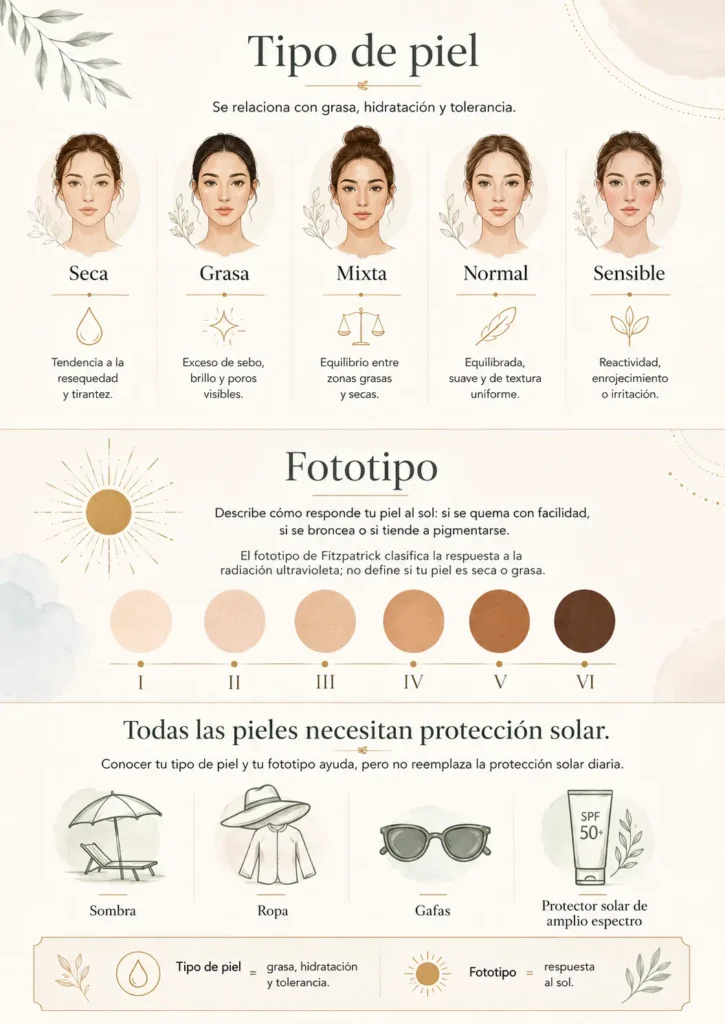
- Skin type : dry, oily, combination, normal, or sensitive. This relates to oiliness, hydration, and tolerance.
- Phototype : describes how your skin responds to the sun: whether it burns easily, tans, or tends to pigment. The Fitzpatrick phototype is used to classify the response to ultraviolet radiation, not to determine if your skin is dry or oily. Oakley 2012
Knowing both helps, but it doesn’t replace the basic rule: all skin types need adequate sun protection. Sun protection should combine shade, clothing, sunglasses, and broad-spectrum sunscreen, not rely on just one cream. CDC 2026
How does it work? A simple, uncomplicated explanation
The skin changes according to four main factors.
- First: sebum production. Sebum is a mixture of lipids produced by the sebaceous glands. In appropriate amounts, it helps protect the skin; in excess, it can contribute to shine, visible pores, and acne breakouts. Oily skin is not “dirty” or necessarily “poorly cared for”; it has a different biology and requires balance, not aggression. The American Academy of Dermatology warns that over-washing or scrubbing can irritate oily skin and worsen its appearance. AAD 2026
- Second: hydration. Dry skin tends to lose water easily or have a less efficient barrier. It may feel rough, tight, or flaky. Proper hydration not only “softens” the skin; it also helps maintain the barrier function. Humectants, emollients, and occlusives perform different functions: attracting water, smoothing the surface, or reducing water loss. Purnamawati 2017
- Third: distribution. Many people don’t have the same oily skin all over their face. The T-zone—forehead, nose, and chin—tends to produce more oil, while the cheeks can be normal or dry. This explains combination skin.
- Fourth : reactivity. Sensitive skin is characterized by sensations such as burning, stinging, tightness, pain, itching, or redness in response to stimuli that other people tolerate. It doesn’t always mean an allergy. It can be related to an altered skin barrier, inflammation, rosacea, contact dermatitis, eczema, climate, irritating products, or overuse of active ingredients. Wollenberg 2022
How to identify your skin type at home
Do it when your skin is relatively stable. It’s not ideal to do it during a sunburn, a severe acne breakout, an allergic reaction, retinoid peeling, or after exfoliating.
Wash your face with a gentle cleanser. Pat dry. Do not apply toner, serum, cream, oil, or makeup. Wait two to three hours in your usual environment. Then observe and feel your skin.
If your face feels comfortable, without excessive shine, tightness, or irritation, you probably have normal skin. However, «normal» doesn’t mean invulnerable: it can also become irritated by too many active ingredients or sun exposure.
If you experience tightness, roughness, fine flaking, a pulling sensation, or more visible fine lines when you make facial expressions, you likely have dry skin. In this case, creams tend to work better than very light lotions, and moisturizing after washing is especially important. The AAD recommends applying moisturizer while your skin is still slightly damp and using gentle cleansers to help control dryness. AAD 2026
If you notice shine across most of your face, an oily feel to the touch, more visible pores, and a tendency towards blackheads or breakouts, you probably have oily skin. This doesn’t mean you should aggressively «dry» it out. The goal is to cleanse without irritating, moisturize with lightweight textures if needed, and use non-comedogenic products.
If your forehead, nose, and chin are shiny, but your cheeks feel normal, dry, or tight, you probably have combination skin. In this case, you don’t need to use the same amount of the same cream all over your face. You can use a lighter texture on your T-zone and increase hydration on your cheeks.
If your skin burns, itches, reddens, feels hot, or becomes irritated by common products, fragrances, exfoliants, temperature changes, or after washing, it may be sensitive or sensitized. The difference is important: a person may have a naturally sensitive skin tendency, but they can also sensitize their skin through over-exfoliation, improper application of retinoids, overuse of acids, or harsh cleansers.
For all skin types, sunscreen is part of a preventative routine. Choose a broad-spectrum sunscreen that’s comfortable to wear and appropriate for your needs. The British Association of Dermatologists recommends SPF 30 or higher and good UVA protection; also remember that the best sunscreen is the one you’re willing to use consistently. BAD 2024
Common mistakes
- The first mistake is confusing oily skin with hydrated skin. Oil and water are not the same. Skin can look shiny and, at the same time, feel tight or irritated. In that case, it may be dehydrated or have a compromised skin barrier.
- The second mistake is thinking that dry skin can be fixed by exfoliating. If flaking is due to dryness, exfoliating more frequently can actually worsen the skin barrier. It’s usually wiser to reduce irritants and increase hydration.
- The third mistake is using too many active ingredients at the same time. Retinoids, exfoliating acids, benzoyl peroxide, acidic vitamin C, and astringent toners can be helpful in some cases, but combining them without adjusting the formula increases the risk of irritation.
- The fourth mistake is buying products just because they say «for your skin type.» The label helps, but it doesn’t guarantee tolerance. Your skin dictates: if it burns, itches, flakes, or gets worse, you need to adjust your routine.
- The fifth mistake is believing that skin type is defined only once. Skin can change due to climate, age, menstrual cycle, pregnancy, menopause, medications, acne, rosacea, eczema, dermatological treatments, or changes in routine.
- The sixth mistake is thinking that darker skin doesn’t need sun protection. While it may burn less in some cases, it can also develop sunspots, sun damage, and skin cancer. Sun protection should be individualized, but it should never be omitted. Passeron 2021
Myths vs. Facts
Myth: If I have oily skin, I shouldn’t use moisturizer.
Fact: Some oily skin types tolerate light gels or lotions better, and others don’t need moisturizer in all areas. But if there’s tightness, irritation, or acne treatment, proper hydration can improve tolerance.
Myth: If a product burns, it means it’s working.
Fact: A mild tingling sensation may occur with some active ingredients, but intense burning, pain, persistent redness, or marked peeling are signs of irritation.
Myth: Sensitive skin is always allergic.
Fact: Sensitivity can have many causes. It can be irritation, a compromised skin barrier, rosacea, contact dermatitis, eczema, or another condition.
Myth: Natural is better for sensitive skin.
Fact: Natural does not equal harmless. Fragrances, essential oils, and plant extracts can also cause irritation.
Myth: My skin type is defined by how I wake up one day.
Fact: It’s best to observe patterns over several weeks, especially if you’ve changed products, weather, medications, or routine.
Myth: Phototype and skin type are the same thing.
Fact: Phototype describes the response to the sun; skin type describes oiliness, hydration, and tolerance. These are different things.
Frequently Asked Questions
How can I tell if my skin is dry or dehydrated?
- Dry skin typically produces less lipids or retains moisture less effectively; it can feel rough, tight, and flake easily. Dehydrated skin lacks water and can occur even in oily skin. A clue: if you have shine but also tightness, there may be dehydration or barrier irritation.
Does oily skin need cream?
- You don’t always need a heavy cream, but you might need hydration. Many oily skin types tolerate gels, light lotions, or non-comedogenic products better. If you use acne treatments, hydration can help reduce irritation.
Is sensitive skin a skin type?
- It can be considered a skin tendency, but it can also be a temporary condition. Skin can become sensitive due to over-exfoliation, excessive use of active ingredients, cold weather, procedures, contact dermatitis, rosacea, or eczema.
How often can my skin type change?
- There’s no exact rule. It can change with seasons, age, hormones, pregnancy, menopause, medications, dermatological treatments, stress, humidity, and changes in routine. That’s why it’s best to observe patterns, not just one single day.
How do I know if I have combination skin?
- There’s often shine or an oily feeling on the forehead, nose, and chin, while the cheeks feel normal or dry. The key is not to treat the entire face the same way: some areas need more hydration and others less.
Can I have oily and sensitive skin at the same time?
- Yes. Oily skin can also become irritated. In fact, some «oil control» routines are too harsh and end up disrupting the skin barrier, causing burning, tightness, and other discomfort.
What do I do if I can’t identify my skin type?
- Go back to basics for two weeks: gentle cleanser, simple moisturizer as tolerated, and sunscreen. Stop using any non-essential irritants. If burning, flaking, persistent acne, redness, or itching still occurs, consult a doctor.
Bibliography and sources
- American Academy of Dermatology Association. Skin care basics [Internet] . Rosemont: AAD; 2026 [citado 2026 Jul 2] . Available at: https://www.aad.org/public/everyday-care/skin-care-basics
- American Academy of Dermatology Association. Dermatologists’ top tips for relieving dry skin [Internet] . Rosemont: AAD; 2026 [citado 2026 Jul 2] . Available at: https://www.aad.org/public/everyday-care/skin-care-basics/dry/dermatologists-tips-relieve-dry-skin
- American Academy of Dermatology Association. How to control oily skin [Internet] . Rosemont: AAD; 2026 [citado 2026 Jul 2] . Available at: https://www.aad.org/public/everyday-care/skin-care-basics/dry/oily-skin
- American Academy of Dermatology Association. How to pick the right moisturizer for your skin [Internet] . Rosemont: AAD; 2022 [citado 2026 Jul 2] . Available at: https://www.aad.org/public/everyday-care/skin-care-basics/dry/pick-moisturizer
- Oakley A. Fitzpatrick skin phototype [Internet] . DermNet NZ; 2012 [actualizado 2023; citado 2026 Jul 2] . Available at: https://dermnetnz.org/topics/skin-phototype
- British Association of Dermatologists. Sun Protection Fact Sheet [Internet] . London: BAD Patient Hub; 2024 [citado 2026 Jul 2] . Available at: https://www.skinhealthinfo.org.uk/sun-awareness/the-sunscreen-fact-sheet/
- Centers for Disease Control and Prevention. Sun Safety Facts [Internet] . Atlanta: CDC; 2026 [citado 2026 Jul 2] . Available at: https://www.cdc.gov/skin-cancer/sun-safety/index.html
- Purnamawati S, Indrastuti N, Danarti R, Saefudin T. The role of moisturizers in addressing various kinds of dermatitis: a review. Clin Med Res. 2017;15(3-4):75-87. Available at: https://pmc.ncbi.nlm.nih.gov/articles/PMC5849435/
- Farage MA. The prevalence of sensitive skin. Front Med (Lausanne). 2019;6:98. Available at: https://pmc.ncbi.nlm.nih.gov/articles/PMC6533878/
- Endly DC, Miller RA. Oily skin: a review of treatment options. J Clin Aesthet Dermatol. 2017;10(8):49-55. Available at: https://pmc.ncbi.nlm.nih.gov/articles/PMC5605215/
- Wollenberg A, et al. Sensitive skin: a relevant syndrome, be aware. J Eur Acad Dermatol Venereol. 2022;36 Suppl 5:3-6. Available at: https://pubmed.ncbi.nlm.nih.gov/35315153/
- Passeron T, Lim HW, Goh CL, Kang HY, Ly F, Morita A, et al. Photoprotection according to skin phototype and dermatoses: practical recommendations from an expert panel. J Eur Acad Dermatol Venereol. 2021;35(7):1460-1469. Available at: https://pmc.ncbi.nlm.nih.gov/articles/PMC8252523/
Categories: For everyone

Content reviewed by
Dr. Rodolfo Suárez
Médico Patólogo y Dermatólogo Master en Patología Cutánea Avanzada
- Published
- September 18, 2026
- Updated
- September 23, 2026
Medically reviewed by specialists
Our content is based on current scientific evidence and clinical protocols.