
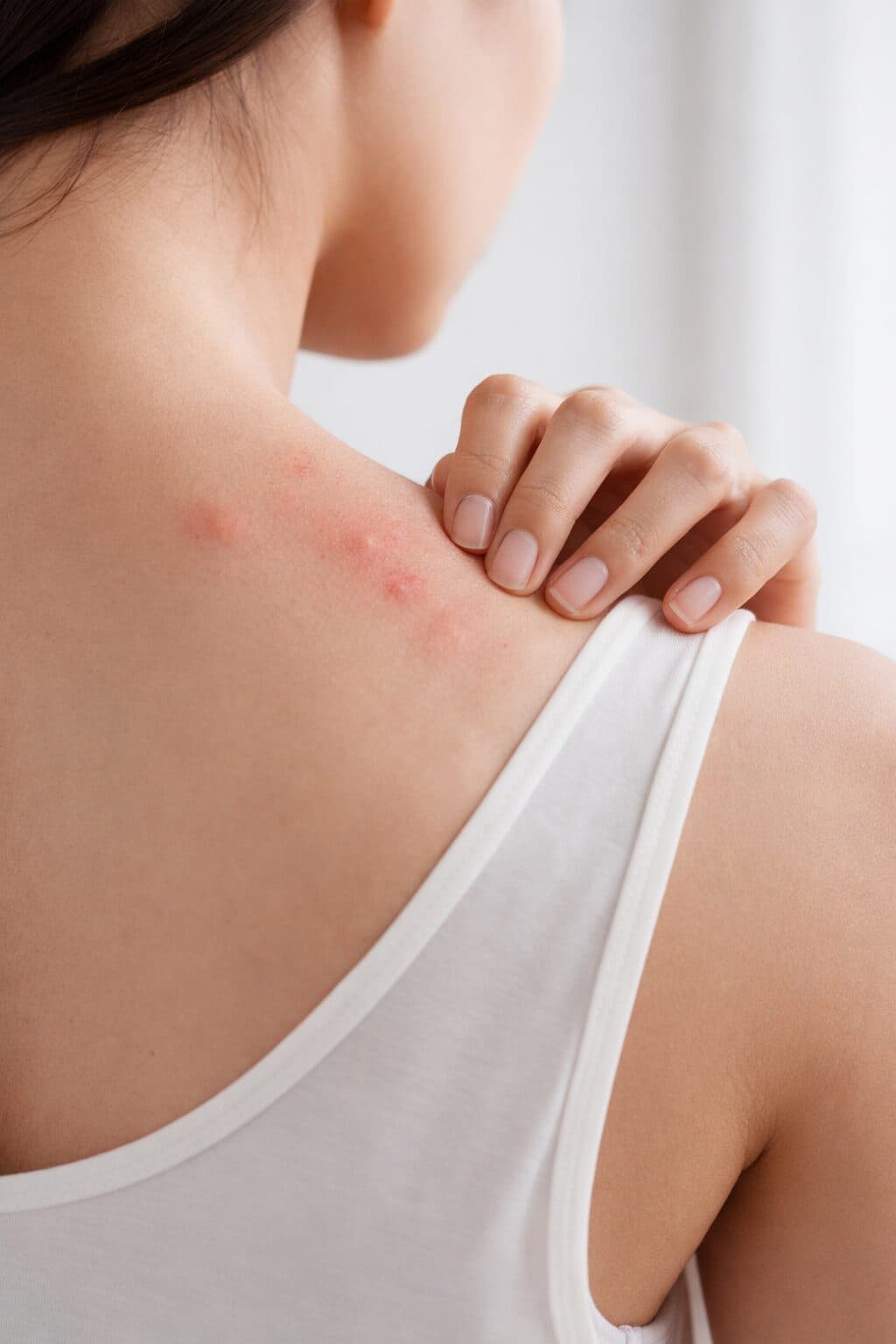
A clear guide to understanding why hives appear, what is usually behind them, and when it is advisable to consult a doctor.
Before you read: At Skinpaths, we distinguish between opinion and evidence. To write this content, we prioritized indexed medical sources and recommendations from scientific societies. You’ll find the complete bibliography at the end for your reference.
Important: This article is for informational purposes only and does not replace medical advice. If you have any questions, persistent symptoms, or your condition worsens, consult a healthcare professional.
Summary in 60 seconds
- Urticaria is a skin reaction that produces hives or welts that are usually very itchy.
- It can appear acutely, lasting for hours or days, or become chronic if it lasts more than 6 weeks.
- It doesn’t always mean an allergy. In chronic urticaria, a single trigger is often not identified.
- Some common causes are infections, medications, food, heat, cold, pressure, exercise, or stress.
- The injuries usually change location, shape, and size, and each one disappears without leaving a mark.
- Sometimes it is accompanied by angioedema: deeper swelling in the lips, eyelids or tongue.
- Treatment usually begins with second-generation antihistamines, as prescribed by a doctor.
- You should consult a specialist if it lasts for weeks, recurs frequently, leaves bruises, or is accompanied by difficulty breathing.
- When there is swelling of the tongue or throat, choking, dizziness or fainting, it is a medical emergency.
What is urticaria?
Urticaria is an inflammatory skin condition characterized by raised, itchy, and ever-changing wheals or hives; it can occur alone or be accompanied by angioedema, which is deeper swelling. For practical purposes, it is classified as acute when it lasts less than 6 weeks and chronic when it lasts longer. (Zuberbier 2022 ; Ben-Shoshan 2024)
Why does it appear?
The honest answer is this: the causes are varied. In acute urticaria, the most common triggers are infections, medications, and, in some cases, foods. It can also worsen with heat, cold, pressure on the skin, exercise, or stress. In chronic spontaneous urticaria, on the other hand, a single, demonstrable cause is often not found, which does not mean that the problem “isn’t real,” but rather that its mechanism is usually more complex than a simple allergy. Ben-Shoshan 2024 ; Friedman 2024 ; Powell 2015
An important distinction for the general public: saying “I have urticaria” does not automatically mean “I have an allergy.” Sometimes there is an allergic reaction; other times there isn’t. This should be evaluated based on medical history, context, and evolution, not just on intuition. Schoepke 2013 ; Ben-Shoshan 2024
What does it look like and what symptoms does it cause?
It typically appears as raised, pink, reddish, or skin-colored welts of varying sizes, appearing in one or more areas, changing shape, and often migrating. Intense itching is typical, although some people report stinging or burning. Each individual lesion usually disappears in less than 24 hours and should not leave a bruise or persistent mark. Ben-Shoshan 2024 ; Matos 2022
When swelling also occurs in the lips, eyelids, hands, feet, or tongue, it is called angioedema. This swelling can last longer than the superficial hive and requires urgent medical attention if it affects the mouth, throat, or breathing. Ben-Shoshan 2024 ; Golden 2024
What can you do today?
If the lesions are mild and there are no alarming symptoms, the sensible approach is to observe the pattern: when they appear, how long each outbreak lasts, and whether they coincide with a new medication, a recent infection, heat, exercise, pressure from clothing, or a particular food. A notebook or a simple log on your mobile phone can be much more helpful than trying to remember the following week by heart. Schoepke 2013 ; Friedman 2024
In practice, it usually helps to avoid excessive heat, very hot baths, tight clothing, intense scratching, and, if you’ve already noticed a clear correlation, the triggers that worsen your outbreaks. Second-generation antihistamines are the first-line treatment, but the choice and dosage should be individualized with a healthcare professional, especially if the episodes are recurrent. Zuberbier 2022 ; Kolkhir 2024
What NOT to do?
Don’t assume that all cases of urticaria require a battery of tests or allergy screenings. In many cases, especially in uncomplicated acute urticaria, the diagnosis is clinical, and extensive testing is not helpful. Schoepke 2013 ; Khan 2020
It’s also not advisable to start severe restrictive diets, stop prescribed medication on your own, or normalize recurring outbreaks that last for months «because they’ll surely go away on their own.» And a key point: if the lesions last more than 24 hours in the same place, are painful, burn, or leave bruises, don’t treat it as typical urticaria without a specialist medical evaluation. Matos 2022 ; Ben-Shoshan 2024
When should I consult?
Consult a doctor immediately or seek urgent medical attention if any of these signs appear:
- swelling of tongue, lips or throat
- difficulty breathing, sudden hoarseness in voice, or a feeling of suffocation
- severe dizziness, fainting, or confusion
- hives along with severe vomiting or a feeling of collapse following a possible allergic reaction
- Injuries that last more than 24 hours in the same place, are painful, or leave bruises
- fever, joint pain, or significant malaise accompanying the outbreak
These situations may point to anaphylaxis or diagnoses other than common urticaria, and one should not wait to see “if it goes away.” Golden 2024 ; NHS 2025 ; Matos 2022
What does a dermatologist usually do?
The first step is usually a detailed medical history: duration of outbreaks, length of each lesion, medications, recent infections, physical factors, presence of angioedema, and impact on sleep or daily life. In many patients, this is more helpful than a long list of tests. Schoepke 2013 ; Friedman 2024
Depending on the case, basic or targeted tests may be ordered, and urticaria may be inducible with simple maneuvers. If the lesions persist, are painful, or leave purpura or bruising, a biopsy may be indicated to rule out vasculitic urticaria or other possible differential diagnoses. Schoepke 2013 ; Matos 2022
Frequently Asked Questions
Is hives contagious?
- Urticaria itself is not contagious. However, a contagious infection can trigger an outbreak. This is a reasonable clinical inference: the infection is transmitted, not the hives themselves. Ben-Shoshan 2024
How long does it last?
- Acute urticaria lasts less than 6 weeks; many episodes improve within hours or days. Chronic urticaria lasts longer than 6 weeks and can be characterized by intermittent outbreaks for months or longer. Zuberbier 2022 ; Kolkhir 2024
Do allergy tests always have to be done?
- No. They are reserved for specific contexts, when the medical history suggests a specific cause. Indiscriminate testing usually provides little benefit. Schoepke 2013 ; Khan 2020
Does hives leave marks?
- Typical urticaria should not leave bruising or persistent welts. If it leaves bruising, pain, or residual pigmentation, the diagnosis should be reassessed. Matos 2022 ; Ben-Shoshan 2024
Can stress make it worse?
- Yes, it can act as an aggravating factor in some people, although it rarely explains the entire picture on its own. It should be understood as a modulating factor, not a universal explanation. Powell 2015 ; Ben-Shoshan 2024
When does it go from being a nuisance to being an emergency?
- When respiratory symptoms, swelling of the tongue or throat, severe dizziness, fainting, or suspected anaphylaxis occur, it is not advisable to wait at home. (Golden 2024 ; NHS 2025)
Bibliography and sources
- Zuberbier T, Abdul Latiff AH, Asero R, et al. The international EAACI/GA²LEN/EuroGuiDerm/APAAACI guideline for the definition, classification, diagnosis, and management of urticaria . Allergy. 2022;77(3):734-766. Zuberbier 2022
- Ben-Shoshan M, Soller L. Urticaria . CMAJ. 2024. Ben-Shoshan 2024
- Friedman A, et al. A Practical Approach to Diagnosing and Managing Chronic Spontaneous Urticaria . Dermatol Ther (Heidelb). 2024.Friedman 2024
- Kolkhir P, et al. Chronic Spontaneous Urticaria: A Review . JAMA. 2024. Kolkhir 2024
- Schoepke N, Doumoulakis G, Maurer M. Diagnosis of urticaria . Indian J Dermatol. 2013;58(3):211-218. Schoepke 2013
- Matos AL, et al. Differential Diagnosis of Urticarial Lesions . FrontAllergy. 2022. Matos 2022
- Powell RJ, Leech SC, Till S, et al. BSACI guideline for the management of chronic urticaria and angioedema . Clin Exp Allergy. 2015;45(3):547-565. Powell 2015
- Khan S, Avison R. Routine Testing not Beneficial in Evaluation of Patients with Chronic Spontaneous Urticaria . Indian Dermatol Online J. 2020;11(6):1016-1018. Khan 2020
- Golden DBK, et al. Anaphylaxis: A 2023 practice parameter update . Ann Allergy Asthma Immunol. 2024. Golden 2024
- American Academy of Dermatology. Hives: FAQs . 2024. AAD 2024
Categories: For everyone · Itch · Welts

Content reviewed by
Dr. Rodolfo Suárez
Médico Patólogo y Dermatólogo Master en Patología Cutánea Avanzada
- Published
- September 18, 2026
- Updated
- September 23, 2026
Medically reviewed by specialists
Our content is based on current scientific evidence and clinical protocols.