
How to recognize it, relieve it, and know when to consult a specialist
Before you read: At Skinpaths, we distinguish between opinion and evidence. To write this content, we prioritized indexed medical sources and recommendations from scientific societies. You’ll find the complete bibliography at the end for your reference.
Important: This article is for informational purposes only and does not replace medical advice. If you have any questions, persistent symptoms, or your condition worsens, consult a healthcare professional.
Summary in 60 seconds
- Hyperhidrosis is excessive sweating beyond what is necessary to regulate body temperature.
- It can affect the armpits, hands, feet, face, or larger areas.
- The primary form usually begins in childhood or adolescence and affects both sides of the body.
- Secondary diabetes may be related to medications or other medical conditions.
- Its impact can be physical, emotional, social, and professional.
- Antiperspirants reduce sweat; deodorants work on odor.
- Medical treatments are available when initial measures are not sufficient.
- New, generalized, or persistent night sweats warrant evaluation.
- The goal of treatment is to improve daily life with a reasonable balance between benefits and risks.
What is hyperhidrosis?
Sweating is a normal function: it helps the body lose heat. Therefore, sweating during exercise or in a hot environment does not, in itself, mean that there is an illness.
Hyperhidrosis occurs when sweat production exceeds the body’s temperature regulation needs. It can manifest even at rest or with minor stimuli, and can become so severe that it hinders simple activities such as writing, handling objects, or choosing clothes.
It’s not just how much you sweat that matters. It’s also how much that sweating interferes with a person’s life . Nawrocki, 2019 .
Why does it appear?
Primary hyperhidrosis: an exaggerated response to the signals that trigger sweating
This is the most common form. No specific disease or medication is identified as the cause, and it is considered to be related to excessive activity of the nerve signals that stimulate the sweat glands.
It usually begins in childhood or adolescence, may have a family history, and particularly affects the armpits, palms, and soles of the feet. It is often bilateral: for example, both hands sweat. Excessive sweating typically stops during sleep.
Stress can intensify it, but attributing the entire problem to nerves oversimplifies a real medical condition. Primary Care Dermatology Society, 2026 .
Secondary hyperhidrosis: sweating as a manifestation of another cause
In other cases, sweating is related to medication, a physiological change, or an illness. Possibilities include menopause, overactive thyroid, some disorders associated with diabetes, and certain infections.
Some antidepressants and other medications can also increase it.
Secondary sweating can be more widespread and occur at night, although neither its distribution nor timing alone can identify the cause . Generalized sweating does not automatically equate to a serious illness; however, it may warrant further evaluation. British Association of Dermatologists, 2022 .
Stress can aggravate hyperhidrosis, but it does not explain all cases on its own.
What does it look like and what symptoms does it cause?
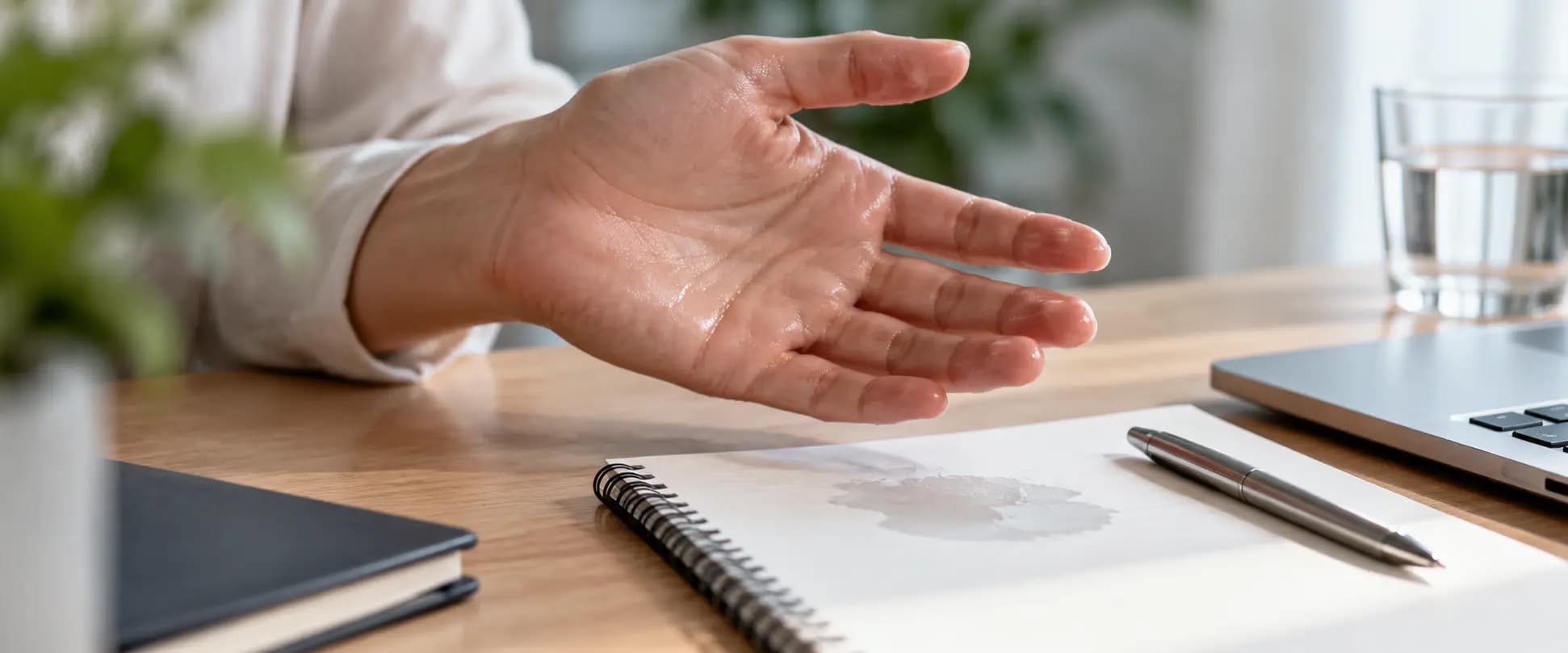
Underarms, large patches of dampness or sweat may appear, repeatedly soaking through clothing. On the hands, palms remain damp, beads of sweat form, or it becomes difficult to hold a pen. On the feet, socks and shoes may become damp quickly.
Prolonged moisture can also soften the skin, leading to peeling, chafing, and infections. If pain, inflammation, or discharge occurs, it’s unwise to assume it’s solely due to sweat.
There are also less visible manifestations: avoiding shaking hands, limiting certain activities, or feeling constant worry about the spots. This impact deserves attention and is part of the medical evaluation. American Academy of Dermatology, 2024c .
What can you do today?
Make sure you’re using an antiperspirant
Deodorant and antiperspirant are not the same. The former controls odor; the latter reduces perspiration. Some products combine both functions.
Antiperspirants containing aluminum salts can be a good starting point. Stronger formulations require special care: they are usually applied at night, to completely dry skin, and following the product or professional instructions.
Do not increase the amount to speed up the result. If significant irritation occurs, discontinue use and consult a doctor before resuming. Avoid applying to broken or recently waxed skin. British Association of Dermatologists, 2022 .
Reduce the time that the skin remains wet
Choose loose, breathable clothing. Change your socks when they get damp and let your shoes dry completely before wearing them again. Absorbent underarm pads can help protect your clothes.
These measures improve comfort, although they do not necessarily correct hyperhidrosis. NHS, 2023a .
Observe your triggers without imposing unnecessary restrictions
Note when the sweating starts, which areas it affects, and what you were doing. Heat, caffeine, alcohol, spicy foods, or certain emotional situations can act as triggers, but they don’t affect everyone the same way.
This record can also facilitate consultation.
Stay properly hydrated
Drinking less water is not a treatment for sweating less. If you sweat a lot, pay attention to fluid replacement. When fluid restriction is indicated due to kidney disease, heart disease, or another condition, follow your doctor’s plan. American Academy of Dermatology, 2025 .
What NOT to do?
Do not stop taking a medication on your own. If you suspect that sweating began after starting the medication or changing the dose, discuss it with the prescribing doctor. The relationship should be reviewed, and some treatments should not be stopped abruptly. ALWAYS consult your doctor. American Academy of Dermatology, 2024a .
Do not self-medicate with pills to «stop sweating.» They can affect your vision, bowel function, or bladder, and make it harder for your body to cool down.
Do not use an underarm product on any other area. The face, genitals, and other sensitive areas require specific instructions and specialized products.
Don’t dismiss new sweating as a mere cosmetic issue. Before intensifying treatment, it may be necessary to determine its cause. American Academy of Dermatology, 2024b .
When should I consult?
Immediate attention
- Sudden sweating accompanied by chest pain or tightness, severe dizziness, or nausea , especially if the person is clearly unwell. Seek urgent medical attention; do not simply attribute it to hyperhidrosis. Healthdirect Australia, 2026 .
Seek medical attention without postponing it
- Repeated night sweats that soak through clothes or sheets , despite sleeping in a cool room.
- Sweating accompanied by persistent fever, unintentional weight loss, or a persistent cough.
- A clear change from your usual pattern , especially if you suddenly start sweating a lot or without a recognizable explanation.
Night sweats can have common causes, such as hormonal changes or medications. Their presence does not establish a diagnosis, but the pattern and accompanying symptoms help determine further investigation. NHS, 2023b .
Scheduled appointment
It’s also advisable to seek help when sweating limits work, studies, relationships, or daily activities, or when initial measures don’t work. There’s no need to wait until the problem becomes unbearable to consult a doctor. NHS, 2023a .
What does a dermatologist usually do?
Confirm the pattern and assess its impact
The evaluation begins with questions about the onset, affected areas, frequency, presence of night sweats, family history, and medications used. The skin is also examined to assess how much the problem limits its severity.
In typical focal hyperhidrosis, the diagnosis is usually clinical. Tests are not mandatory for everyone ; they are ordered when the history or examination suggests a secondary cause.
A skin biopsy is not part of the routine workup for typical hyperhidrosis. An iodine-starch test may be used in certain procedures to pinpoint where the sweat is produced; however, this test alone does not identify the cause. (McConaghy, 2018 )
Choose the treatment according to the area and the situation
There is no single option that is right for all cases. If there is an underlying cause, treating it or reviewing the responsible medication is part of the plan.
Medications that generally reduce sweating, especially some oral treatments, can make it harder for the body to lose heat . This risk should be considered when exercising or being exposed to high temperatures. Botulinum toxin is a treatment option for the armpits and other selected areas, although its effect is temporary.
Sympathectomy , a surgery that interrupts certain nerve signals, is reserved for carefully selected cases. It can cause intense and persistent compensatory sweating in other areas, so it should not be presented as a simple or consequence-free solution. American Academy of Dermatology, 2024b .
Review results and tolerance
Follow-up allows us to determine whether the benefits outweigh the discomfort, whether maintenance is needed, and whether it’s advisable to combine or change treatments. The evidence is not equally strong for all options; nor does it allow us to conclude that one is best for everyone. Stuart, 2020 .
Frequently Asked Questions
Is hyperhidrosis curable?
- Primary dermatitis can persist for years, although it decreases with age in some people. Treatments can control it, but many require continuous or repeated administration. In secondary dermatitis, the course depends on the underlying cause and whether it can be corrected. British Association of Dermatologists, 2022 .
Is it an anxiety problem?
- Anxiety can increase sweating, and excessive sweating can cause anxiety. However, this does not mean that primary hyperhidrosis is solely psychological. Emotional support can complement treatment, but it should not replace medical evaluation. Primary Care Dermatology Society, 2026 .
Does sweating a lot mean having bad odor or poor hygiene?
- Not necessarily. The amount of sweat and body odor are related but distinct problems. Odor depends, among other factors, on the interaction of secretions with microorganisms on the skin. Hyperhidrosis can occur despite adequate hygiene. British Association of Dermatologists, 2022 .
Do antiperspirants containing aluminum cause breast cancer?
The available evidence does not establish that regular use of antiperspirants containing aluminum causes breast cancer. This does not mean that any formulation is suitable for all skin types: irritation and individual tolerance remain important. American Cancer Society, 2026 .
How long does the effect of botulinum toxin last?
It usually lasts for several months. For the underarms, the American Academy of Dermatology describes an approximate interval of 3 to 10 months , with individual variation. This is not a guarantee of duration; to maintain the benefit, the procedure usually needs to be repeated. American Academy of Dermatology, 2024b .
Can it affect children and teenagers?
Yes. Primary hyperhidrosis often begins during these stages. If it makes writing, activities, or social interaction difficult, it warrants evaluation. Treatment should be tailored to the age and context, not simply copied from a plan prescribed for an adult. (McConaghy, 2018 )
Does sweating at night mean I have hyperhidrosis?
Not necessarily. An overly warm room or excessive clothing can explain sweating. When episodes are repeated, intense, or occur without a clear explanation, other causes should be considered rather than assuming primary hyperhidrosis. NHS, 2023b .
Bibliography and sources
- Nawrocki S, Cha J. The etiology, diagnosis, and management of hyperhidrosis: a comprehensive review: etiology and clinical work-up . J Am Acad Dermatol. 2019;81(3):657-666. doi:10.1016/j.jaad.2018.12.071.
- American Academy of Dermatology Association. Hyperhidrosis: diagnosis and treatment [Internet] . 2024 [actualizado 16 jul 2024; citado 8 sep 2026] .
- Primary Care Dermatology Society. Hyperhidrosis (excessive sweating) [Internet] . 2026 [actualizado 8 jun 2026; citado 8 sep 2026] .
- British Association of Dermatologists. Hyperhidrosis [Internet] . 2022 [actualizado may 2022; citado 8 sep 2026] .
- American Academy of Dermatology Association. Hyperhidrosis: signs and symptoms [Internet] . 2024 [actualizado 16 jul 2024; citado 8 sep 2026] .
- National Health Service. Excessive sweating (hyperhidrosis) [Internet] . 2023 [revisado 7 nov 2023; citado 8 sep 2026] .
- American Academy of Dermatology Association. Hyperhidrosis: 6 tips dermatologists give their patients [Internet] . 2025 [actualizado 24 jul 2025; citado 8 sep 2026] .
- American Academy of Dermatology Association. Hyperhidrosis: causes [Internet] . 2024 [actualizado 16 jul 2024; citado 8 sep 2026] .
- Healthdirect Australia. Excessive sweating (hyperhidrosis) [Internet] . 2026 [revisado mar 2026; citado 8 sep 2026] .
- National Health Service. Night sweats [Internet] . 2023 [revisado 9 nov 2023; citado 8 sep 2026] .
- McConaghy JR, Fosselman D. Hyperhidrosis: management options . Am Fam Physician. 2018;97(11):729-734.
- Stuart ME, Strite SA, Gillard KK. A systematic evidence-based review of treatments for primary hyperhidrosis . J Drug Assess. 2020;10(1):35-50. doi:10.1080/21556660.2020.1857149.
- American Cancer Society. Antiperspirants and breast cancer risk [Internet] . 2026 [revisado 26 jun 2026; citado 8 sep 2026] .
Categories: For everyone

Content reviewed by
Dr. Rodolfo Suárez
Médico Patólogo y Dermatólogo Master en Patología Cutánea Avanzada
- Published
- September 18, 2026
- Updated
- September 30, 2026
Medically reviewed by specialists
Our content is based on current scientific evidence and clinical protocols.