
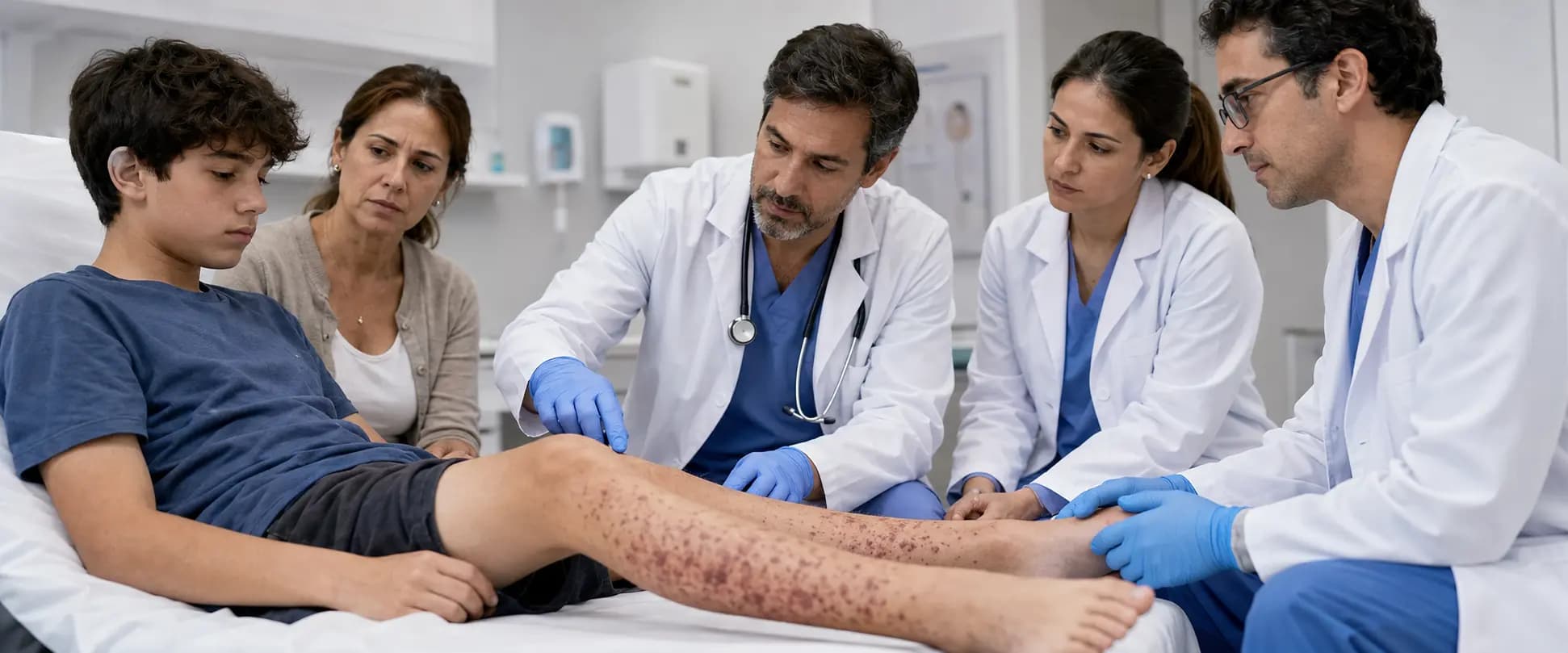
A clear guide to recognizing when a vasculitic skin rash may require medical evaluation.
Before you read: At Skinpaths, we distinguish between opinion and evidence. To write this content, we prioritized indexed medical sources and recommendations from scientific societies. You’ll find the complete bibliography at the end for your reference.
Important: This article is for informational purposes only and does not replace medical advice. If you have any questions, persistent symptoms, or your condition worsens, consult a healthcare professional.
Summary in 60 seconds
- Cutaneous vasculitis occurs when blood vessels in the skin become inflamed.
- Its most characteristic appearance is red, violet or purple spots that do not disappear when pressed.
- It often appears on legs, ankles, or pressure points.
- It may be limited to the skin, but in some people it is related to infections, medications, autoimmune diseases, or systemic vasculitis.
- Not every purple spot is vasculitis, and not all cutaneous vasculitis is serious.
- The key is to recognize warning signs: fever, severe pain, ulcers, blood in urine, abdominal pain, shortness of breath, chest pain, weakness, or numbness.
- The dermatologist may order tests, a urine test, and, in some cases, a skin biopsy.
- Avoid self-medicating with corticosteroids, antibiotics, or anti-inflammatories without a prescription.
- Seek medical attention as a priority if the rash progresses rapidly, is very painful, or is accompanied by general symptoms.
What is cutaneous vasculitis?
Cutaneous vasculitis is a group of conditions in which blood vessels in the skin become inflamed. When small vessels become inflamed, they can leak blood and fluid into the tissues, producing red, purplish, or purple patches, sometimes raised to the touch. This form is often referred to as cutaneous small vessel vasculitis or leukocytoclastic vasculitis , although the latter term describes a microscopic/histological finding and not a single cause. Alpsoy 2022
In many cases, vasculitis is limited to the skin and has a good prognosis. However, the skin can also be the first indication of inflammation of blood vessels in other organs, such as the kidneys, intestines, lungs, or nerves. Therefore, rather than panicking, the important thing is to understand the clinical context : what the lesions look like, where they are located, how long they have been present, what symptoms accompany them, and what the person’s medical history is. Micheletti 2023
In cutaneous vasculitis, the skin may be the main problem or the first clue to something more widespread.
Why does it appear?
Cutaneous vasculitis does not have a single cause. In a significant proportion of patients, no specific trigger is identified; this is called idiopathic or primary vasculitis. In others, it can appear after an infection, such as a respiratory or gastrointestinal infection, or some viral infections. It has also been described after the start of certain medications, especially antibiotics, nonsteroidal anti-inflammatory drugs (NSAIDs), diuretics, anticonvulsants, allopurinol, and anticoagulants, among others. DermNet 2024
It can also be associated with autoimmune diseases, such as lupus, rheumatoid arthritis, inflammatory bowel disease, or Sjögren’s syndrome. Less frequently, it may be related to hematological diseases or cancer. This last point should not be interpreted as a probable cause in all cases, but rather as a reason for the doctor to assess the overall picture, especially if the vasculitis is persistent, recurrent, atypical, or occurs alongside weight loss, prolonged fever, or other systemic symptoms. British Association of Dermatologists n.d.
In children, an important form to consider is IgA vasculitis , formerly called Henoch-Schönlein purpura. It can cause skin lesions, abdominal pain, joint pain, and, in some cases, kidney involvement. In adults, evaluation typically focuses more on medications, autoimmune diseases, infections, and signs of systemic vasculitis. Vasculitis Foundation 2024
What does it look like and what symptoms does it cause?
The classic appearance is palpable purpura : red, purplish, or violet patches, often small, that can be felt slightly raised when run over with the fingers. A telling sign is that these patches do not blanch when pressed , unlike many common inflammatory rashes.
It commonly affects the legs, especially ankles, calves, and pressure points. It can also appear on the buttocks, thighs, arms, or torso. Some lesions cause burning, itching, tenderness, or pain. In more severe cases, blisters, scabs, ulcers, dark areas of necrosis, or a net-like discoloration called livedo may appear. Frumholtz 2021
Cutaneous vasculitis can remain localized to the skin, but certain symptoms change the priority of care. Fever, marked malaise, abdominal pain, vomiting, blood in the urine, blood in the stool, coughing up blood, chest pain, shortness of breath, weakness, tingling, or numbness should not be interpreted as “just skin.” In these cases, medical evaluation is mandatory and prompt. PCDS 2023
What can you do today?
If lesions consistent with cutaneous vasculitis appear, it’s best to document them and consider the context. Take well-lit photographs, note when they started, whether they’re spreading, if they’re painful, and if there have been any recent infections, fever, travel, vaccinations, new medications, or supplements. This information can be very helpful during a consultation.
You can review your list of recent medications, but do not stop important treatments on your own , such as anticoagulants, antihypertensives, anticonvulsants, corticosteroids, or medications prescribed for another illness. If you suspect a medication may have triggered the rash, inform your doctor to make a safe decision.
While you are receiving guidance, some conservative measures can provide relief if the condition is mild and there are no warning signs: relative rest, elevating the legs, avoiding prolonged standing, and protecting the skin from friction. If there is pain, it is best to ask a doctor before using anti-inflammatory medications such as ibuprofen, naproxen, or diclofenac, especially if there is blood in the urine, kidney disease, significant gastritis, anticoagulation, or suspected internal involvement. Micheletti 2022
It’s also helpful to check your urine: if it appears reddish, tea-colored, persistently foamy, or if swelling appears in the legs, eyelids, or face, you should consult a doctor soon. These signs don’t confirm systemic vasculitis, but they do warrant medical evaluation.
What NOT to do?
It is not advisable to treat the condition with oral corticosteroids, antibiotics, or immunosuppressants without a diagnosis. These medications can alter the appearance of the lesions, delay diagnosis, or increase risks if an infection is present.
It is also not advisable to apply irritating remedies, exfoliants, alcohol, homemade mixtures, intense heat, or vigorous massage to the affected areas. If the skin is inflamed or bleeding, these measures can worsen the irritation or cause further wounds.
Avoid assuming that all purple spots are due to “poor circulation” or “allergies.” Cutaneous vasculitis can resemble bruises, insect bites, hives, capillaritis, infections, clotting problems, or reactions to medications. The difference matters because the treatment is not the same.
Don’t delay seeking medical attention if the lesions become painful, ulcerated, black, widespread, or if symptoms appear outside the skin. In vasculitis, patient safety depends less on «guessing the cause» and more on recognizing when to seek care.
When should I consult?
Consult a dermatologist if you develop red, purplish, or purple spots that do not disappear when pressed, especially if they are new, recur, or are located on the legs and ankles.
Seek same-day or emergency care if any of these signs appear:
- Fever, significant weakness, or a general feeling of illness.
- Injuries that progress rapidly, hurt a lot, or turn black.
- Extensive blisters, open wounds, or ulcers.
- Blood in the urine, dark-colored urine (black tea), decreased amount of urine, or swelling of the face, eyelids, or legs.
- Severe abdominal pain, persistent vomiting, or blood in the stool.
- Chest pain, shortness of breath, coughing up blood, or persistent cough accompanied by general malaise.
- Weakness, tingling, numbness, or loss of strength in hands or feet.
- Intense joint pain or marked joint swelling.
- Purple spots with high fever, confusion, stiff neck, or rapid deterioration of general condition.
- Appearance of lesions in an immunosuppressed, pregnant, anticoagulated person or with known kidney disease.
These signs do not automatically mean there is a serious complication, but they do raise the priority of evaluation. Chen 2008
The urgency is not defined solely by the color of the spots, but by the context: pain, fever, ulcers, and symptoms outside the skin.
What does a dermatologist usually do?
The dermatologist begins by examining the skin in detail: the distribution of lesions, their size, whether they are palpable, and if there are blisters, necrosis, ulcers, livedo, or signs of infection. They will also ask about new medications, recent infections, autoimmune diseases, respiratory, digestive, urinary, and neurological symptoms, as well as any relevant family or personal medical history.
Dermatoscopy can help observe vascular or hemorrhagic patterns in the lesion, although it does not replace the medical history, laboratory tests, or biopsy when necessary. In vasculitis, confirmation usually depends on the correlation between what is seen on the skin, the tests, and, in some cases, microscopic examination.
The most common tests include a complete blood count, kidney function tests, liver function tests, inflammatory markers, urinalysis, and blood pressure measurement. Depending on the case, tests for hepatitis B, hepatitis C, HIV, complement, ANA, ANCA, cryoglobulins, immunoglobulins, or other targeted tests may be ordered. The intention is not to order everything for everyone, but rather to look for causes and reasonably rule out internal involvement. Alpsoy 2022
A skin biopsy can be very useful, especially if the lesions are recent. Sometimes one sample is taken for histopathology and another for direct immunofluorescence, a technique that helps identify immunological deposits such as IgA, IgM, IgG, or complement. The timing and location of the biopsy matter: lesions that are too old may provide less information. Sunderkötter 2018
Treatment depends on the cause, severity, and the presence or absence of affected organs. If there is a clear trigger, such as an infection or medication, the first step is usually to treat or safely discontinue it under medical supervision. If the vasculitis is limited to the skin and is mild, conservative measures may suffice. If it is painful, extensive, recurrent, ulcerated, or affects other organs, corticosteroids or other anti-inflammatory or immunomodulatory drugs may be necessary, ideally with dermatological follow-up and, when appropriate, rheumatological, nephrological, or internal medicine follow-up. Micheletti 2022
Frequently Asked Questions
Is cutaneous vasculitis serious?
- It may be mild and limited to the skin, but it should not be taken lightly. The severity depends on the extent of the infection, the pain, the presence of ulcers, recurrence, and, above all, whether there are symptoms that suggest involvement of other organs.
Do vasculitis spots disappear when pressed?
- They often don’t disappear when pressed, because they are small bleeds within the skin. This information is helpful, but it doesn’t confirm the diagnosis on its own.
Can it be caused by medication?
- Yes. Some cases are related to medications, especially if the lesions appear days after starting a new drug. Even so, it’s not safe to stop important treatments without medical advice.
Is cutaneous vasculitis contagious?
- No. Vasculitis itself is not contagious. Some infections can act as triggers, but vasculitis lesions are not transmitted through contact.
Do I need a biopsy?
- Not always. In mild and clear cases, the doctor may decide to observe and order tests. If there are diagnostic uncertainties, atypical lesions, recurrence, ulcers, or suspicion of systemic vasculitis, a biopsy can provide important information.
Which specialist should I consult?
- A dermatologist is usually key when the problem manifests on the skin. If there are signs of kidney, respiratory, digestive, neurological, or autoimmune involvement, joint management with rheumatology, nephrology, internal medicine, or other specialists may be necessary.
Can it reappear?
- Yes. Some forms are self-limiting and disappear within weeks; others can recur. That’s why it’s important to identify triggers, review medications, and follow up if the condition recurs.
Bibliography and sources
- Alpsoy E. Cutaneous vasculitis; an algorithmic approach to diagnosis. Front Med (Lausanne). 2022;9:1012554. doi:10.3389/fmed.2022.1012554. Available at: https://pmc.ncbi.nlm.nih.gov/articles/PMC9532537/
- Micheletti RG. Treatment of cutaneous vasculitis. Front Med (Lausanne). 2022;9:1059612. doi:10.3389/fmed.2022.1059612. Available at: https://pmc.ncbi.nlm.nih.gov/articles/PMC9716566/
- Micheletti RG. Cutaneous small vessel vasculitis: a practical guide to diagnosis and management. Am J Clin Dermatol. 2023;24(1):89-95. doi:10.1007/s40257-022-00736-6. Available at: https://pubmed.ncbi.nlm.nih.gov/36308673/
- Sunderkötter CH, Zelger B, Chen KR, Requena L, Piette W, Carlson JA, et al. Nomenclature of cutaneous vasculitis: dermatological addendum to the 2012 Revised International Chapel Hill Consensus Conference Nomenclature of Vasculitides. Arthritis Rheumatol. 2018;70(2):171-184. doi:10.1002/art.40375. Available at: https://pubmed.ncbi.nlm.nih.gov/29136340/
- Chen KR, Carlson JA. Clinical approach to cutaneous vasculitis. Am J Clin Dermatol. 2008;9(2):71-92. doi:10.2165/00128071-200809020-00001. Available at: https://pubmed.ncbi.nlm.nih.gov/18284262/
- Frumholtz L, Laurent-Roussel S, Lipsker D, Terrier B. Cutaneous vasculitis: review on diagnosis and clinicopathologic correlations. Clin Rev Allergy Immunol. 2021;61(2):181-193. doi:10.1007/s12016-020-08788-4. Available at: https://pubmed.ncbi.nlm.nih.gov/32378145/
- Goeser MR, Laniosz V, Wetter DA. A practical approach to the diagnosis, evaluation, and management of cutaneous small-vessel vasculitis. Am J Clin Dermatol. 2014;15(4):299-306. doi:10.1007/s40257-014-0076-6. Available at: https://pubmed.ncbi.nlm.nih.gov/24756249/
- Jennette JC, Falk RJ, Bacon PA, Basu N, Cid MC, Ferrario F, et al. 2012 revised International Chapel Hill Consensus Conference Nomenclature of Vasculitides. Arthritis Rheum. 2013;65(1):1-11. doi:10.1002/art.37715. Available at: https://pubmed.ncbi.nlm.nih.gov/23045170/
- Chung SA, Langford CA, Maz M, Abril A, Gorelik M, Guyatt G, et al. 2021 American College of Rheumatology/Vasculitis Foundation Guideline for the Management of Antineutrophil Cytoplasmic Antibody–Associated Vasculitis. Arthritis Care Res (Hoboken). 2021;73(8):1088-1105. doi:10.1002/acr.24634. Available at: https://pubmed.ncbi.nlm.nih.gov/34235880/
- Hellmich B, Sanchez-Alamo B, Schirmer JH, Berti A, Blockmans D, Cid MC, et al. EULAR recommendations for the management of ANCA-associated vasculitis: 2022 update. Ann Rheum Dis. 2024;83(1):30-47. doi:10.1136/ard-2022-223764. Available at: https://pubmed.ncbi.nlm.nih.gov/36927642/
- DermNet New Zealand Trust. Cutaneous small vessel vasculitis [Internet] . DermNet; 2024 [citado 2026 Jul 6] . Available at: https://dermnetnz.org/topics/cutaneous-small-vessel-vasculitis
- British Association of Dermatologists. Cutaneous vasculitis [Internet] . London: British Association of Dermatologists; [citado 2026 Jul 6] . Available at: https://www.bad.org.uk/pils/cutaneous-vasculitis/
- Primary Care Dermatology Society. Vasculitis [Internet] . PCDS; 2023 Jul 18 [citado 2026 Jul 6] . Available at: https://www.pcds.org.uk/clinical-guidance/vasculitis-and-capillaritis
- Vasculitis Foundation. Cutaneous small-vessel vasculitis [Internet] . Vasculitis Foundation; 2024 Feb 5 [citado 2026 Jul 6] . Available at: https://vasculitisfoundation.org/education/vasculitis-types/cutaneous-small-vessel-vasculitis/
Categories: For everyone

Content reviewed by
Dr. Rodolfo Suárez
Médico Patólogo y Dermatólogo Master en Patología Cutánea Avanzada
- Published
- September 18, 2026
- Updated
- September 23, 2026
Medically reviewed by specialists
Our content is based on current scientific evidence and clinical protocols.