
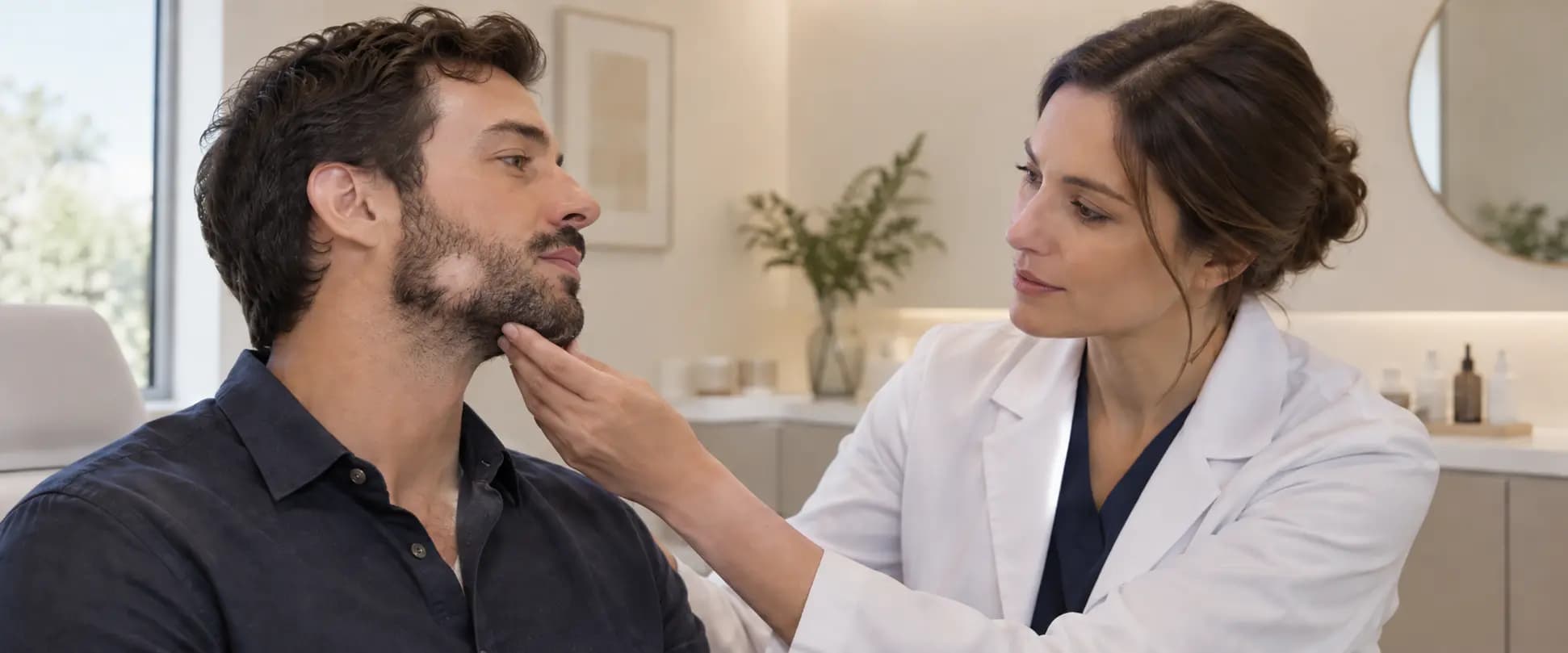
Discovering a bald patch can raise many questions: Why did it happen? Will it spread? Will it grow back? Understanding what alopecia areata is helps address these questions with information, without assigning blame or creating expectations that no treatment can guarantee.
Before you read: At Skinpaths, we distinguish between opinion and evidence. To write this content, we prioritized indexed medical sources and recommendations from scientific societies. You’ll find the complete bibliography at the end for your reference.
Important: This article is for informational purposes only and does not replace medical advice. If you have any questions, persistent symptoms, or your condition worsens, consult a healthcare professional.
Summary in 60 seconds
- Alopecia areata is an autoimmune disease that disrupts hair growth.
- It usually produces round or oval areas without hair, although other presentations exist.
- It can affect the scalp, beard, eyebrows, eyelashes, and other areas.
- It is not contagious and does not appear due to lack of hygiene.
- The follicles are usually preserved, so hair can grow back in most cases.
- Stress does not explain all cases and should not be considered the sole cause.
- The evolution is variable: there may be recovery, persistence, or new episodes.
- Treatment depends on the extent, age, affected areas, and personal impact.
- Protecting the skin and caring for emotional well-being are also part of the care.
- New hair loss warrants evaluation to confirm its cause.
What is alopecia areata?
Alopecia areata is a condition in which the immune system reacts inappropriately against hair follicles , the skin structures that produce hair. This reaction disrupts the hair growth cycle and causes hair loss.
It is classified as a non-scarring alopecia : it does not usually replace hair follicles with scar tissue. This allows them to produce hair again, although it does not guarantee a complete or permanent recovery. Pratt, 2017
The most common form appears in patches . When all or almost all scalp hair is lost, it is called alopecia totalis ; when the loss also affects facial and body hair, it is called alopecia universalis . These names describe the extent: they are not mandatory stages that everyone must go through .
It can begin in childhood or adulthood and affect people of any sex or ethnic background. NIAMS, 2024a
Why does it appear?
There is no single cause that explains all cases. Genetic predisposition, immune system function, and environmental factors, which are still being investigated, all play a role. Having affected family members increases the likelihood of developing the condition, but it does not necessarily mean that it will appear.
It is also incorrect to describe it simply as a problem of «low defenses» : the immune system is reacting against a structure of the body itself.
What role does stress play?
- Some people recall a period of intense stress before the fall. However, this coincidence does not prove that stress is the sole cause. In many cases, no trigger is identified.
- Taking care of your rest and emotional well-being can be helpful, but saying «it’s because you worry too much» oversimplifies an autoimmune disease and adds unnecessary guilt. Ludmann, 2023a
Is it related to other diseases?
- It can coexist with autoimmune thyroid diseases, vitiligo, and allergic disorders, such as atopic dermatitis or atopic eczema.
- An association does not mean that everyone with alopecia areata has those diseases. History and symptoms help determine whether further investigation is needed. NIAMS, 2024a
What does it look like and what symptoms does it cause?
Typically, one or more round or oval hairless patches are observed, with relatively smooth skin and no significant flaking. They can appear quickly and be discovered when combing, shaving, or cutting the hair. Short hairs that taper close to the skin, called «exclamation mark hairs,» may be found at the edges. Some people experience itching, tingling, or mild burning; others have no discomfort.
Small pitting, roughness, or brittleness of the nails may also appear. Loss of eyebrows or eyelashes may be accompanied by eye irritation. Not all cases form well-defined circles: some presentations are diffuse, while others affect a band around the back of the neck and the sides of the head. Ludmann, 2023b
The emotional impact also matters
Concern about appearance, uncertainty, and other people’s reactions can affect daily life. Studies have found a higher burden of anxiety and depression in people with alopecia areata, although not everyone develops these problems.
The emotional impact deserves attention, not comments that minimize it. Macbeth, 2022
What can you do today?
Prepare for the appointment. Note when the hair loss began, which areas are affected, and what products or medications you are using. An initial photograph, taken with good lighting, can serve as a reference point for discussing its progression.
Protect exposed areas. Wear a hat and broad-spectrum sunscreen with a sun protection factor (SPF) of at least 30 on exposed skin. Reapply during sun exposure as directed on the product, especially after sweating or getting wet.
Wash and style gently. Choose non-irritating products and avoid hairstyles that pull on the hair. Gentle care doesn’t treat the autoimmune reaction, but it helps prevent further damage.
Take care of your eyes if you are missing eyelashes or eyebrows. Glasses can help protect them from wind and particles. Discuss any persistent irritation with a professional. Ludmann, 2023c
Decide how you want to manage your appearance. Wigs, scarves, hairpieces, and makeup are options, not obligations. It’s also perfectly acceptable not to cover hair loss.
Seek support when you need it. Talking to trusted people, a mental health professional, or a support group can be part of caring for yourself. This support doesn’t mean the illness is imaginary; it addresses the challenges of living with a visible and unpredictable condition. NIAMS, 2024b
What NOT to do?
Do not rub the area with irritants. Applying onion, garlic, homemade mixtures, or essential oils is not a substitute for medical treatment. There is insufficient evidence to recommend many of these alternatives, and causing irritation does not prove that the follicle is recovering.
Do not take supplements indiscriminately. Finding low levels of a nutrient in some patients does not prove that supplementing with it will treat alopecia areata. Correcting a confirmed deficiency may be necessary for health, but it is different from promising that it will make hair grow. Harries, 2026
Do not use corticosteroids on your own. The strength, area, and duration of use matter. These medications can cause adverse effects, such as thinning of the skin; injections should be performed by specialist doctors. British Association of Dermatologists, 2024
Don’t blame or minimize. As an editorial guideline for Skinpaths, we recommend replacing «it’s just hair» with a more helpful question: «How is this affecting you, and what support do you need?»
When should I consult?
Seek medical evaluation if you experience new or unexplained hair loss. There’s no need to wait until it affects a large area.
Signs that require priority consultation
- Hair loss that spreads rapidly or begins to affect eyebrows and eyelashes.
- Marked scaling, crusting, discharge, or significant inflammation , because there may be a different cause, such as an infection.
- Areas that appear to leave scars , especially if there is discomfort or persistent inflammation.
- Emotional distress that interferes with sleep, school, work, or relationships.
Alopecia areata and other causes of hair loss can look similar. Identifying an infection or scarring alopecia changes the treatment and necessitates prompt action. Harries, 2026
Seek immediate medical attention if you experience fever along with severe swelling and significant pain, or if you have thoughts of self-harm. These situations should not be minimized.
What does a dermatologist usually do?
Confirm the diagnosis
The practitioner examines the scalp, nails, and other affected areas. They ask about the progression of the condition, family history, medications, and the impact of the hair loss on daily life. They may use hair dermatoscopy or trichoscopy : an examination with an instrument that magnifies the image of the skin and hair. This helps identify characteristics that are not visible to the naked eye. A biopsy is not necessary in all cases . It is reserved for situations where doubts persist or it is important to rule out other diseases. It involves obtaining a small sample of skin for examination under a microscope. NIAMS, 2024b
Decide if further tests are needed
There is no comprehensive battery of tests that everyone should undergo. Tests are selected based on medical history, examination findings, symptoms, and the treatment being considered. For example, investigating thyroid function may be relevant in certain circumstances. Routinely ordering iron or vitamins without a clinical reason is not similarly supported. (Harries, 2026)
Choosing a treatment
Corticosteroids applied to the skin or administered via small injections are common options. The choice depends on age, location, and tolerance to the procedure. Minoxidil can be used as an adjunct to promote or maintain growth. It does not, on its own, correct the autoimmune reaction. In some recent and limited cases , observation with follow-up may be agreed upon, because there is a possibility of spontaneous recovery. Observation does not mean abandoning care: it involves defining when to review and what changes would warrant treatment. (Ludmann, 2024a)
Consider other options when the disease is extensive.
In selected cases, contact immunotherapy , a specialized procedure that triggers a controlled skin reaction, may be used. There are also medications that act on the whole body. These alternatives require specialized medical supervision and are not appropriate for everyone. (British Association of Dermatologists, 2024 ) JAK inhibitors block certain signals of the immune response. They have expanded the options for severe disease: for example, clinical trials showed that baricitinib promoted hair growth more than placebo in adults with severe alopecia areata. The response was not the same in all participants. (King, 2022)
Consider age and medication safety
Some treatments also have indications for adolescents. For example, ritlecitinib is authorized in the United States for severe alopecia areata in patients 12 years of age and older . Authorizations and availability should be verified in the country where care is received. These medications require prior specialist evaluation and monitoring. Warnings include serious infections, thrombosis, cardiovascular events, and certain cancers. It is also important to review vaccinations, other medications, pregnancy, pregnancy planning, and breastfeeding. Pfizer Laboratories, 2026. The risk is not identical for all individuals. Some warnings come from studies conducted with other medications in the same class and in different populations. Ludmann, 2024b
Review the progress and adjust the plan.
Hair regrowth does not necessarily eliminate the possibility of relapse. In a trial with people who had responded to baricitinib, many lost the benefit after discontinuing it. This explains why some require maintenance. Changes or discontinuations should be agreed upon with the treatment team , taking into account the response and safety. King, 2024
Frequently Asked Questions
Is alopecia areata contagious?
- No. Its origin is autoimmune, not an infection transmitted through close contact or hugging. There is no reason to isolate a person based on this diagnosis. Ludmann, 2023a
Can hair grow back white or thinner?
- Yes. The hair that grows back may initially be fine, white, or gray and later regain its normal appearance. This initial growth does not allow us to predict how the entire process will unfold. Ludmann, 2023b
Does having a patch mean I’ll lose all my hair?
- No. Some people maintain localized hair loss; others regrow their hair or develop new areas. An initial patch does not predict total hair loss, and progression to complete body hair loss is not typical. NIAMS, 2024a
How long does it take to grow back?
- There is no single timeframe. Growth may begin within a few months, but hair loss may persist or new episodes may occur. The extent of the hair loss and its previous progression influence the prognosis; it is best to avoid guaranteed recovery dates. British Association of Dermatologists, 2024
How is it treated in children?
- Decisions are tailored to the child’s age, the extent of the loss, and their tolerance to the procedures. Topical corticosteroids are a common option; however, not all adult treatments are suitable for children. (Ludmann, 2024a ) In addition to treatment, it is important to listen to how the child is experiencing the situation and to address any teasing or school difficulties, without imposing a specific way of showing or hiding the loss. (Ludmann, 2023c)
Can the treatment be stopped when the hair grows back?
- In some cases, the treatment is adjusted or discontinued; in others, maintenance is necessary. The decision depends on the medication, the patient’s progress, and the risks. Hair regrowth is not sufficient reason to unilaterally discontinue systemic treatment. King, 2024
Bibliography and sources
- Pratt CH, King LE Jr, Messenger AG, Christiano AM, Sundberg JP. Alopecia areata . Nat Rev Dis Primers. 2017;3:17011. doi:10.1038/nrdp.2017.11.
- Harries MJ, Ahmed A, Ascott A, Bhatti K, Earley J, Farrant P, et al. British Association of Dermatologists living guideline for managing people with alopecia areata 2025 . Br J Dermatol. 2026;194(2):e56-e73. doi:10.1093/bjd/ljaf452.
- National Institute of Arthritis and Musculoskeletal and Skin Diseases. Alopecia areata [Internet] . Bethesda (MD): National Institutes of Health; 2024 [citado 15 sep 2026] . Available from: NIAMS, 2024a .
- Ludmann P. Hair loss types: alopecia areata causes [Internet] . Rosemont (IL): American Academy of Dermatology; 2023 [actualizado 30 ago 2023; citado 15 sep 2026] . Available in: Ludmann, 2023a .
- Ludmann P. Hair loss types: alopecia areata signs and symptoms [Internet] . Rosemont (IL): American Academy of Dermatology; 2023 [actualizado 30 ago 2023; citado 15 sep 2026] . Available in: Ludmann, 2023b .
- Macbeth AE, Holmes S, Harries M, Chiu WS, Tziotzios C, de Lusignan S, et al. The associated burden of mental health conditions in alopecia areata: a population-based study in UK primary care . Br J Dermatol. 2022;187(1):73-81. doi:10.1111/bjd.21055.
- Ludmann P. Hair loss types: alopecia areata self-care [Internet] . Rosemont (IL): American Academy of Dermatology; 2023 [actualizado 30 ago 2023; citado 15 sep 2026] . Available in: Ludmann, 2023c .
- National Institute of Arthritis and Musculoskeletal and Skin Diseases. Alopecia areata: diagnosis, treatment, and steps to take [Internet] . Bethesda (MD): National Institutes of Health; 2024 [citado 15 sep 2026] . Available from: NIAMS, 2024b .
- British Association of Dermatologists. Alopecia areata [Internet] . London: British Association of Dermatologists; 2024 [actualizado abr 2024; citado 15 sep 2026] . Available from: British Association of Dermatologists, 2024 .
- Ludmann P. Hair loss types: alopecia areata diagnosis and treatment [Internet] . Rosemont (IL): American Academy of Dermatology; 2024 [actualizado 22 ago 2024; citado 15 sep 2026] . Available in: Ludmann, 2024a .
- King B, Ohyama M, Kwon O, Zlotogorski A, Ko J, Mesinkovska NA, et al. Two phase 3 trials of baricitinib for alopecia areata . N Engl J Med. 2022;386(18):1687-99. doi:10.1056/NEJMoa2110343.
- Pfizer Laboratories Div Pfizer Inc. Litfulo—ritlecitinib capsule: prescribing information [Internet] . Bethesda (MD): National Library of Medicine, DailyMed; 2026 [actualizado 17 jun 2026; citado 15 sep 2026] . Available from: Pfizer Laboratories, 2026 .
- Ludmann P. JAK inhibitors: what your dermatologist wants you to know [Internet] . Rosemont (IL): American Academy of Dermatology; 2024 [actualizado 4 sep 2024; citado 15 sep 2026] . Available in: Ludmann, 2024b .
- King B, Ko J, Kwon O, Vañó-Galván S, Piraccini BM, Dutronc Y, et al. Baricitinib withdrawal and retreatment in patients with severe alopecia areata: the BRAVE-AA1 randomized clinical trial . JAMA Dermatol. 2024;160(10):1075-81. doi:10.1001/jamadermatol.2024.2734.
Categories: For everyone · Hair loss

Content reviewed by
Dr. Rodolfo Suárez
Médico Patólogo y Dermatólogo Master en Patología Cutánea Avanzada
- Published
- September 18, 2026
- Updated
- September 23, 2026
Medically reviewed by specialists
Our content is based on current scientific evidence and clinical protocols.