


Dermatologists who treat skin cancer, moles, and dermatological oncology
Choosing sunscreen shouldn't start with the brand, but with your routine: how much sun you get, whether you sweat, drive, play sports, have blemishes, sensitive skin, or work outdoors. The best sunscreen is the one you can use in sufficient quantity, reapply as needed, and tolerate every day.
Before reading: En skinpaths We distinguish between opinion and evidence. To write this content, we prioritized indexed medical sources and recommendations from scientific societies. At the end, you will find the complete bibliography for your reference.
Important: This article is for informational purposes only and does not replace medical advice. If you have any questions, persistent symptoms, or your condition worsens, consult a healthcare professional.
Summary in 60 seconds
- The starting point for almost everyone is a sunscreen. spread spectrum, FPS 30 or higher and, if there is sweat, water or prolonged exposure, Waterproof.
- The American Academy of Dermatology (AAD) recommends looking for these three things on the label: broad spectrum, SPF 30 or higher, and water resistance when needed.
- For office or urban routines, a comfortable, lightweight, and everyday SPF 30–50 sunscreen may suffice.
- For sports, the beach, the pool, the mountains, or outdoor work, it's advisable to go up to FPS 50 or higher, in formula water resistant for 80 minutes, reapplying every 2 hours or sooner if you sweat, swim or towel dry.
- No screen protector is "waterproof" or "sweatproof".
- If you have sensitive skin, rosacea, a tendency towards burning or eczema, filters are usually better tolerated. minerals , the zinc oxide y titanium dioxide.
- If you have melasma, dark spots, or hyperpigmentation, also look for sunscreen. with colour that contains iron oxidesbecause it helps against visible light, a relevant trigger for some blemishes.
What is a sunscreen and why is it important?
Sunscreen is a formula that combines ultraviolet filters with a cosmetic base: cream, gel, fluid, lotion, stick, or spray. The filters are the ingredients that reduce the amount of ultraviolet radiation that reaches the skin.
It matters for three reasons: it reduces sunburn, helps prevent cumulative damage, and is part of skin cancer and photoaging prevention. Trials and reviews have associated regular sunscreen use with a lower risk of squamous cell carcinoma, less melanoma at long-term follow-up, and less clinically measured skin aging. (Green 1999 , Green 2011 , Hughes 2013)
But sunscreen isn't a complete, standalone shield. It needs to be combined with shade, clothing, a hat, UV-protective sunglasses, and smart timing. The FDA also emphasizes limiting time in intense sunlight, wearing protective clothing, and reapplying sunscreen at least every two hours, more often if you're sweating or wet. FDA 2026
How does it work? Simple explanation, no complicated physics
There are three main practical groups:
1. Mineral or inorganic filters
The most commonly used are zinc oxide y titanium dioxideThey are known as “mineral” or “physical” sunscreens. They are a good option for sensitive skin, children over 6 months old, and people who experience burning sensations with other products. The FDA considers that there is sufficient safety information for zinc oxide and titanium dioxide at concentrations up to 25% within its proposed US regulatory framework. FDA 2022
2. Organic filters, popularly known as “chemical” filters
They include ingredients such as avobenzone, octocrylene, octisalate, homosalate u octinoxateDepending on the country. In Europe, Asia, and other markets, more modern filters are also available, such as bemotrizinol, bisoctrizol, DHHB, ethylhexyl triazone o Mexoryl SX/XLDepending on local regulations, they usually allow for lighter, more transparent, and more comfortable textures, which is important for adhesion.
3. Hybrid formulas
They combine mineral and organic filters. They are very useful when you're looking for a balance: good coverage, better cosmetics, less white residue, and good tolerance.
SPF (Sun Protection Factor) primarily refers to protection against UVB rays, the type of radiation most closely associated with sunburn. Therefore, simply choosing a high number isn't enough: you should also look for broad spectrum , as this indicates coverage against both UVA and UVB rays. The AAD (American Association of Sunscreens) reminds us that high SPFs block slightly more UVB rays, but no sunscreen provides 100% protection, and all require reapplication. AAD 2025
How to choose and how to use it?
The right question isn't "What's the best sunscreen?", but "What's the best for my actual sun exposure?". This table summarizes a reasonable choice based on lifestyle.
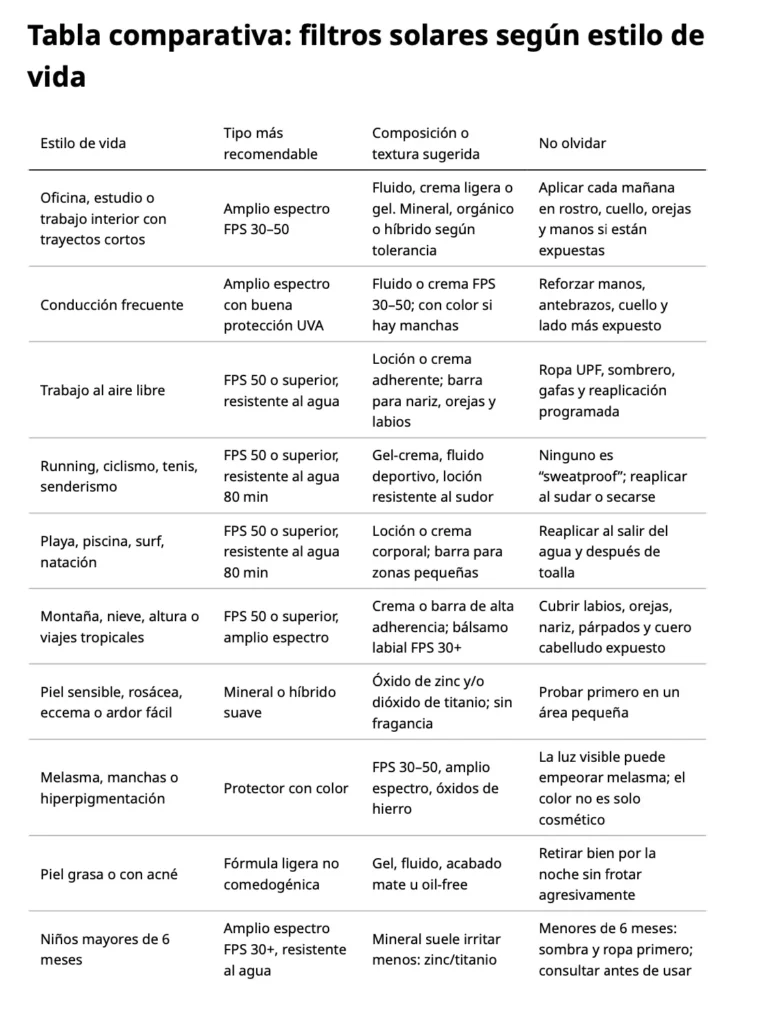
For amount, the FDA recommends applying 15 minutes beforehand, using enough product, and reapplying at least every 2 hours. An average adult requires about 1 ounce to cover the body, roughly equivalent to a small shot glass. The AAD adds a practical guide for the face: at least 1 teaspoon for the face, and don't forget the neck, ears, feet, hairline, lips, and exposed scalp. FDA 2026 AAD 2025
Practical rules according to the exhibition
- Low or urban exposure: SPF 30–50, broad spectrum, pleasant texture. Consistency is key here. If a mineral formula leaves a white residue and you therefore don't use it, a hybrid or organic formula might be better for you.
- Moderate exposure: Walks, long errands, driving, outdoor activities like patios or light exercise. SPF 50 is recommended if you'll be outside for longer periods, especially in warm weather or when the UV index is high.
- High exposure: Beach, pool, mountains, intense sports, or outdoor work. Look for SPF 50 or higher, broad spectrum, water resistant for 80 minutes, and pair it with clothing, a hat, sunglasses, and sun protection. The Skin Cancer Foundation recommends broad spectrum SPF 30 or higher for daily use, and SPF 50 or higher water resistant for prolonged outdoor activity. Skin Cancer Foundation sf
Common Mistakes
- Choose only by SPF. A high SPF does not replace the phrase "broad spectrum." Without good UVA protection, the number can give a false sense of security.
- Use a small amount. If you apply a very thin layer, you won't reach the protection of the container.
- Do not reapply. The protector shifts with sweat, friction, water, and towels. It also degrades with actual use.
- Believing that water-resistant means waterproof. The FDA reminds us that there is no such thing as a "waterproof" sunscreen; water resistance is expressed as 40 or 80 minutes. FDA 2026
- Spray and do not spread. The spray may leave some areas uncovered. Apply a sufficient amount and then spread it evenly. For children or sensitive individuals, a cream or stick is usually easier to control.
- Trust only makeup with SPF. It can help, but it is rarely applied in the amount needed to achieve the stated FPS.
- Forget small areas. Ears, lips, eyelids, back of hands, insteps, nape of the neck, hairline and exposed scalp are common areas of omission.
FAQ
Is a mineral or chemical filter better?
- It depends on your skin and your routine. For sensitive skin, rosacea, easily irritated skin, children, and eczema, mineral sunscreen is usually a reasonable first choice. For sports or everyday urban use, many people tolerate organic or hybrid textures better because they are lighter and more transparent. The key is that it's broad-spectrum, SPF 30 or higher, and that you apply it correctly.
What sunscreen should I use if I play sports?
- Choose SPF 50 or higher, broad spectrum, water-resistant for 80 minutes, in a gel-cream, sports lotion, or fluid texture that won't irritate your eyes. Carry a stick for your nose, cheekbones, ears, and lips. Reapply every 2 hours, and more often if you sweat a lot or towel dry.
Which sunscreen is best if I have dark spots or melasma?
- Look for a wide FPS range of 30–50 and, preferably, a screen protector. with colour that contains iron oxidesIn melasma, visible light can contribute to pigmentation, especially in higher phototypes; that's why dye can provide additional protection, not just cosmetic coverage. AAD 2023, Dumbuya 2020
Can I use the same sunscreen for face and body?
- Yes, provided you tolerate it and apply a sufficient amount. In practice, many people prefer a more elegant one for the face and a more economical, abundant, and long-lasting one for the body. especially in sports or at the beach.
Can children use sunscreen?
- For children over 6 months, yes: broad spectrum, SPF 30 or higher, and water-resistant if there's a pool or sweating. For children under 6 months, the priority is to avoid direct sunlight, use shade, wear clothing and a hat, and consult a doctor before applying sunscreen. The AAD and FDA recommend minimizing or avoiding routine use in young babies except in situations where shade and clothing are insufficient. AAD 2025, FDA 2024
Does the spray provide the same protection?
- It can protect if applied in sufficient quantity and spread evenly, but it's easy to apply too little or miss areas. Do not apply it directly to the face or inhale it. For children, sensitive skin, or wind, it's usually safer and easier to control to use a cream, lotion, or stick.
How often should I reapply if I'm in the office?
- If you're indoors all day and don't sweat, a generous application in the morning may be enough for a low-exposure routine. If you go for walks, drive a lot, eat outdoors, sweat, or are near windows for extended periods, reapply. Outdoors, the rule of thumb remains every two hours.
BIBLIOGRAPHY AND SOURCES
- American Academy of Dermatology Association. How to select a sunscreen. AAD; 2025.
- American Academy of Dermatology Association. How to apply sunscreen. AAD; 2025.
- American Academy of Dermatology Association. Sunscreen FAQs. AAD; 2025.
- US Food and Drug Administration. Sunscreen: How to help protect your skin from the sunFDA; 2026.
- US Food and Drug Administration. Questions and answers: FDA posts deemed final order and proposed order for over-the-counter sunscreenFDA; 2022.
- The Skin Cancer Foundation. sun protection. Skin Cancer Foundation; consulted 2026 May 29.
- Green A, Williams G, Neale R, Hart V, Leslie D, Parsons P, et al. Daily sunscreen application and betacarotene supplementation in prevention of basal-cell and squamous-cell carcinomas of the skin: a randomized controlled trial. Lancet. 1999;354(9180):723-729.
- Green AC, Williams GM, Logan V, Strutton GM. Reduced melanoma after regular sunscreen use: randomized trial follow-up. J Clin Oncol. 2011;29(3):257-263.
- Hughes MCB, Williams GM, Baker P, Green AC. Sunscreen and prevention of skin aging: a randomized trial. Ann Intern Med. 2013;158(11):781-790.
- Sander M, Sander M, Burbidge T, Beecker J. The efficacy and safety of sunscreen use for the prevention of skin cancer. CMAJ. 2020;192(50):E1802-E1808.
- Beasley DG, Meyer TA. Characterization of the UVA protection provided by avobenzone, zinc oxide, and titanium dioxide in broad-spectrum sunscreen products. Am J Clin Dermatol. 2010;11(6):413-421.
- Dumbuya H, Grimes PE, Lynch S, Ji K, Brahmachary M, Zheng Q, et al. Impact of iron-oxide containing formulations against visible light-induced skin pigmentation in skin of color individuals. J Drugs Dermatol. 2020;19(7):712-717.
- Morgado-Carrasco D, Piquero-Casals J, Granger C, Trullàs C, Jesús-Silva A, Krutmann J. Melasma: the need for tailored photoprotection to improve clinical outcomes. Photodermatol Photoimmunol Photomed. 2022;38(6):515-521.
- American Academy of Dermatology Association. Melasma: self-careAAD; 2023

 |
|