

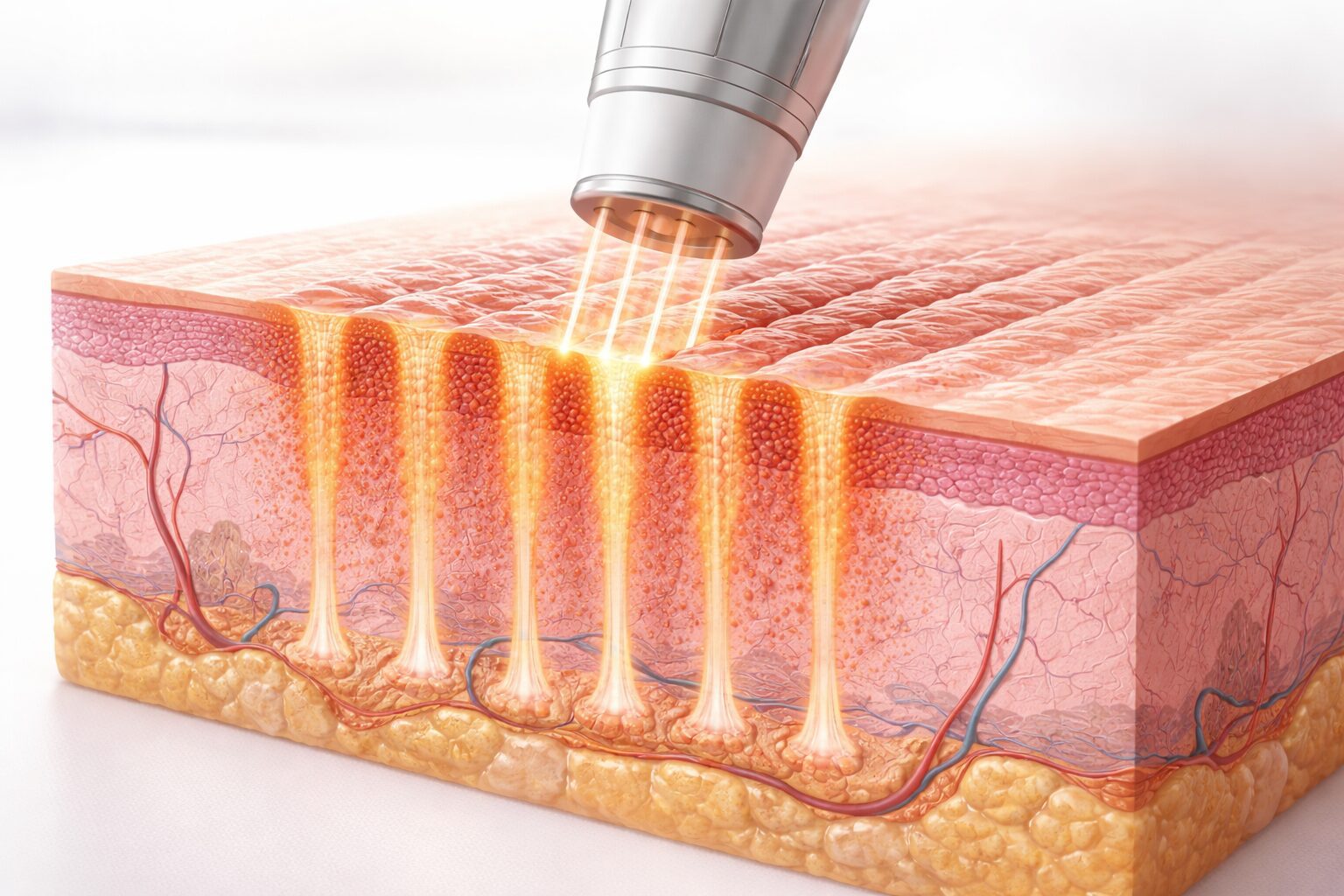
A guide to understanding what CO₂ laser is, how it works on the skin and in what cases it is used, risks and care.
Before reading: En skinpaths We distinguish between opinion and evidence. To write this content, we prioritized indexed medical sources and recommendations from scientific societies. At the end, you will find the complete bibliography for your reference.
Important: This article is for informational purposes only and does not replace medical advice. If you have any questions, persistent symptoms, or your condition worsens, consult a healthcare professional.
Summary in 60 seconds
- The CO₂ laser is a medical technology that “interacts” primarily with the water in the skin.
- When applied in a controlled manner, it can remove damaged surface layers and/or create micro-treatment zones to stimulate collagen repair and remodeling.
- In dermatology it is used, above all, to improve texture, some scars (for example, from acne), fine wrinkles and certain selected benign lesions.
- The results depend on the diagnosis, the type of laser (full or fractional ablative), the skin phototype, and the aftercare.
- It requires professional evaluation because it also has risks: pigmentation changes, infection, scarring, and recovery time.
What is it?
The CO₂ (carbon dioxide) laser is a laser that emits infrared light (wavelength 10.600 nm). In practice, it is used as a "precision" tool for treating skin: it can vaporize superficial tissue while simultaneously producing a controlled thermal effect that promotes repair. Janik 2007
What is?
In dermatology, its most frequent uses include:
- Skin rejuvenation (“resurfacing”): improvement of fine wrinkles, pores and uneven texture due to photoaging.
- Scars: especially atrophic acne scars (sunken) and some selected surgical scars.
- Specific benign lesions (as assessed): for example, some warts, thickened lesions or surface irregularities, when the specialist considers it appropriate.
- These uses and their selection depend on the case; it is not a "universal" treatment for any stain or lesion. ASDS sf
How Does It Work?
Think of the skin as a tissue with a high "water content." The CO₂ laser is intensely absorbed by this water. Upon absorption, it transforms energy into very localized heat: it can vaporize a very thin fraction of tissue and leave around a controlled heat zoneThis combination allows:
- Remove altered surface layers (when used as an ablative).
- Activate repairDuring healing, collagen is reorganized and the skin surface is renewed.
Two common uses
- Complete ablative (full-field): It treats the entire surface of an area. It usually has a greater "impact" and also a faster recovery time.
- Fractional ablative: It treats microscopic "columns" leaving intact skin between them, which speeds up recovery in many cases. Omi 2014
What to expect? (before / during / after treatment)
Before
- Medical evaluation and diagnosis: The first step is to confirm what you want to treat and whether the CO₂ laser is the best option.
- Background check: tendency to abnormal scarring, recurrent cold sores, medications, recent sun exposure, pregnancy (depending on the case) and phototype.
- Realistic plan: In scarring, the goal is usually to to improve texture and relief, do not "erase" completely. AAD sf
During
- May require topical anesthesia, Anesthesia local or, in more extensive procedures, other analgesic measures according to professional judgment.
- It's common to feel heat, itching o burning during and after the session (at varying intensity).
After
- In ablative treatments, it is common to see redness, inflammation y crusts/exudate the first few days. Re-epithelialization (surface closure) usually occurs around 1–2 weeks in many protocols, but the redness may last longer. MSKCC sf
- The improvement in texture and firmness can be progressive over weeks to months, because collagen remodeling is gradual.
Aftercare
Exact aftercare varies depending on the laser's power, type (whole ablative vs. fractional), the treatment area, and your skin type. Generally, it includes:
- Gentle hygiene as directed and keep the area with the protection/ointment prescribed to promote proper healing.
- Strict photoprotectionThe sun can worsen redness and promote blemishes.
- avoid irritants (for example, acids, exfoliants, fragrances) until authorized by the team.
- Do not manipulate scabs: pulling them out increases the risk of pigmentation and scarring.
If you have eczema, rosacea, or another skin condition, please mention it: it may require adjustments to the plan.
Expected vs. unexpected effects
Expected (usual)
- Redness and sensitivity.
- Swelling, a feeling of heat or tightness.
- Crusts or scaling (more in complete ablatives).
- Temporary darkening (“more tanned skin”) or temporary lightening in some phototypes, while pigmentation normalizes.
Not expected (require assessment)
- pain that increases instead of improving.
- Yellow/greenish discharge, foul odor, or rapid worsening of redness (suggests infection).
- Extensive blisters or black/ulcerated areas.
- Persistent worsening of spots or appearance of raised scarring. Yumeen 2023
Warning signs (emergency)
Query immediately Consult your dermatologist if any of the following appear:
- Fever, chills, or marked general malaise.
- Disproportionate or rapidly worsening intense pain.
- Redness that expands, pus, or upward red lines.
- Significant swelling around the eyes or difficulty opening them.
- Vision problems or eye pain (if the treatment was close to the eyes).
- Persistent bleeding or a wound that “does not close” as directed.
FAQ
Does CO₂ laser "fine-tune" the skin or weaken it?
- Properly indicated and well maintained, it seeks a controlled renewal. The goal is not to "weaken," but to repair and reorganize. Safety depends on the protocol and monitoring.
Does CO₂ laser completely remove a scar?
- The most common is to improve Texture and relief; it cannot be completely erased. The response varies depending on the type of scar and skin. AAD sf
How long does recovery last?
- It depends on the type of treatment. In many ablative cases, superficial healing can take around 1–2 weeks; redness may persist longer. MSKCC sf
Fractional or full ablative: which is “better”?
- There is no single "best" option. Whole-body ablation is usually more intense and requires a longer recovery time; fractional ablation can balance effectiveness and recovery for many patients. The choice depends on the patient's goals and risk.
Can it be done on dark skin?
- It can be done in some cases, but the risk of pigmentation changes may be higher and requires careful selection, appropriate parameters and strict photoprotection.
Can it worsen blemishes or cause hyperpigmentation?
- Yes, it is a recognized risk, especially with sun exposure or a predisposition. Prior expert assessment, a good prevention plan, and proper care reduce the likelihood, but do not eliminate it.
How many sessions are needed?
- For some indications, one session may suffice; for scars or texture, several sessions are often recommended. It depends on the objective, tolerance for recovery time, and response.
Bibliography and sources
- Janik JP, Markus RF, Biesman BS. Laser resurfacing. Facial Plast Surg Clin North Am. 2007. Janik 2007
- Omi T, Numano K. The role of the CO2 laser and fractional CO2 laser in dermatology. Laser Therapy.2014;23(1):49–60. Omi 2014
- Hedelund L, Moreau KE, Beyer DM, Nymann P, Haedersdal M. Ablative fractional CO2 laser resurfacing for atrophic acne scars: a randomized controlled trial. J Eur Acad Dermatol Venereol. 2012. Hedelund 2012
- Zhang DD, Chen Y, Lv ZY, Li Q. The efficacy of fractional CO2 laser in acne scar treatment: a systematic review and meta-analysis. Dermatol Ther. 2021. Zhang 2021
- Yumeen S, Brennan D, Chaffins ML. Carbon Dioxide Laser Resurfacing. StatPearls [Internet]. 2023. Yumeen 2023
- American Society for Dermatologic Surgery (ASDS). Laser Resurfacing (patient information). ASDS sf
- American Academy of Dermatology (AAD). 10 things to know before having laser treatment for your scar (patient information). AAD sf
- Mayo Clinic. Laser resurfacing (overview for patients). 2024. Mayo Clinic 2024
- Memorial Sloan Kettering Cancer Center. Skin care after fractionated carbon dioxide laser treatment (patient education). MSKCC sf

 |
|