
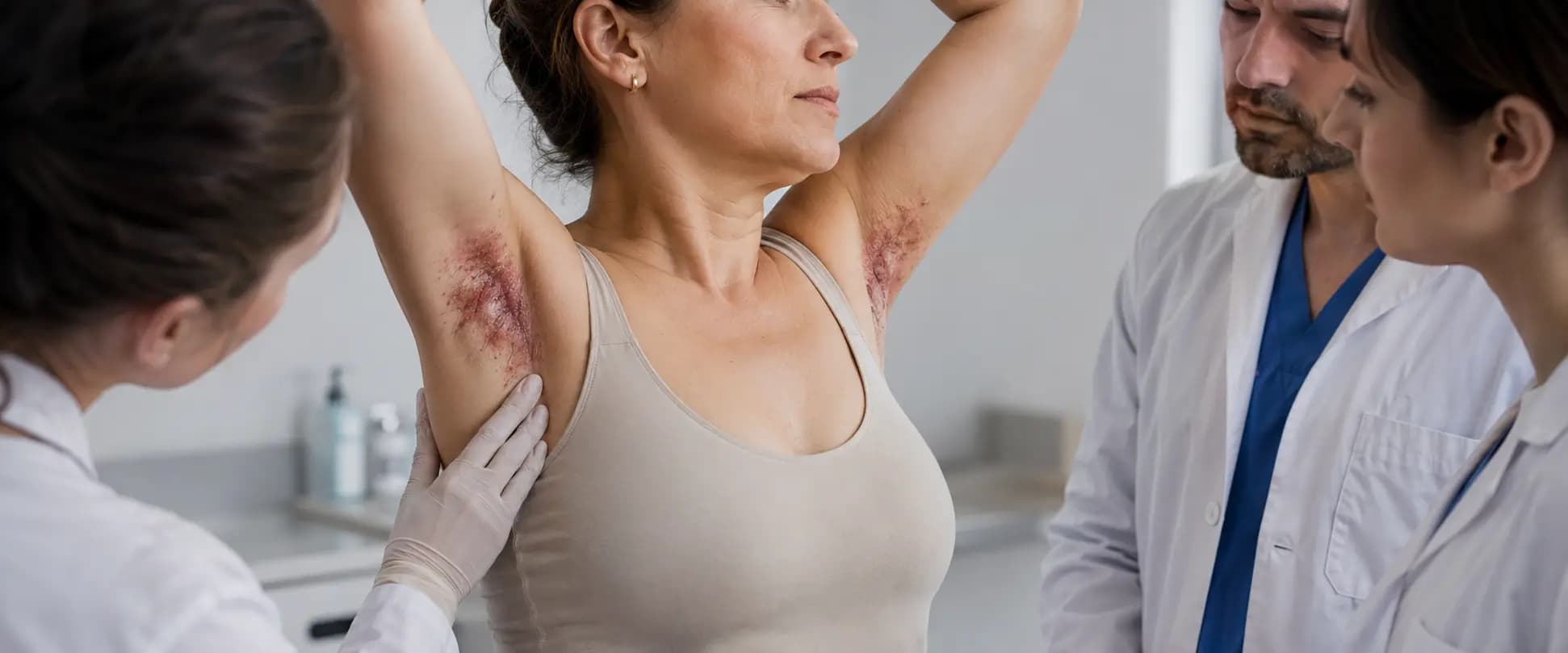
A rare genetic disease that causes recurring outbreaks of fragile, painful, and eroded skin, especially in the folds.
Before you read: At Skinpaths, we distinguish between opinion and evidence. To write this content, we prioritized indexed medical sources and recommendations from scientific societies. You’ll find the complete bibliography at the end for your reference.
Important: This article is for informational purposes only and does not replace medical advice. If you have any questions, persistent symptoms, or your condition worsens, consult a healthcare professional.
Summary in 60 seconds
- Hailey-Hailey disease is an inherited disorder that weakens the bond between cells in the epidermis.
- It is not contagious, it is not due to an allergy, and it is not an autoimmune disease.
- It usually begins after puberty or during adulthood, although it can appear at any age.
- It mainly affects the armpits, groin, neck, area under the breasts and the fold between the buttocks.
- Heat, sweat, humidity, and friction can trigger or worsen outbreaks.
- The lesions can cause burning, itching, pain, fissures, discharge, and, if infected, a bad odor.
- The diagnosis is usually based on examination and can be confirmed by a skin biopsy.
- Currently there is no treatment that definitively corrects the genetic alteration, but many outbreaks can be controlled.
- Fever, severe pain, rapid spread, or clustered blisters require immediate medical evaluation.
What is Hailey-Hailey disease?
Hailey-Hailey disease is a genodermatosis , meaning a genetic disorder that primarily affects the skin. It is also historically known as benign familial pemphigus or benign familial chronic pemphigus .
Despite these names, it does not belong to the group of autoimmune pemphigus. In Hailey-Hailey disease, the autoantibodies characteristic of pemphigus vulgaris are not formed. It is also not transmitted through physical contact, sexual relations, towels, or cohabitation. Porro 2024
This alteration causes the cells in the skin’s surface layer to lose some of their cohesion. As a result, the epidermis becomes especially vulnerable to friction, heat, sweat, and humidity. In skin folds, where these factors converge, very fragile blisters can appear that rupture quickly, leaving painful erosions.
The word “benign” can be misleading. The disease does not usually affect internal organs or reduce life expectancy on its own, but severe flare-ups can make it difficult to walk, sleep, work, exercise, or have intimate relationships. Pain, odor, and recurrence can also significantly affect self-esteem and quality of life. Rogner 2024
Why does it appear?
The genetic cause
Hailey-Hailey disease is usually caused by a pathogenic variant in the ATP2C1 gene. This gene contains the instructions for making a protein called hSPCA1, which is responsible for transporting calcium and manganese into cells.
Calcium balance is important for keratinocytes—the main cells of the epidermis—to remain attached. When the hSPCA1 protein does not function properly, this adhesion weakens and the cells can separate. This phenomenon is called acantholysis . Hu 2000
A simple way to visualize this is to think of a brick wall: the keratinocytes would be the bricks, and the connective structures would act as the mortar. In Hailey-Hailey disease, the mortar is less resistant, so the skin’s surface wall is less able to withstand friction.
How is it inherited?
Transmission is usually autosomal dominant . This means that an affected person has a 50% chance of passing the genetic variant on to their child in each pregnancy.
Inheriting the variant does not predict disease severity. Even within the same family, one person may experience mild outbreaks while another may have extensive or painful lesions. There are also patients with no known family history, either due to a new variant or because other family members have very mild symptoms. MedlinePlus Genetics 2020
When there are doubts about familial transmission, genetic counseling can help interpret the risk without replacing the personal decisions of each family.
Cause and triggers are not the same thing
The underlying cause is a genetic alteration. Heat, sweat, or friction do not cause the disease, but they can trigger a flare-up in predisposed skin.
The most clinically recognized triggers are:
- heat and sweating;
- persistent humidity;
- friction between skin surfaces or with clothing;
- sunburn;
- bacterial, fungal, or viral infections on a previous injury.
Some people identify other individual factors. Keeping a flare-up diary can be helpful, but a personal association does not necessarily prove that a factor is a universal cause. British Association of Dermatologists 2019
What does it look like and what symptoms does it cause?
The first lesions may appear as small, superficial blisters. Because their roof is very thin, they often rupture before the person can clearly see them. The most common findings are:
- red, moist or macerated areas;
- superficial erosions, like «raw» skin;
- painful fissures;
- scaling or crusting;
- irregular edges that may extend around the fold.
The most common areas affected are the armpits, groin, sides of the neck, under the breasts, and the crease between the buttocks. It can also affect the genital or perianal area. Less frequently, lesions appear in other areas subject to friction.
Burning, itching, and pain are common. A fissure in the groin, for example, can be painful when walking because the skin surfaces rub together repeatedly. Sweating often increases the burning sensation.
Bacteria, fungi, and the herpes simplex virus can take advantage of a compromised skin barrier. A secondary infection can lead to increased pain, discharge, crusting, a new or stronger odor, and rapid spread. Odor should not automatically be interpreted as poor hygiene; it may be due to maceration, microbial colonization, or infection.
Between flare-ups, the skin may return to an almost normal appearance. The lesions usually heal without scarring, although they may leave darker or lighter pigmentation for several months. Some people also develop white longitudinal lines on their nails, a finding that can help guide the diagnosis. British Association of Dermatologists 2019
Due to its location, Hailey-Hailey lesions can resemble candidiasis, dermatophyte infection, bacterial intertrigo, irritant or contact dermatitis, eczema, or inverse psoriasis. Some autoimmune blistering diseases may also be considered in the differential diagnosis. If a suspected fungal infection recurs repeatedly, affects several skin folds similarly, or does not improve with appropriate treatment, the diagnosis should be reconsidered.
What can you do today?
The following measures are complementary. They do not replace specialized medical assessment and monitoring.
Keep the folds fresh
Reduce prolonged exposure to heat and change out of wet clothes after sweating. Fans, air conditioning, lukewarm or cool showers, and breaks during physical activity can reduce maceration.
It’s not necessary to automatically stop exercising. It may be more sensible to adjust the timing, intensity, clothing, and type of activity to reduce heat and friction.
It reduces friction
Choose soft, loose-fitting, and breathable clothing. Check for seams, elastic, or straps that don’t put pressure on the same spot. In some areas, non-adherent absorbent material can be used, provided it is changed frequently and doesn’t keep the skin damp.
If there is significant rubbing between skin folds, the medical team may consider various strategies, including weight management when appropriate. Weight is not the genetic cause of Hailey-Hailey and should not be approached with guilt.
Clean without harming
Wash the area with lukewarm water and a mild, fragrance-free cleanser, or with the product recommended by your dermatologist. Avoid rubbing with sponges or brushes. To dry, gently pat with a clean towel or use a cool, dry air source.
More intense cleansing does not necessarily mean healthier skin. Excessive soap, exfoliation, or friction can worsen skin fragility.
Protects without over-occluding
A simple barrier, such as a zinc oxide paste, can reduce contact with moisture and friction for some people. However, not all products are appropriate for a very moist, infected, or extensive wound. Discontinue use of any product that causes persistent burning or worsening of the wound.
Adhesive dressings and highly occlusive coverings can tear the epidermis or retain moisture.
Request a written plan for the first symptoms
Many people experience itching, stinging, or burning before extensive erosion develops. A dermatologist can advise on the appropriate treatment at this stage, its duration, and under what circumstances it should be discontinued or a follow-up appointment requested.
This plan is safer than self-administering alternating corticosteroids, antibiotics, and antifungals. Primary Care Dermatology Society 2021
It tracks the evolution
Photograph the lesions under similar lighting and note any triggers, the treatment used, and the response time. This record helps differentiate isolated observations from recurring patterns and facilitates more accurate consultation.
Controlling heat, sweating, friction, and infection are central to daily management. British Association of Dermatologists 2019
Controlling heat, sweat, moisture, friction, and infection can be just as important as choosing a medication.
What NOT to do?
- Do not apply bleach, alcohol, hydrogen peroxide, concentrated vinegar, essential oils, or homemade mixtures to broken skin. Some diluted formulas are used in specific medical contexts, but the concentration and indication should be determined by a professional.
- Do not leave a strong corticosteroid in skin folds for extended periods without supervision. These areas absorb more medication and are vulnerable to skin thinning, stretch marks, and other adverse effects.
- Do not use leftover antibiotics or antifungals for each new outbreak. The lesion may not be infected, the microorganism may be different, and unnecessary use promotes resistance.
- Do not pop blisters or aggressively remove scabs. Trauma widens the wound and makes it easier for microorganisms to enter.
- Do not cover the area for long periods with plastic, adhesive tape, or very tight bandages.
- Don’t assume all outbreaks are the same. A more painful, faster-lasting, or fever-inducing episode may indicate a secondary infection and require different treatment.
Topical treatments are often important, but the duration, potency, and combination must be adjusted to the affected area and the presence or absence of infection. Chiaravalloti 2014
When should I consult?
Red flags: seek medical evaluation the same day
- Fever, chills, general malaise, or unusual weakness.
- Rapid increase in redness, heat, swelling, or pain.
- Pus, abundant discharge, extensive scabs, or a new and intense odor.
- Clusters of small blisters or very painful erosions, especially if you have a history of oral or genital herpes.
- Rapid spread of the lesions or involvement of a large surface area.
- Pain that prevents walking, sleeping, sitting, or performing basic activities.
- Injuries near the eyes or eye symptoms.
A skin herpes simplex infection with Hailey-Hailey lesions can spread and requires early antiviral treatment. Extensive bacterial infections may also require systemic medication. British Association of Dermatologists 2019
Request a priority dermatology consultation when
- is the first episode or the diagnosis is not confirmed;
- Outbreaks are becoming more frequent, widespread, or resistant;
- You need corticosteroids or antimicrobials repeatedly;
- Pain, odor, or injuries affect work, sleep, physical activity, or intimacy;
- a persistently thickened, ulcerated, raised, or bleeding area appears;
- an injury does not heal or changes in appearance gradually.
Transformation to squamous cell carcinoma is very rare , but a chronic lesion that bleeds, grows, or does not heal warrants medical evaluation and, sometimes, biopsy. MedlinePlus Genetics 2020
What does a dermatologist usually do?
1. Reconstruct the disease pattern
The dermatologist will ask when the problem started, where the outbreaks occur, what triggers them, how long they last, and what treatments have been used. A family history is helpful, but its absence does not rule out Hailey-Hailey syndrome.
The examination may include other apparently healthy skin folds, the nails, and the perianal or genital areas when clinically necessary. Signs of infection, maceration, or damage from previous treatments will also be sought.
2. Use dermatoscopy as a complement
Dermatoscopy allows the observation of structures and vessels that are not as clearly visible to the naked eye. It can provide information, but there is no single dermatoscopic pattern that, by itself, confirms all cases of Hailey-Hailey syndrome.
3. Investigate a possible infection
If there is discharge, crusting, odor, disproportionate pain, or an insufficient response, samples may be taken for bacterial culture or fungal examination. In the case of clustered blisters or very painful erosions, a test for herpes simplex may be requested.
The goal is to treat the identified microorganism and avoid the repeated use of unnecessary antibiotics or antifungals.
4. Perform a biopsy when necessary
Confirmation is usually made by taking a small biopsy of an active lesion that still has sufficient epidermis. Under a microscope, the pathologist looks for extensive loss of cohesion between keratinocytes, known as suprabasal acantholysis. The classic image is compared to a “deteriorated/dilapidated brick wall.”
When it is necessary to rule out autoimmune pemphigus, another sample can be obtained for direct immunofluorescence. At Hailey-Hailey, this test is usually negative.
Genetic testing is not essential for all patients. It may be considered in atypical presentations, complex diagnoses, or situations where the result is relevant for family counseling. Porro 2024
5. Design a treatment based on intensity and recurrence
Limited disease or initial outbreak. Treatment usually includes measures to reduce friction and moisture, along with a topical corticosteroid for a short period. If infection is present, a targeted antimicrobial is added.
Maintenance or repeated flare-ups. In some patients, topical tacrolimus or pimecrolimus is used to reduce cumulative corticosteroid exposure. Skin barriers, antiperspirants on non-eroded skin, and other sweat control strategies may also be considered.
Extensive or difficult-to-control disease. The specialist may consider certain oral antibiotics for their antimicrobial or anti-inflammatory effects, antivirals when recurrent herpes is present, and other systemic medications. Many of these indications are off-label and require evaluation of interactions, tests, and adverse effects.
This is a localized and resistant condition. Botulinum toxin can reduce sweating in the armpits or groin. In selected cases, ablative lasers, dermabrasion, or surgery are considered.
Responses have also been reported with low-dose naltrexone, biologics, and inhibitors of certain inflammatory pathways. However, most of this information comes from small series and case reports; a favorable individual response does not guarantee the same outcome for everyone.
In terms of evidence, environmental measures, short-term topical anti-inflammatories, and targeted treatment of infections remain the most widely accepted approach. Systemic and emerging therapies should be individualized in experienced units. Ben Lagha 2020 Mathur 2025
Frequently Asked Questions
Is Hailey-Hailey disease contagious?
- No. It cannot be transmitted through physical contact, cohabitation, sexual activity, swimming pools, towels, or clothing. Infections that appear on the erosions may require specific precautions, but the underlying genetic condition is not contagious.
Is it an autoimmune disease?
- No. The historical name “benign familial pemphigus” can be confusing, but Hailey-Hailey is primarily due to a genetic alteration of epidermal cohesion, not to autoantibodies directed against the skin.
Will my children necessarily have the disease?
- Not necessarily. When one parent carries the genetic variant, each child has a 50% chance of inheriting it. Each pregnancy is a separate event. Furthermore, the severity can vary greatly among family members.
Is there a cure?
- Currently, there is no treatment that permanently corrects the genetic variant in routine clinical practice. However, this does not mean that all patients will have permanent lesions. Prolonged remissions can occur, and some people experience less disease activity with age.
Is there a special diet for Hailey-Hailey?
- No diet is part of the standard treatment for the genetic cause. A balanced diet can promote overall health, but extensive restrictions, supplements, or very strict diets should be avoided without specific medical advice. When skin fold friction is significant, a healthy weight management strategy can help reduce friction, but it does not alter the genetic predisposition or constitute a cure.
Can I exercise?
- In many cases, yes. It may be necessary to adjust activity to reduce heat, sweat, and friction: train in cool environments, choose soft clothing, change out of damp garments, and avoid movements that repeatedly injure the same skin fold. During a painful flare-up, it may be reasonable to temporarily reduce certain activities, without making permanent avoidance the only strategy.
Can it turn into cancer?
- It is very rare. Squamous cell carcinomas have been described arising from chronic lesions, especially in certain genital locations. Any area that grows, hardens, bleeds, or does not heal should be evaluated, but this risk does not mean that common outbreaks will necessarily develop into cancer.
Bibliography and sources
- Porro AM, Arai Seque C, Miyamoto D, Vanderlei Medeiros da Nóbrega D, Simões E Silva Enokihara MM, Giuli Santi C. Hailey-Hailey disease: clinical, diagnostic and therapeutic update . An Bras Dermatol. 2024;99(5):651-661. doi:10.1016/j.abd.2023.12.003.
- Hu Z, Bonifas JM, Beech J, Bench G, Shigihara T, Ogawa H, et al. Mutations in ATP2C1, encoding a calcium pump, cause Hailey-Hailey disease . Nat Genet. 2000;24(1):61-65. doi:10.1038/71701.
- Rogner D, Heimerl L, Heyer S, Biedermann T, Sattler E, Zink A. Patients’ perspective, quality of life and treatment goals in Hailey-Hailey disease: lessons learned from the German National Registry . J Eur Acad Dermatol Venereol. 2024;38(2):419-429. doi:10.1111/jdv.19583.
- Ben Lagha I, Ashack K, Khachemoune A. Hailey-Hailey disease: an update review with a focus on treatment data . Am J Clin Dermatol. 2020;21(1):49-68. doi:10.1007/s40257-019-00477-z.
- Mathur M, Paudel S, Bhattarai N, Karki S, Regmi S. Hailey-Hailey disease: an updated review with a focus on therapeutic mechanisms . Health Sci Rep 2025;8(7):e71061. doi:10.1002/hsr2.71061.
- Arora H, Bray FN, Cervantes J, Falto-Aizpurua LA. Management of familial benign chronic pemphigus . Clin Cosmet Investig Dermatol. 2016;9:281-290. doi:10.2147/CCID.S89483.
- Chiaravalloti A, Payette M. Hailey-Hailey disease and review of management . J Drugs Dermatol. 2014;13(10):1254-1257.
- British Association of Dermatologists. Hailey-Hailey disease: patient information leaflet . London: British Association of Dermatologists; update October 2019 [citado 16 jul 2026] .
- Primary Care Dermatology Society. Hailey-Hailey disease: familial benign chronic pemphigus . Primary Care Dermatology Society; 2021 [citado 16 jul 2026] .
- DermNet. Hailey-Hailey disease: benign familial pemphigus . Hamilton: DermNet New Zealand; updated June 2023 [citado 16 jul 2026] .
- National Library of Medicine. Hailey-Hailey disease . MedlinePlus Genetics. Bethesda (MD): National Library of Medicine; 2020 [citado 16 jul 2026] .
Categories: Skin blisters

Content reviewed by
Dr. Rodolfo Suárez
Médico Patólogo y Dermatólogo Master en Patología Cutánea Avanzada
- Published
- September 18, 2026
- Updated
- September 23, 2026
Medically reviewed by specialists
Our content is based on current scientific evidence and clinical protocols.