
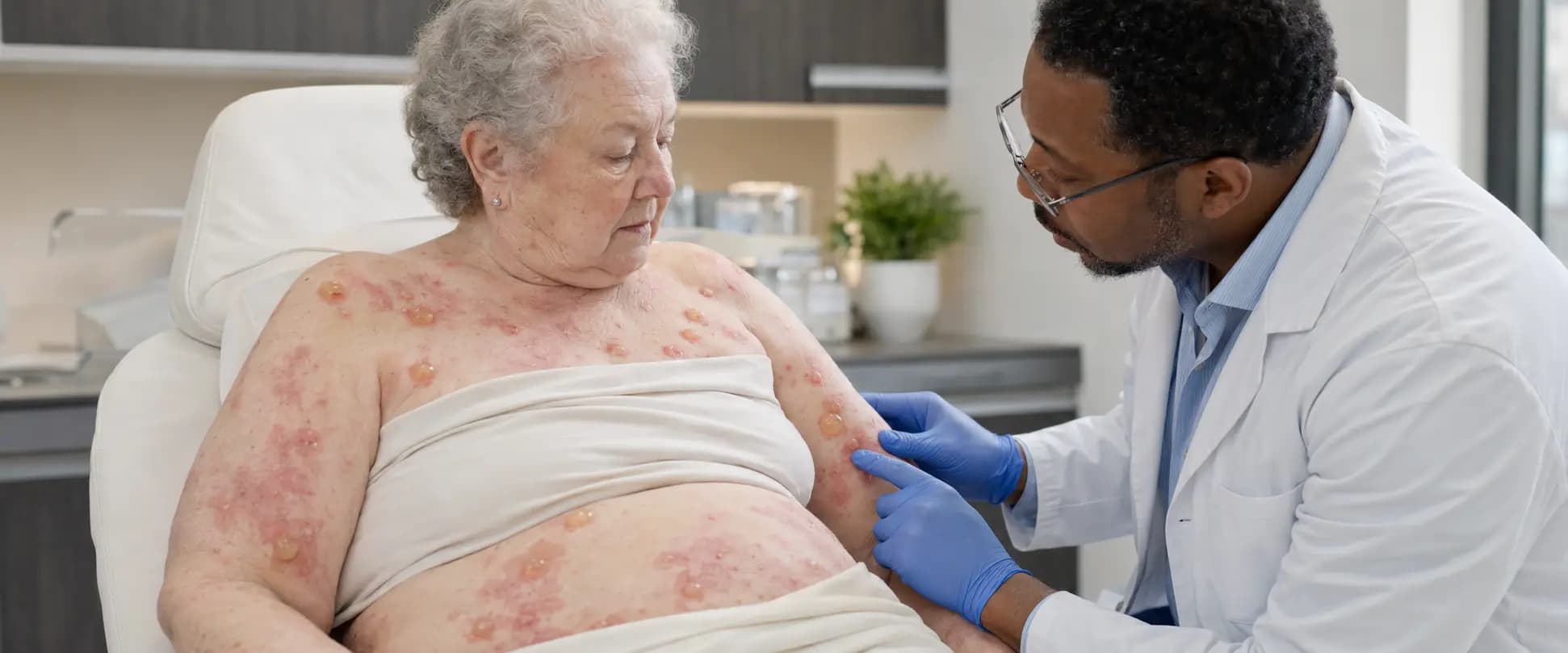
An autoimmune disease that can begin with intense itching before blisters appear.
Before you read: At Skinpaths, we distinguish between opinion and evidence. To write this content, we prioritized indexed medical sources and recommendations from scientific societies. You’ll find the complete bibliography at the end for your reference.
Important: This article is for informational purposes only and does not replace medical advice. If you have any questions, persistent symptoms, or your condition worsens, always consult a healthcare professional.
Summary in 60 seconds
- Bullous pemphigoid is a rare autoimmune skin disease.
- It appears mainly in older people, although it can occur at other ages.
- It often begins with intense itching and rashes resembling hives or eczema.
- Afterwards, large, firm, and tight blisters may appear.
- Some people experience itching and inflamed lesions without developing visible blisters.
- It is not contagious and is not due to insufficient hygiene.
- Diagnosis usually requires skin biopsies and, sometimes, antibody testing.
- The treatment aims to stop new blisters from forming and reduce the risks associated with the medication.
- Fever, increasing pain, or signs of infection require immediate evaluation.
What is bullous pemphigoid?
Bullous pemphigoid is a disease in which the immune system mistakenly attacks structures that hold together the superficial and deep layers of the skin. The main targets of these antibodies are proteins called BP180 and BP230 .
Because the separation occurs beneath the epidermis, the blisters are usually firmer and more resistant than those of pemphigus. It is not an infection, a common allergy, or a communicable disease. Miyamoto 2019 .
A new and intense itching may precede the blisters by weeks or months.
Why does it appear?
In most cases, a single trigger is not identified. Advanced age is the main associated factor. It is also more frequently observed in people with neurological conditions, such as dementia, Parkinson’s disease, epilepsy, or a history of stroke; however, this association does not prove that these conditions are the direct cause.
Some medications can act as triggers in susceptible individuals. The most consistent association has been observed with certain diabetes treatments called DPP-4 inhibitors or gliptins . There are also cases linked to other medications and cancer treatments. Medication should not be discontinued without medical evaluation. Phan 2020 .
What does it look like and what symptoms does it cause?
The most common initial symptom is intense itching , either localized or generalized. For weeks or months, raised, red, urticarial or eczematous patches may appear without blisters.
When they appear, blisters are usually:
- Large, rounded, and tense.
- Of clear or, occasionally, bloody content.
- More common in the abdomen, groin, armpits and flexural areas.
- Painful or sensitive when they break and leave an erosion.
The mouth may be affected, but this is less common than in other blistering diseases. In dark skin, the redness may appear brown, purplish, or be faint. BAD 2023, AAD 2021 .
What can you do today?
- Always seek prompt medical evaluation by a specialist if you experience tense blisters or intense itching without explanation.
- Photograph any new lesions and note when they appeared.
- Protect broken blisters with clean, non-adherent dressings.
- Wear loose clothing and reduce friction on the skin.
- Apply cool compresses to itchy areas, without rubbing.
- Bring to the appointment a complete list of medications and the approximate date you started taking them.
Large blisters should only be drained after a medical professional has explained how to do so safely. AAD 2021 .
What NOT to do?
- Do not break blisters with needles or household instruments.
- Do not apply alcohol, caustic substances, essential oils, or irritating remedies.
- Do not start taking corticosteroids, antibiotics, or immunosuppressants on your own.
- Do not stop taking medication for diabetes, blood pressure, or other illnesses without medical advice.
- Don’t delay seeking medical advice thinking it’s just an allergy.
- Do not abruptly stop a prescribed corticosteroid treatment.
When should I consult?
Any suspicion of bullous pemphigoid deserves priority dermatological evaluation, especially in an elderly person with recently developed itching.
Seek immediate medical attention if any of these signs appear:
- Fever, chills, severe weakness, or confusion.
- Blisters that spread rapidly.
- Increasing pain, heat, pus, foul odor, or redness around the wounds.
- Difficulty eating, drinking, or swallowing.
- Injuries to the eyes, mouth or genitals.
- Signs of dehydration or decreased urine output.
- Worsening in a frail, immunosuppressed, or multi-illness individual.
Open erosions can become infected and, in vulnerable people, cause major complications.
What does a dermatologist usually do?
The dermatologist examines the distribution of the lesions, reviews medications, and looks for signs of infection or mucosal involvement. Dermatoscopy can provide additional information, but it does not, on its own, confirm the diagnosis .
Usually two samples are taken:
- A biopsy of the edge of a recent blister for histopathological study.
- Another image of apparently healthy skin, next to a lesion, for direct immunofluorescence .
This latter test looks for linear deposits of IgG and complement in the basement membrane. Blood tests for anti-BP180 and anti-BP230 antibodies can support the diagnosis and, in certain cases, help assess disease activity. Miyamoto 2019 , Van Beek 2024 .
Treatment depends on the extent of the injuries, age, autonomy, and accompanying illnesses:
- High-potency topical corticosteroids are a first-line option when they can be applied correctly.
- Oral corticosteroids may be necessary in extensive disease or disease that is difficult to manage with topical treatment.
- In selected patients, doxycycline or other corticosteroid-sparing drugs may be considered.
- Resistant cases may require specialized immunomodulatory treatments.
The goal is not to administer the largest possible amount of medication, but to achieve control with the least effective and safe exposure . Joly 2002 , Williams 2017 and Borradori 2022 .
Frequently Asked Questions
Is it contagious?
- No. It is not transmitted through contact, clothing, towels, or cohabitation.
Is it an allergy?
- It’s not a conventional allergy. It’s an autoimmune disease, although some initial lesions may resemble an allergic reaction or hives.
Can it disappear?
- In some people, it goes into remission after months or years. It can also relapse, so treatment is usually reduced gradually and under supervision.
Can it affect the mouth?
- Yes, although it is less frequent. Predominant involvement of the eyes, mouth, throat, or genitals necessitates ruling out other variants of pemphigoid.
Should I stop taking a suspected medication?
- Not on your own. The doctor must assess the strength of the combination, the need for the medication, and the available alternatives.
Is it the same as pemphigus?
- No. In pemphigoid, the blisters form deeper and are usually tense. In pemphigus, they tend to be more fragile, and mucosal involvement is more common. Confirmation requires specific tests.
Does it leave scars?
- It usually heals without scarring, but may leave temporary light or dark spots. Infection, scratching, or deep wounds can disrupt healing.
Bibliography and sources
- Borradori L, Van Beek N, Feliciani C, et al. Updated S2 K guidelines for the management of bullous pemphigoid initiated by the European Academy of Dermatology and Venereology . J Eur Acad Dermatol Venereol. 2022;36(10):1689-1704. doi:10.1111/jdv.18220.
- Venning VA, Taghipour K, Mohd Mustapa MF, Highet AS, Kirtschig G. British Association of Dermatologists’ guidelines for the management of bullous pemphigoid 2012 . Br J Dermatol. 2012;167(6):1200-1214. doi:10.1111/bjd.12072.
- Miyamoto D, Santi CG, Aoki V, Maruta CW. Bullous pemphigoid . An Bras Dermatol. 2019;94(2):133-146. doi:10.1590/abd1806-4841.20199007.
- Van Beek N, Holtsche MM, Atefi I, Olbrich H, Schmitz MJ, Pruessmann J, et al. State-of-the-art diagnosis of autoimmune blistering diseases . Front Immunol. 2024;15:1363032. doi:10.3389/fimmu.2024.1363032.
- Joly P, Roujeau JC, Benichou J, Picard C, Dreno B, Delaporte E, et al. A comparison of oral and topical corticosteroids in patients with bullous pemphigoid . N Engl J Med. 2002;346(5):321-327. doi:10.1056/NEJMoa011592.
- Williams HC, Wojnarowska F, Kirtschig G, Mason J, Godec TR, Schmidt E, et al. Doxycycline versus prednisolone as an initial treatment strategy for bullous pemphigoid: a pragmatic, non-inferiority, randomized controlled trial . Lancet. 2017;389(10079):1630-1638. doi:10.1016/S0140-6736(17)30560-3.
- Phan K, Charlton O, Smith SD. Dipeptidyl peptidase-4 inhibitors and bullous pemphigoid: a systematic review and adjusted meta-analysis . Australas J Dermatol. 2020;61(1):e15-e21. doi:10.1111/ajd.13100.
- American Academy of Dermatology Association. Bullous pemphigoid: signs and symptoms [Internet] . 2021 Sep 21 [citado 2026 Jul 20] .
- American Academy of Dermatology Association. Bullous pemphigoid: self-care [Internet] . 2021 Sep 21 [citado 2026 Jul 20] .
- British Association of Dermatologists. Pemphigoid, also known as bullous pemphigoid [Internet] . 2023 May [citado 2026 Jul 20] .
Categories: Skin blisters

Content reviewed by
Dr. Rodolfo Suárez
Médico Patólogo y Dermatólogo Master en Patología Cutánea Avanzada
- Published
- September 18, 2026
- Updated
- September 23, 2026
Medically reviewed by specialists
Our content is based on current scientific evidence and clinical protocols.