
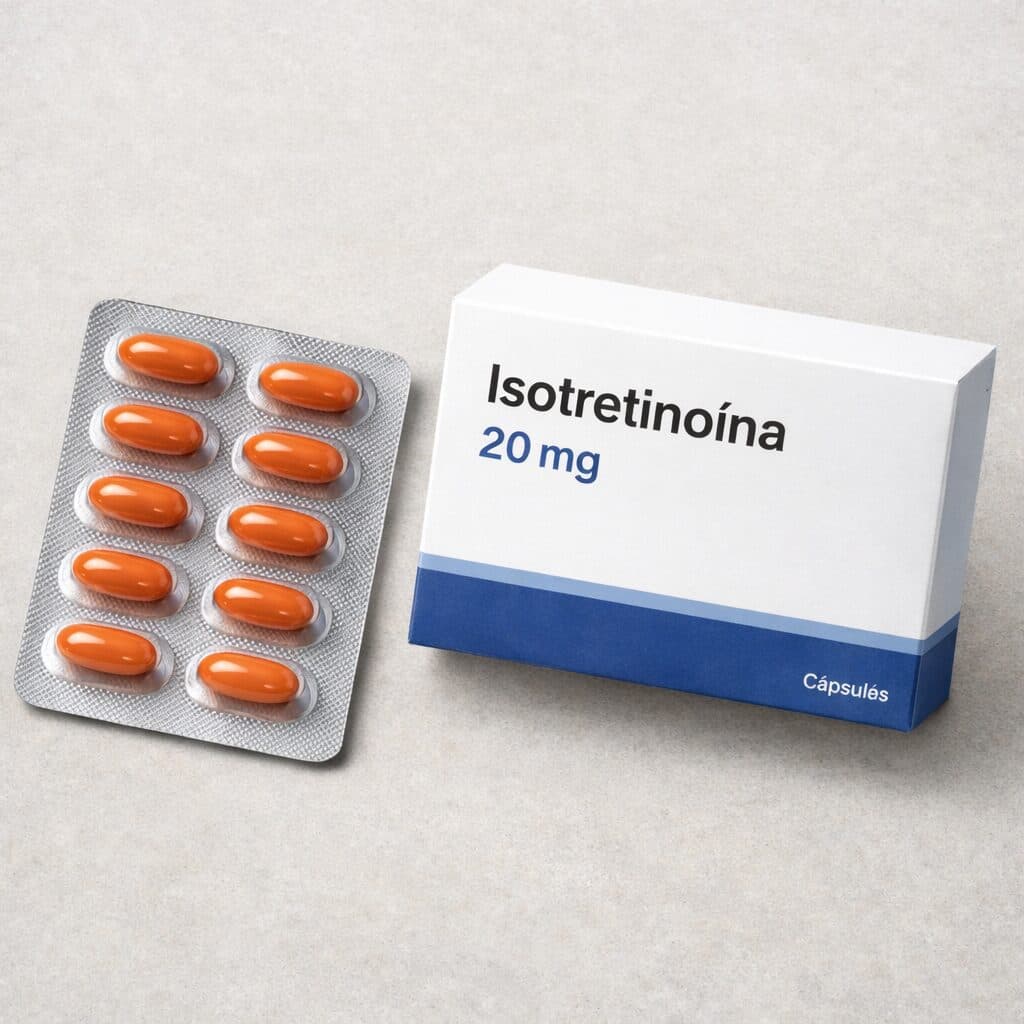
A complete guide to safe use, controls, monitoring and contraindications.
Before you read: At Skinpaths, we distinguish between opinion and evidence. To write this content, we prioritized indexed medical sources and recommendations from scientific societies. You’ll find the complete bibliography at the end for your reference.
Important: This article is for informational purposes only and does not replace medical advice. If you have any questions, persistent symptoms, or your condition worsens, consult a healthcare professional.
Summary in 60 seconds
- Oral isotretinoin is a retinoid (vitamin A derivative) primarily indicated for severe acne , acne with a risk of scarring , significant emotional impact, or acne that does not respond to standard treatments. It is strongly recommended in current guidelines. Reynolds 2024
- It acts on several «engines» of acne: it reduces the size and activity of the sebaceous glands, helps to normalize pore obstruction, and decreases inflammation.
- It requires a prescription and strict medical monitoring : education, medication review, and in many people , laboratory tests and strict pregnancy prevention due to its high teratogenicity. FDA 2026
- Most common: intense dryness of lips and skin, dry eyes, nosebleeds, photosensitivity, mild muscle pain.
- Warning signs (immediate consultation): severe headache with blurred vision , worrying mood changes, severe abdominal pain, jaundice, bloody diarrhea, severe skin reaction.
What is isotretinoin?
Isotretinoin (known by historical brands such as Roccutane and by multiple generics) is an oral medication that changed the management of acne because it can achieve prolonged remissions in cases where other treatments fall short.
It is considered especially useful when there is:
-
Nodulocystic acne, severe or moderate with scarring or high psychosocial impact.
-
Lack of response to reasonable combinations of topical (retinoid + benzoyl peroxide) and indicated systemic treatments. Reynolds 2024
-
Persistent outbreaks with risk of marks/scarring, or frequent relapses.
How does it work?
Without getting into technicalities, isotretinoin «turns off» several acne switches at once:
-
Reduces sebum
The size and activity of the sebaceous glands decrease. Less sebum means a less favorable environment for acne. Cell studies show pathways that promote the involution/apoptosis of sebocytes. Nelson 2011 -
It helps prevent pores from becoming clogged.
It modulates keratinization: it reduces the formation of microcomedones (seed lesions of acne). -
Lower inflammation
It has direct and indirect anti-inflammatory effects: by reducing sebum and microcomedones, it also decreases the inflammatory cascade. -
Indirectly reduces Cutibacterium acnes
It is not an antibiotic, but by changing the environment of the follicle, it usually reduces bacterial proliferation.
How to choose and how to use it?
The decision and usage plan must be strictly under the supervision of a qualified medical professional . Even so, there are practical points worth knowing.
Who is usually a candidate?
-
Severe acne or acne with risk of scarring.
-
Acne that does not improve with well-prescribed treatments.
-
People with episodes that cause significant emotional distress or affect quality of life. Reynolds 2024
Forms of “application”
-
Oral route (capsules) : This is the standard form for moderate-to-severe/severe acne.
-
Topical : It exists in some places, but it is not the usual approach for severe acne; it should not be confused with other topical retinoids (adapalene, tretinoin, tazarotene), which are different treatments.
What does typical follow-up look like (generally speaking)?
Your dermatologist usually:
-
Review history (liver, lipids, mental health, medications, supplements).
-
Explain expected effects and warning signs.
-
Request baseline analyses and, as appropriate, repeat them during treatment. In large cohorts, severe alterations in triglycerides or liver enzymes were infrequent, which has led to more individualized monitoring strategies (not “monthly for everyone” in all contexts). Barbieri 2019
-
In individuals of childbearing potential: require strict prevention measures and testing according to the regulatory/local program (varies by country). In the U.S., there is a specific program (iPLEDGE) with mandatory requirements. FDA 2026
Self-care that really helps during treatment
-
Lips : thick balm (petrolatum/vaseline or similar) several times a day.
-
Skin : gentle cleanser + simple moisturizer (fragrance-free if it irritates you).
-
Eyes : Use artificial tears if there is dryness, especially if you wear contact lenses.
-
Daily sun protection : the skin is usually more sensitive; sunscreen and shade habits.
-
If you are prone to eczema or have very reactive skin, say so from the start: skin barrier management is key.
Use responsibly
Safety rules you should know
-
Pregnancy: Absolutely contraindicated. Isotretinoin is highly teratogenic. If pregnancy is possible, strict contraindications and testing according to local regulations are required. FDA 2026
-
Do not share the medication (even if another person “has the same acne”).
-
Do not donate blood during treatment and for a period afterward (regulatory programs specify at least 1 month) to avoid accidental exposure in pregnant women. FDA 2010
-
Avoid vitamin A supplements (risk of toxicity).
-
Report all medications, especially tetracyclines (e.g., doxycycline, minocycline) due to the risk of intracranial hypertension/pseudotumor cerebri when combined. Lee 1995
The responsible thing to do here is not to «endure» adverse effects: it is to prevent risks and act in time .
Mental health: a balanced approach
Acne itself can be associated with a greater emotional burden, and the debate about isotretinoin and mood has existed for decades. The best recent population-based evidence does not show an increased relative risk of psychiatric disorders globally, but clinical monitoring is recommended, especially if there is a family history. (Tan 2024)
In practice: if you notice depression, marked irritability, intense anxiety, or thoughts of self-harm, consult your dermatologist immediately .
Contraindications
These may vary depending on the country and product specifications, but generally include:
-
Pregnancy (absolute contraindication) and, in many contexts, breastfeeding .
-
Hypersensitivity to the drug or excipients.
-
Concomitant use with tetracyclines (due to the risk of intracranial hypertension). Lee 1995
-
Important caution (individual assessment) in:
-
Liver disease, significant hypertriglyceridemia, previous pancreatitis.
-
Current mood disorders or significant history.
-
Severe dry eyes, use of contact lenses with poor tolerance.
-
People planning aggressive skin procedures (waxing, certain lasers, dermabrasion): it should be individualized.
-
Common mistakes
-
Do not mention supplements (vitamin A) or antibiotics (tetracyclines).
-
Thinking that extreme dryness is «normal and you have to put up with it»: it can almost always be managed better .
-
Stopping and restarting without notice: specialized medical monitoring exists for safety reasons.
-
Using harsh or irritating exfoliants «to dry out pimples»: usually worsens the skin barrier.
Myths vs. Facts
Myth: “Isotretinoin is only for extreme cases.”
Fact: It is reserved for severe cases or those with high therapeutic impact/failure, but this includes situations more frequent than it seems (scarring, relapses, significant emotional distress). Reynolds 2024
Myth: “If I take it, I’ll never have acne again.”
Fact: Many people achieve long-term remissions; others may relapse and require new strategies (sometimes a second course). The realistic expectation is “better long-term control,” not an absolute promise.
Myth: “It’s a strong antibiotic.”
Fact: It is not an antibiotic; it reduces acne by modifying sebum, pore, and inflammation.
Myth: “Monthly tests are mandatory for everyone everywhere.”
Fact: It depends on the country, the safety program, and the risk profile. The trend is toward more personalized monitoring (except for specific regulatory requirements, especially in pregnancy prevention). Barbieri 2019
When should I consult a specialist?
Check immediately if any of these appear:
-
Possible pregnancy or contraceptive failure during treatment.
-
Severe headache, vomiting, blurred vision, eye pain (possible intracranial hypertension).
-
Deep sadness, debilitating anxiety, extreme irritability, thoughts of self-harm.
-
Severe abdominal pain, persistent nausea/vomiting, yellowing of the skin or eyes, dark urine (possible liver problem).
-
Severe or bloody diarrhea.
-
Severe rash, blisters, fever, or lesions on mucous membranes.
And consult with priority (without life-threatening urgency) if:
-
The dryness effects prevent you from sleeping or working.
-
There are frequent nosebleeds, very dry eyes, or worsening dermatitis/eczema.
-
Notice noticeable hair loss or persistent muscle pain.
Frequently Asked Questions
When will I start to notice improvement?
- It varies. Some people notice an initial worsening followed by gradual improvement. The exact timeline depends on your individual case and the prescribed treatment plan.
How long does the treatment last?
- Generally, it’s designed as a course of several months , adjusted to individual response, tolerance, and clinical goals. It’s not advisable to compare yourself to others: the plan is individualized.
Do I need blood tests?
- These tests are often ordered at the beginning and repeated according to risk (lipids and liver enzymes, among others). The frequency varies in many healthcare systems. Barbieri 2019
Why is the issue of pregnancy so strict?
- Because isotretinoin can cause serious birth defects. That’s why there are prevention programs and regulatory requirements. FDA 2026
Can I drink alcohol?
- There’s no universal rule, but alcohol can complicate triglyceride control and liver health. It’s wise to discuss it with your doctor.
Does depression or anxiety affect it?
- At the population level, a large meta-analysis found no increased relative risk of psychiatric disorders, but monitoring is recommended, especially if there is a family history. (T an 2024)
Is there a link with inflammatory bowel disease?
- The overall evidence is mixed; recent reviews don’t show a clear increase in risk, and some studies suggest that acne itself may be associated with IBD, rather than isotretinoin. If you have concerning digestive symptoms, consult a doctor. (Yu 2023)
Bibliography and sources
- Reynolds RV, Yeung H, Cheng CE, Cook-Bolden F, Desai SR, Druby K, et al. Guidelines of care for the management of acne vulgaris . J Am Acad Dermatol. 2024;90(5):1006.e1-1006.e30. doi:10.1016/j.jaad.2023.12.017.
- Nast A, Dréno B, Bettoli V, Bukvic Mokos Z, Degitz K, Dressler C, et al. European evidence-based (S3) guideline for the treatment of acne – update 2016 – short version . J Eur Acad Dermatol Venereol. 2016;30(8):1261-1268. doi:10.1111/jdv.13776.
- Layton A. The use of isotretinoin in acne . Dermatoendocrinol. 2009;1(3):162-169. doi:10.4161/derm.1.3.9364.
- Nelson AM, Cong Z, Gilliland KL, Thiboutot DM. TRAIL contributes to the apoptotic effect of 13-cis retinoic acid in human sebaceous gland cells . Br J Dermatol. 2011;165(3):526-533. doi:10.1111/j.1365-2133.2011.10392.x.
- Barbieri JS, Shin DB, Wang S, Margolis DJ, Takeshita J. The clinical utility of laboratory monitoring during isotretinoin therapy for acne and changes to monitoring practices over time . J Am Acad Dermatol. 2020;82(1):72-79. doi:10.1016/j.jaad.2019.06.025.
- Tan NKW, Tang A, MacAlevey NCYL, Tan BKJ, Oon HH. Risk of suicide and psychiatric disorders among isotretinoin users: a meta-analysis . JAMA Dermatol. 2024;160(1):54-62. doi:10.1001/jamadermatol.2023.4579.
- Yu CL, Chou PY, Liang CS, Chiang LH, Wang TY, Tu YK, et al. Isotretinoin exposure and risk of inflammatory bowel disease: a systematic review with meta-analysis and trial sequential analysis . Am J Clin Dermatol. 2023;24(4):721-730. doi:10.1007/s40257-023-00765-9.
- American Academy of Dermatology Association.Acne clinical guideline [Internet] . Rosemont (IL): American Academy of Dermatology Association; 2024 [consultado 19 jun 2026] . Available from: American Academy of Dermatology Association .
- National Institute for Health and Care Excellence. Acne vulgaris: management [Internet] . London: NICE; 2021 [consultado 19 jun 2026] . Available from: NICE .
- US Food and Drug Administration. iPLEDGE Risk Evaluation and Mitigation Strategy (REMS) [Internet] . Silver Spring (MD): US Food and Drug Administration; 2026 [consultado 19 jun 2026] . Available from: FDA .
- Medicines and Healthcare products Regulatory Agency. Isotretinoin – changes to prescribing guidance and additional risk minimization measures [Internet] . London: GOV.UK; 2026 [consultado 19 jun 2026] . Available from: GOV.UK.
- British Association of Dermatologists. Changes to isotretinoin prescribing 2026 – FAQs [Internet] . London: British Association of Dermatologists; 2026 [consultado 19 jun 2026] . Available from: British Association of Dermatologists .
Categories: Acne · For everyone

Content reviewed by
Dr. Rodolfo Suárez
Médico Patólogo y Dermatólogo Master en Patología Cutánea Avanzada
- Published
- September 18, 2026
- Updated
- September 23, 2026
Medically reviewed by specialists
Our content is based on current scientific evidence and clinical protocols.