
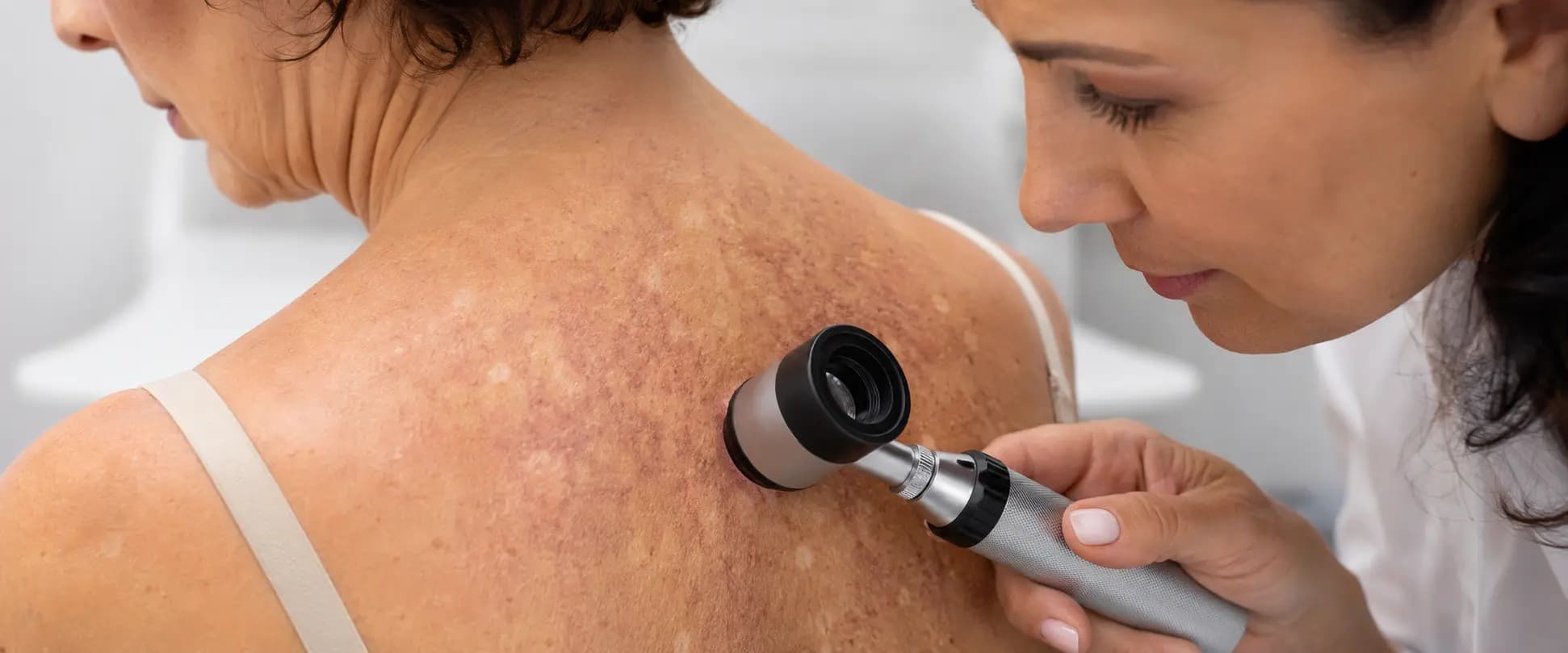
Dermatomyositis is a rare inflammatory disease in which the immune system affects the skin and, often, the muscles. It can occur in adults and children, although in adults it requires a more comprehensive evaluation due to its potential systemic associations.
Before you read: At Skinpaths, we distinguish between opinion and evidence. To write this content, we prioritized indexed medical sources and recommendations from scientific societies. You’ll find the complete bibliography at the end for your reference.
Important: This article is for informational purposes only and does not replace medical advice. If you have any questions, persistent symptoms, or your condition worsens, always consult a healthcare professional.
Summary in 60 seconds
- Dermatomyositis is an autoimmune and inflammatory disease.
- It can cause red, purplish or reddish-brown spots on eyelids, knuckles, neck, chest, back, elbows or knees.
- It can also cause muscle weakness, especially in the shoulders, hips, thighs, and neck.
- Some people have skin lesions without any obvious weakness at first.
- The sun can worsen skin lesions.
- It is not a common allergy or a simple irritation when it persists or is accompanied by tiredness or weakness.
- Diagnosis usually requires physical examination, blood tests, autoantibodies, and in some cases, biopsy or muscle studies.
- Treatment exists and is individualized according to skin, muscle, lungs, associated risk and age.
- In adults, the doctor may order tests to rule out cancer or other complications, but this does not mean that all cases are associated with cancer.
- Seeking consultation early improves the safety of the diagnostic and therapeutic process.
What is dermatomyositis?
Dermatomyositis belongs to the group of idiopathic inflammatory myopathies. “Derma” refers to skin, “myo” to muscle, and “itis” to inflammation.
Simply put: the immune system, which normally protects us, triggers an inflammatory response that can affect the skin, muscles, and, in some cases, other organs such as the lungs or digestive system. British Association of Dermatologists 2022
Not everyone presents with the same pattern. Some have very visible skin lesions; others present with fatigue and difficulty performing everyday activities; and a group may have typical skin lesions without clear muscle weakness, which is known as clinically amyopathic dermatomyositis («dermatomyositis without myositis»).
Why does it appear?
The exact cause is unknown. Current evidence suggests it is an immune-mediated disease: it is not contagious, it is not due to poor hygiene, and it is not usually explained by a single cause.
In some people, it can coexist with other autoimmune diseases. In adults, especially when it recurs in middle or later life, the medical team may consider targeted studies to rule out cancer, based on age, symptoms, examination findings, and autoantibodies. International guidelines recommend stratifying this risk and not assuming it automatically. Oldroyd 2023
Possible triggers or associations, such as infections, medications, or genetic predisposition, have also been described, but in many patients a single factor is not identified.
The skin can be the first clue: eyelids, knuckles, décolletage, and scalp deserve attention when lesions persist.
What does it look like and what symptoms does it cause?
The skin can provide the first clues. The most characteristic lesions include:
- Heliotrope rash: purplish, reddish or brownish-purple discoloration around the eyelids, sometimes with swelling.
- Gottron’s papules: raised, reddish or purplish lesions on the knuckles.
- Gottron’s sign: redness or plaques on elbows, knees or backs of hands.
- Photosensitivity: lesions that worsen with sun exposure, especially on the face, neck, chest, shoulders, or back.
- Inflamed scalp: itching, flaking, or a burning sensation that may be confused with seborrheic dermatitis or psoriasis.
- Changes around the nails: irregular cuticles, redness, or small visible blood vessels.
In darker skin tones, the purplish color may be more difficult to recognize; therefore, location, texture, itching, persistence, and accompanying symptoms are important. DermNet 2025
Muscle weakness often affects muscles near the torso. It may be noticeable when climbing stairs, getting up from a chair, carrying objects, combing hair, raising the arms, or getting out of bed. Other symptoms may include fatigue, muscle pain, difficulty swallowing, coughing, or shortness of breath.
What can you do today?
If you suspect dermatomyositis, the safest thing to do is to arrange a medical consultation, ideally with a dermatology specialist and, depending on the case, rheumatology or neurology.
Prudent measures while awaiting the assessment:
- Use daily sun protection: shade, protective clothing, hat and broad spectrum sunscreen.
- Take photographs of the injuries with the date, natural light and good distance.
- Note any associated symptoms: weakness, tiredness, fever, weight loss, cough, shortness of breath, muscle pain, or difficulty swallowing.
- Avoid strenuous physical activity if you notice progressive weakness.
- Bring a list of medications, supplements, and pre-existing conditions to your appointment.
- Do not stop or start important medications without medical advice.
These measures do not replace the diagnosis, but they help to make the consultation more accurate.
What NOT to do?
It is not advisable to treat a persistent rash on the eyelids, knuckles, or décolletage as an «allergy» for months without evaluation.
It is also not advisable to use potent corticosteroids on the face on your own, self-medicate with immunosuppressants, start intense exercise routines if there is weakness, or ignore respiratory symptoms or difficulty swallowing.
Another common mistake is thinking that if there is no muscle weakness, it can’t be dermatomyositis. Some forms begin predominantly in the skin (without muscle weakness).
When should I consult?
Consult a doctor promptly if a persistent rash appears on your eyelids, knuckles, elbows, knees, chest, or back, especially if it worsens with sun exposure or is accompanied by tiredness.
Seek medical evaluation more urgently if you experience:
- Progressive weakness when climbing stairs, getting up from a chair, or raising your arms.
- Difficulty swallowing, choking, or unexplained weight loss.
- Shortness of breath, persistent cough, or chest pain.
- Fever, poor general condition, or rapid deterioration.
- Painful ulcers on fingers or intense black/purple lesions.
- Very dark urine along with significant muscle pain.
- Unexplained bleeding, persistent change in bowel habits, or coughing up blood.
What does a dermatologist usually do?
The dermatologist assesses the distribution of lesions, scalp, nails, mucous membranes, and signs of photosensitivity. They may also assess muscle strength or coordinate evaluation with rheumatology, neurology, pulmonology, or other specialists.
Studies may include blood tests—such as muscle enzymes and inflammatory markers—, myositis-specific autoantibodies, muscle MRI, electromyography, respiratory tests, or chest imaging. In some cases, a skin or muscle biopsy is performed to support the diagnosis. Waldman 2020
Treatment depends on the severity of the disease. It may include strict photoprotection, topical treatments, antimalarials, systemic corticosteroids, immunosuppressants, intravenous immunoglobulin, or other medications. Guidelines recommend tailoring management to the extent of skin, muscle, and lung involvement, as well as the individual patient’s risk profile. Oldroyd 2022
Frequently Asked Questions
Is dermatomyositis contagious?
- No. It is not transmitted through contact, saliva, blood, or cohabitation.
Is there a cure?
- It can be controlled, and some people achieve remission, but the course varies. The goal is to control inflammation, protect organs, reduce flare-ups, and minimize treatment side effects.
Can it affect only the skin?
- Yes. Some people present with typical skin lesions without obvious muscle weakness. Even so, they need to be monitored because there may be subclinical muscle inflammation or a risk of systemic involvement.
Is it always associated with cancer?
- No. In adults, there is a recognized association in a proportion of cases, but this does not mean that everyone with dermatomyositis has cancer. For safety, the doctor may order tests based on age, symptoms, physical examination, and autoantibodies. Oldroyd 2023
Does the sun worsen dermatomyositis?
- For many people, yes. Sun protection is an important part of skin care.
Which specialist is treating her?
- It usually requires a combined approach. Dermatology evaluates and treats the skin; rheumatology or neurology are usually involved when there is muscle, joint, or systemic involvement; pulmonology may intervene if there is lung involvement.
Does intravenous immunoglobulin work?
- In selected cases of active dermatomyositis, intravenous immunoglobulin has shown benefit in clinical studies, but it is not necessary for all patients and should be prescribed under medical supervision. Aggarwal 2022
Bibliography and sources
- Cassard L, Seraly N, Riegert M, Patel A, Fernandez AP. Dermatomyositis: Practical Guidance and Unmet Needs. ImmunoTargets Ther . 2024;13:151-172. doi:10.2147/ITT.S381472. Available at: PubMed Central
- DeWane ME, Waldman R, Lu J. Dermatomyositis: Clinical features and pathogenesis. J Am Acad Dermatol . 2020;82(2):267-281. doi:10.1016/j.jaad.2019.06.1309. Available in: PubMed
- Waldman R, DeWane ME, Lu J. Dermatomyositis: Diagnosis and treatment. J Am Acad Dermatol . 2020;82(2):283-296. doi:10.1016/j.jaad.2019.05.105. Available in: PubMed
- Lundberg IE, Tjärnlund A, Bottai M, et al. 2017 European League Against Rheumatism/American College of Rheumatology classification criteria for adult and juvenile idiopathic inflammatory myopathies and their major subgroups. Ann Rheum Dis . 2017;76(12):1955-1964. doi:10.1136/annrheumdis-2017-211468. Available in: PubMed
- Oldroyd AGS, Lilleker JB, Amin T, et al. British Society for Rheumatology guideline on management of pediatric, adolescent and adult patients with idiopathic inflammatory myopathy. Rheumatology (Oxford) . 2022;61(5):1760-1768. doi:10.1093/rheumatology/keac115. Available at: PubMed Central
- Oldroyd AGS, Callen JP, Chinoy H, et al. International Guideline for Idiopathic Inflammatory Myopathy-Associated Cancer Screening: an International Myositis Assessment and Clinical Studies Group initiative. Nat Rev Rheumatol . 2023;19(12):805-817. doi:10.1038/s41584-023-01045-w. Available at: PubMed Central
- Aggarwal R, Charles-Schoeman C, Schessl J, et al. Trial of Intravenous Immune Globulin in Dermatomyositis. N Engl J Med . 2022;387(14):1264-1278. doi:10.1056/NEJMoa2117912. Available in: PubMed
- American College of Rheumatology. Inflammatory Myopathies. Patient fact sheet. Updated February 2025. Available from: American College of Rheumatology
- British Association of Dermatologists. Dermatomyositis Patient Information Sheetlet. June 2022. Available from: British Association of Dermatologists
- DermNet New Zealand. Adult-onset dermatomyositis. Updated April 2025. Available at: DermNet
Categories: For everyone

Content reviewed by
Dr. Rodolfo Suárez
Médico Patólogo y Dermatólogo Master en Patología Cutánea Avanzada
- Published
- September 18, 2026
- Updated
- September 23, 2026
Medically reviewed by specialists
Our content is based on current scientific evidence and clinical protocols.