

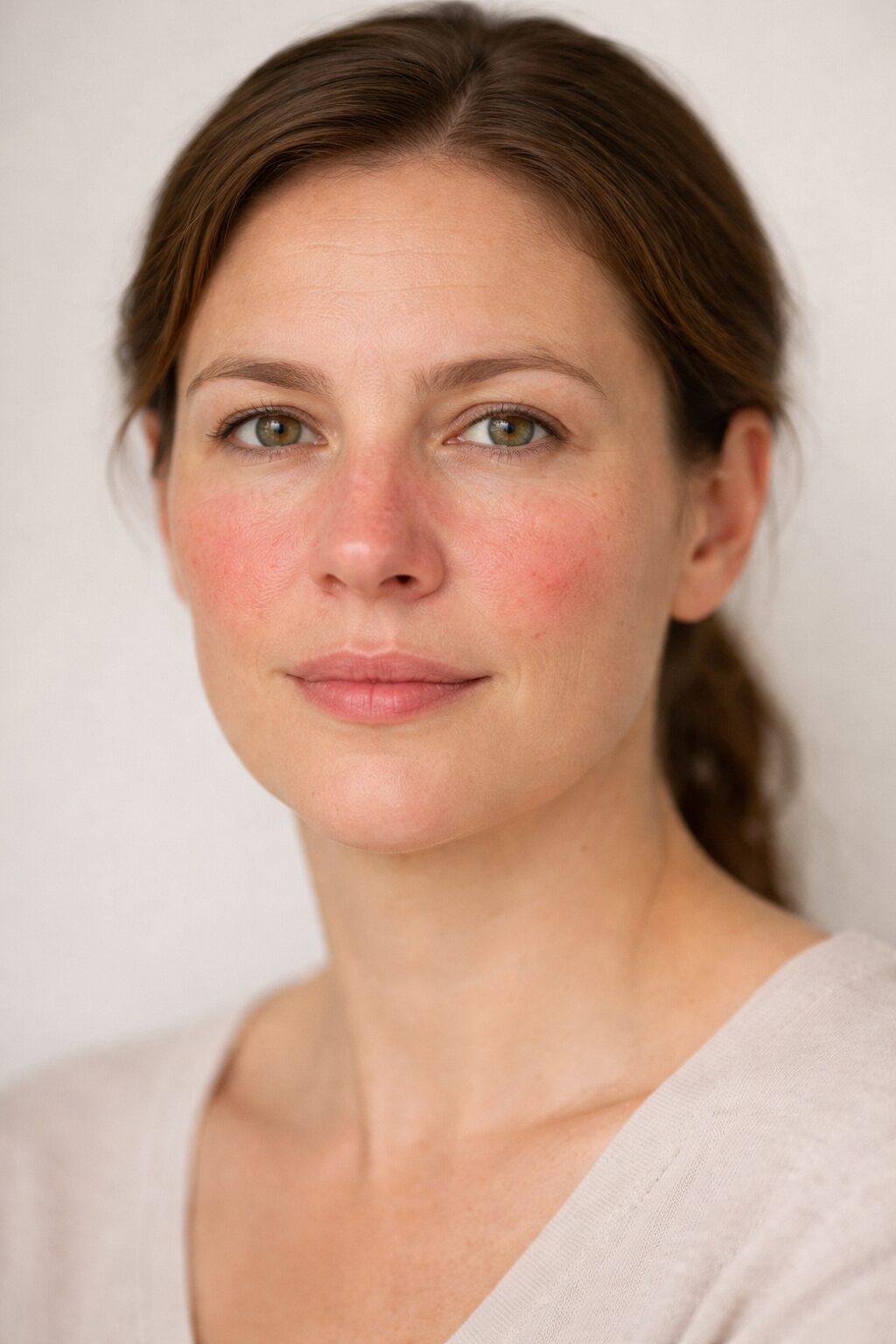
Dermatologists who treat acne, rosacea, and sebaceous disordersWhat is rosacea, why can the face become persistently red, and what sensible measures actually help?
Before reading: En skinpaths We distinguish between opinion and evidence. To write this content, we prioritized indexed medical sources and recommendations from scientific societies. At the end, you will find the complete bibliography for your reference.
Important: This article is for informational purposes only and does not replace medical advice. If you have any questions, persistent symptoms, or your condition worsens, consult a healthcare professional.
Summary in 60 seconds
- Rosacea is a chronic inflammatory skin condition that typically affects the central area of the face: cheeks, nose, forehead, and chin. It can cause easy flushing, persistent redness, visible blood vessels, inflamed pimples, and a burning or stinging sensation.
- In some people it also affects the eyes.
- There is no definitive cure, but there are treatments and habits that help control it.
- Sun, heat, alcohol, spicy food, intense exercise and some cosmetics can worsen it, although not all triggers are the same for every person.
- The diagnosis is usually clinical: it is based on what you see, what you notice, and the history of the problem.
- A realistic plan combines gentle skin care, sun protection, and, when necessary, medical treatment.
- Quality of life also matters: when the face persistently changes color, many people feel exposed or socially uncomfortable.
What is rosacea?
Rosacea is a chronic inflammatory condition that primarily affects the central part of the face. Today, it is best understood as a combination of clinical findings—such as persistent redness, pimple-like outbreaks, visible blood vessels, or eye symptoms—rather than a rigid set of “subtypes.” This approach is important because not everyone has the same mix of signs or needs exactly the same treatment. (Tan 2017 , Schaller 2020)
Rosacea typically begins in adulthood and can go unnoticed or be diagnosed late, especially when skin tone makes the classic redness less noticeable. In darker skin tones, it sometimes manifests more as burning, flare-ups, dryness, or discoloration than as a striking red. NIAMS 2024 , AAD 2024a
Why does it appear?
The honest answer is this: there is no single known cause. Current evidence points to an interaction between individual predisposition, blood vessel reactivity, inflammation, alterations in the skin barrier, the innate immune system, and environmental factors. The role of the skin microbiome and certain skin mites such as Demodex is also being studied , although this does not mean that all rosacea can be explained by a single cause. Gallo 2018 , van Zuuren 2021 , Nguyen 2024
In practice, the important thing is to understand that certain triggers can worsen it: sun, heat, sudden temperature changes, alcohol, spicy food, intense exertion, emotional stress, and some irritating cosmetic products. These don't affect everyone the same way, so it's best to think about "my triggers" rather than a universal list. AAD 2024b , AAD 2024c , Searle 2021
What does it look like and what symptoms does it cause?
The most well-known form is persistent or recurring facial redness, often accompanied by easy blushing. Many people also notice visible fine blood vessels on their cheeks or nose, inflamed breakouts reminiscent of acne, burning, stinging, tightness, or very sensitive skin. Dryness and mild scaling are also common. AAD 2024a , Nguyen 2024
Not everything happens at once. Some people mainly experience persistent discoloration; others, inflamed outbreaks; others, irritated eyes. When the eyes are involved, there may be dryness, tearing, burning, a gritty sensation, light sensitivity, or blurred vision. Less frequently, and especially after years of uncontrolled disease, skin thickening may occur, particularly on the nose. AAD 2024a , Mayo Clinic 2024
Rosacea is not just “easy blushing”: when redness persists, burns, or is accompanied by flare-ups and irritated eyes, it is advisable to consider a treatable inflammatory condition. Nguyen 2024 , AAD 2024a
What can you do today? (clear and concrete steps)
Start with the basics: gentle cleansing, moisturizing, and daily sun protection. The goal is not to "do more," but to cause less irritation. In rosacea, the skin often doesn't tolerate harsh routines well. AAD 2024c , NIAMS 2024b
Sensible and concrete measures:
- Wash your face with a gentle cleanser, without harsh soap, using warm water and without rubbing. AAD 2024c
- Apply a simple moisturizer, preferably fragrance-free, to reduce stinging and strengthen the skin barrier. AAD 2024c
- Use broad-spectrum facial sunscreen with SPF 30 or higher every day. The sun is one of the most common triggers. AAD 2024c, NIAMS 2024b
- Observe your outbreaks for 2 or 3 weeks: heat, wine, spicy food, intense exercise, very hot showers or stress can give clues. AAD 2024b, Searle 2021
- Consult your doctor if the redness persists, if repeated pimples appear, or if you experience eye discomfort. Early treatment often helps to better manage the condition. AAD 2024b, Mayo Clinic 2024
What NOT to do?
- Don't rub, don't exfoliate, and don't use facial brushes "to clean better." Friction usually worsens irritation. AAD 2024c
- Don't overuse toners, astringents, or perfumed products that "dry" the skin. AAD 2024c
- Don't treat every breakout as if it were common acne; sometimes that leads to overly aggressive routines. AAD 2024b, Tan 2017
- Don't change too many products at once. If everything is itchy, it's best to simplify. AAD 2024c
- Don't ignore eye symptoms thinking they "aren't related to the skin." They can be connected. AAD 2024a, Mayo Clinic 2024
When should I consult a specialist?
It is always advisable to seek medical evaluation from a dermatologist if any of these situations occur:
- The redness lasts for weeks or months and does not improve with gentle measures. AAD 2024a, NIAMS 2024
- Repeated outbreaks, visible blood vessels, or a constant burning and tender sensation may appear. Nguyen 2024, AAD 2024a
- Notes: red, dry, burning eyes, blurred vision, or sensitivity to light. AAD 2024a, Mayo Clinic 2024
- The nose or some area of the face seems to thicken. AAD 2024a
- The problem affects you socially, makes you uncomfortable when talking to others, or is altering your quality of life. Oussedik 2018, Chiu 2024
What does a dermatologist usually do?
The dermatologist usually begins with a brief but very helpful medical history: when it started, what makes it worse, whether there is burning, flare-ups, visible blood vessels, or eye symptoms. Then they examine the skin and, if necessary, the eyes as well, or coordinate with an ophthalmologist. There is no single test that “confirms” rosacea in all cases; the diagnosis is usually clinical. AAD 2024b , NIAMS 2024b
In some cases, dermatoscopy can be used to better observe vascular patterns non-invasively. If the appearance is atypical or another disease needs to be ruled out, additional tests may be ordered, and sometimes a skin biopsy. Biopsy is not usually the norm; it is reserved for diagnostic uncertainty or unusual variants. Kara 2021 , AAD 2024b
Treatment is tailored to the predominant feature: persistent redness, inflamed outbreaks, visible vessels, eye involvement, or thickening. Depending on the case, it may include topical treatment, oral medication, laser or light therapy, in addition to a gentle care plan and trigger management. Improvement is usually gradual, not immediate. Thiboutot 2020 , AAD 2024b , NIAMS 2024b
FAQ
Is rosacea the same as acne?
- No. It may look similar because of the pimples, but rosacea is usually accompanied by persistent redness, easy flushing, visible blood vessels, or facial burning. Dermatologists differentiate between them based on the clinical pattern and progression. Tan 2017, AAD 2024a
Is rosacea curable?
- There is no proven cure, but there are effective ways to manage it. The realistic goal is to reduce flare-ups, discomfort, and visible progression. NIAMS 2024, Thibout 2020
Does the sun really make it worse?
- Very often, yes. The sun is one of the most frequent triggers, which is why daily sun protection is not a minor detail but part of basic management. AAD 2024c, NIAMS 2024b
Does alcohol or spicy food cause rosacea?
- They don't necessarily cause it, but they can trigger or worsen outbreaks in some people. The helpful thing is to identify if they affect you, not to assume everyone reacts the same way. AAD 2024b, Searle 2021
Can it affect the eyes?
- Yes. Ocular rosacea exists and can cause dryness, tearing, burning, a gritty sensation, irritated eyelids, or blurred vision. If you experience visual symptoms, it's best to consult a doctor without delay. AAD 2024a, Mayo Clinic 2024
Can it appear on brown or dark skin?
- Yes. The problem is that it can look different and be less easily diagnosed because the classic redness isn't always so obvious. In those cases, the burning sensation, rashes, or certain color changes might be more noticeable. NIAMS 2024, AAD 2024a
How long does it take to get better?
- It depends on the type of rosacea and the treatment, but improvement is usually gradual. Generally, it takes several weeks, and sometimes months, to properly assess the response. NIAMS 2024b, AAD 2024b
Bibliography and sources
- Gallo RL, Granstein RD, Kang S, et al. Standard classification and pathophysiology of rosacea: The 2017 update by the National Rosacea Society Expert Committee. J Am Acad Dermatol. 2018;78(1):148-155. doi:10.1016/j.jaad.2017.08.037.
- Tan J, Almeida LMC, Bewley A, et al. Updating the diagnosis, classification and assessment of rosacea: recommendations from the global ROSacea COnsensus (ROSCO) panel. Br J Dermatol. 2017;176(2):431-438. doi:10.1111/bjd.15122.
- Schaller M, Almeida LMC, Bewley A, et al. Recommendations for rosacea diagnosis, classification and management: update from the global ROSacea COnsensus 2019 panel. Br J Dermatol. 2020;182(5):1269-1276. doi:10.1111/bjd.18420.
- Thiboutot D, Anderson R, Cook-Bolden F, et al. Standard management options for rosacea: The 2019 update by the National Rosacea Society Expert Committee. J Am Acad Dermatol. 2020;82(6):1501-1510. doi:10.1016/j.jaad.2020.01.077.
- van Zuuren EJ, Arents BWM, van der Linden MMD, et al. Rosacea: New Concepts in Classification and Treatment. Am J Clin Dermatol. 2021;22(4):457-465. doi:10.1007/s40257-021-00595-7.
- Nguyen C, Kuceki G, Birdsall M, et al. Rosacea: Practical Guidance and Challenges for Clinical Management. Clin Cosmet Investig Dermatol. 2024;17:175-190. doi:10.2147/CCID.S391705.
- Kara YA, Özden HK. Dermoscopic Findings of Rosacea and Demodicosis. Indian J Dermatol. 2021;66(2):165-168. doi:10.4103/ijd.IJD_290_18.
- Chiu CW, Tsai J, Huang YC. Health-related Quality of Life of Patients with Rosacea: A Systematic Review and Meta-analysis of Real-world Data. Acta Derm Venereol. 2024;104:adv40053. doi:10.2340/actadv.v104.40053.
- Oussedik E, Bourcier M, Tan J. Psychosocial Burden and Other Impacts of Rosacea on Patients' Quality of Life. Dermatol Clin. 2018;36(2):103-113. doi:10.1016/j.det.2017.11.005.
- American Academy of Dermatology Association. Rosacea: Signs and symptoms. Updated in 2024.
- American Academy of Dermatology Association. Rosacea: Diagnosis and treatment. Updated in 2024.
- American Academy of Dermatology Association. 7 rosacea skin care tips dermatologists recommend. Updated in 2024.
- National Institute of Arthritis and Musculoskeletal and Skin Diseases (NIAMS). Rosacea: Symptoms, Causes, & Risk Factors. Updated in 2024.
- NIAMS. Rosacea: Diagnosis, Treatment, and Steps to Take. Updated in 2024.
- Mayo Clinic. Ocular rosacea: Symptoms and causesUpdated on April 6, 2024.

 |
|