

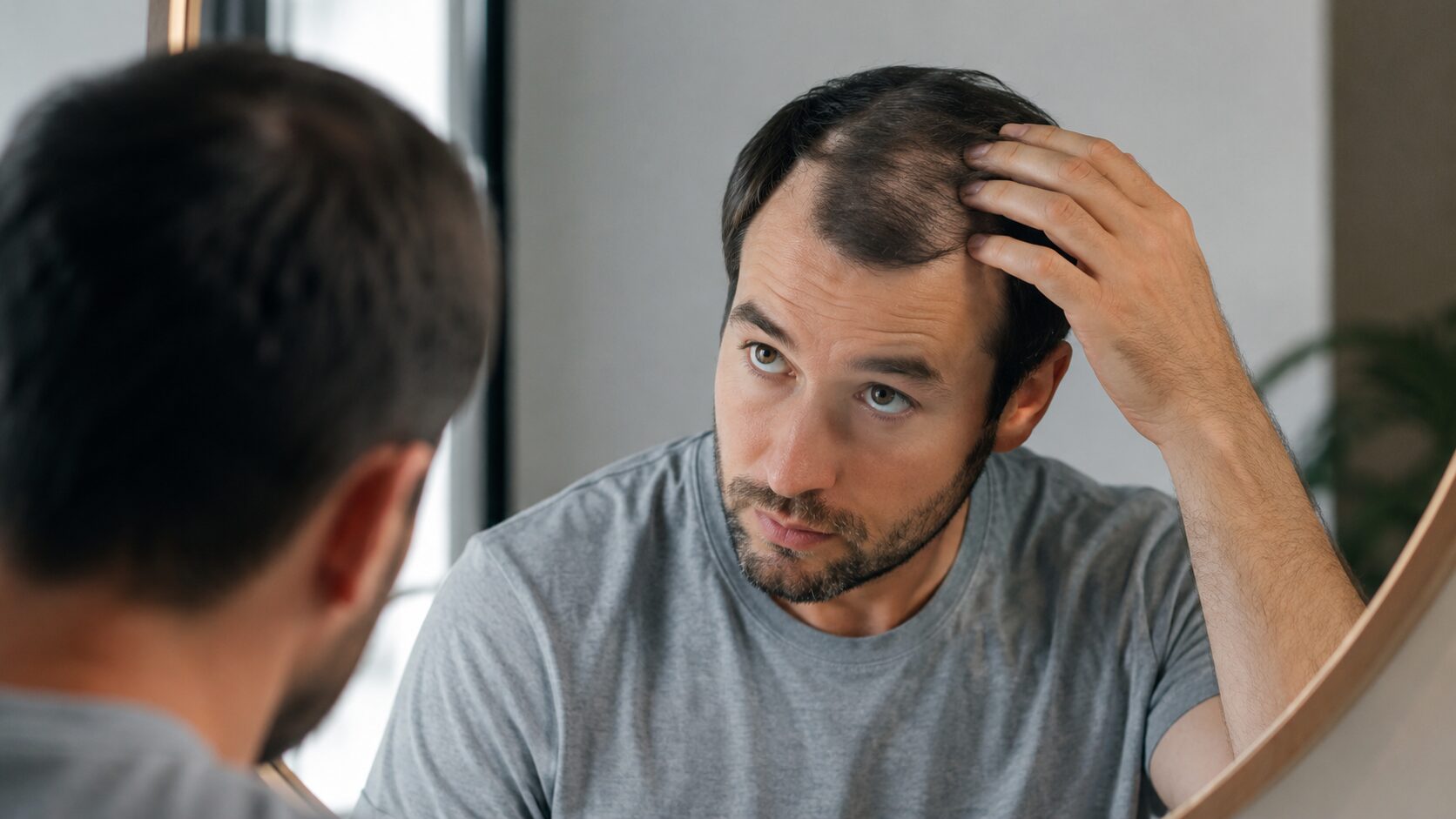
Dermatologists treating Androgenetic Alopecia
A clear guide to understanding the most common progressive hair loss in men and women.
Before reading: En skinpaths We distinguish between opinion and evidence. To write this content, we prioritized indexed medical sources and recommendations from scientific societies. At the end, you will find the complete bibliography for your reference.
Important: This article is for informational purposes only and does not replace medical advice. If you have any questions, persistent symptoms, or your condition worsens, consult a healthcare professional.
Summary in 60 seconds
- La androgenetic alopeciaandrogenic alopecia, also called androgenic alopecia or common baldness, is a frequent form of progressive hair loss.
- It usually has a genetic and hormonal basis: the follicles become smaller and produce increasingly finer hairs.
- In men, it usually begins with a receding hairline, a receding hairline, or hair loss at the crown.
- In women, it is usually seen as a widening of the middle part and less density on the top of the scalp.
- It does not usually cause pain, wounds or intense peeling; if these signs appear, it is advisable to rule out other causes.
- The treatments do not "cure" definitively, but they can help slow the progression and improve density in some cases.
- Topical minoxidil and, in selected men, oral finasteride are evidence-based options, although they are not suitable for everyone, and of course they must be prescribed by a specialist doctor.
- Results usually take months and tend to last only as long as treatment continues.
- Seeking medical advice early allows for confirmation of the diagnosis and avoids unnecessary treatments or unrealistic promises. BAD-2024
What is it?
Androgenetic alopecia is a non-scarring , progressive hair loss with a characteristic pattern. “Non-scarring” means that, at least in the initial and moderate stages, the follicle is not destroyed.
The main change occurs in the hair follicle. Terminal, thick, and pigmented hairs gradually transform into finer, shorter, and lighter hairs. This process is known as follicular miniaturization . Ntshingila-2023
In men, it is usually called male pattern baldness . In women, it may be called female pattern hair loss . Both conditions share underlying mechanisms, but they do not always present in the same way nor do they always require the same therapeutic approach. BAD-2024
It's not usually a medical emergency, but it can have a significant emotional impact. Hair density is part of one's self-image, and the aesthetic concern shouldn't be underestimated.
Why does it appear?
Androgenetic alopecia appears due to a combination of genetic predisposition , sensitivity of the follicles to androgens, and changes in the hair cycle.
In predisposed individuals, dihydrotestosterone, known as DHT, plays a role in the progressive miniaturization of the follicle. This does not necessarily mean that the person has "high hormones"; often hormone levels are normal, but the follicle is more sensitive. Ntshingila-2023
In men, there is often a familial pattern, and it can begin after puberty, although the rate of progression varies considerably among individuals. Hair loss typically affects the frontal hairline, temples, or crown first. B AD-2024
In women, there can also be a hereditary basis. It is sometimes associated with conditions of increased androgenic activity, such as polycystic ovary syndrome, especially if there is acne, increased facial hair, irregular menstrual cycles, or infertility. However, many women with this type of hair loss do not have an obvious hormonal disorder. Ramos-2023
It is also important to differentiate it from other common causes of hair loss, such as telogen effluvium, iron deficiency, thyroid disorders, alopecia areata, scalp infections, traction from tight hairstyles, or scarring alopecia. This distinction is key because the treatment varies depending on the cause. Phillips-2017
What does it look like and what symptoms does it cause?
In men, the typical pattern includes a receding hairline , a receding hairline, and thinning at the crown. Hair at the nape of the neck and sides is often better preserved. Hair in the affected areas becomes thinner and shorter before disappearing completely. BAD-2024
In women, a widening of the center part , reduced volume on the top of the scalp, and diffuse thinning are commonly observed. The frontal hairline is usually relatively preserved, although it may appear less full. BAD-2024
Androgenetic alopecia does not usually cause pain, scabs, sores, pus, or severe scaling . Some people report mild itching, but if there is burning, marked sensitivity, persistent redness, significant scaling, or patchy hair loss, other possibilities should be considered.
Trichoscopy, an evaluation technique performed by a dermatologist, can reveal variations in hair thickness, the presence of miniaturized hairs, and other signs that help confirm the diagnosis. Kuczara-2024
What can you do today?
The first step is to observe the pattern carefully. Taking photographs with the same lighting, distance, and hairstyle every four to eight weeks can help distinguish a subjective impression from actual progression. This also makes it easier to discuss the issue with your dermatologist.
In daily care, it's generally wise to avoid tight hairstyles, excessive heat, harsh bleaching, and repeated pulling. These measures don't "cure" androgenetic alopecia, but they do reduce further damage to hair that may already be thinning.
If dandruff, itching, or inflammation is present, the scalp should be treated appropriately, because inflammation can increase the perception of hair loss or worsen tolerance to topical treatments.
Topical minoxidil is one of the best-supported options for male and female pattern hair loss. It can help in early or moderate stages, but it won't restore a full head of hair when the loss is advanced. It usually requires consistent use for months to assess the response. AAD-2022
In selected men, oral finasteride may reduce the action of DHT and help slow its progression. It is a prescription medication and requires an informed discussion about its benefits, limitations, and potential adverse effects. (Kaufman, 1998)
In 2025, the European Medicines Agency confirmed suicidal ideation as an adverse effect of unknown frequency for finasteride tablets and recommended discontinuing finasteride 1 mg and seeking medical advice if mood changes, depression, or suicidal thoughts occur. EMA-2025
Other treatments—such as low-dose oral minoxidil, antiandrogens in women, dutasteride, platelet-rich plasma, low-level laser therapy, microneedling, or hair transplantation—may be used in selected cases, but should not be presented as universal solutions. Some options are off-label in certain countries or depend on expert judgment. Vañó-Galván-2024
In androgenetic alopecia, consistency usually matters more than intensity: results are measured in months, not days.
What NOT to do?
It is not advisable to begin any treatment without a clear diagnosis. Therapeutic approaches may vary.
It's not advisable to start using multiple products at once without a diagnosis. If your hair improves or worsens, it will be difficult to determine what helped, what caused irritation, or what was irrelevant.
It's not advisable to rely on promises of "guaranteed growth," miracle oils, anti-hair loss shampoos as your sole strategy, or supplements without a proven deficiency. Some products may improve the cosmetic appearance of the hair shaft, but that doesn't equate to reversing follicular miniaturization.
It is also not advisable to discontinue an effective treatment after the first month. In androgenetic alopecia, changes are usually slow. With minoxidil, initial hair loss may occur during the first few weeks, something described in clinical resources for patients, and this does not necessarily mean treatment failure. BAD-2024
Do not use finasteride, dutasteride, antiandrogens, or oral minoxidil without medical supervision. These medications may have relevant contraindications, interactions, and adverse effects. Treatment selection should be especially careful during pregnancy, while trying to conceive, or while breastfeeding. BAD-2024
When to consult?
Consult a dermatologist if any of these situations occur:
- Rapid, intense, or patchy hair loss.
- Round plates without hair.
- Pain, burning, scabs, pus, wounds, or persistent redness.
- Marked peeling, inflammation, or suspected infection.
- Loss of eyebrows, eyelashes, or body hair.
- Signs of scarring or shiny areas where pores appear to disappear.
- Hair loss after high fever, surgery, childbirth, significant weight loss, or intense stress.
- In women: new acne, increased facial hair, irregular cycles, or suspected polycystic ovary syndrome.
- Onset in children or adolescents.
- Significant emotional impact, anxiety, isolation, or mood changes.
- Worsening despite treatments used correctly.
Early consultation helps distinguish androgenetic alopecia from telogen effluvium, alopecia areata, tinea capitis, scarring alopecia, or other causes that require different approaches. Phillips-2017
What does a dermatologist usually do?
The dermatologist usually begins with a medical history: duration of symptoms, pattern of hair loss, family history, medications, illnesses, recent pregnancy, diet, stress, scalp symptoms, and treatments used.
Next, the scalp is examined, often using dermatoscopy or trichoscopy , a magnifying tool that allows visualization of hair thickness variations, density, miniaturization, flaking, inflammation, and signs of other types of alopecia. Kuczara-2024
Tests are not required for all patients. They are ordered when the history or examination suggests anemia, iron deficiency, thyroid disease, hormonal imbalances, nutritional deficiencies, or another associated condition. AAD-2022
A scalp biopsy is not usually necessary when the pattern is clear, but it may be indicated if there is diagnostic uncertainty, signs of scarring alopecia, persistent inflammation, or an atypical course. In women, the British Association of Dermatologists notes that a biopsy may be requested to confirm the diagnosis when necessary. BAD-2024
FAQ
Is there a cure for androgenetic alopecia?
- Not in the sense of a definitive and permanent cure. It's a chronic and progressive condition. The realistic goal is to slow progression, preserve density and partially improve the thickness or number of hairs in those who respond. The benefits usually last only as long as the treatment continues. BAD-2024
Does minoxidil work?
- It can work, especially in early or moderate stages. The evidence is stronger for topical minoxidil than for many cosmetic products marketed as "anti-hair loss." Even so, not everyone responds, and results require consistent use over several months. Ramos-2023
Is it normal to experience increased hair loss when starting minoxidil?
- Some initial hair loss may occur during the first few weeks. This is usually related to the replacement of hairs that were already in the shedding phase. If the hair loss is heavy, prolonged, or accompanied by inflammation, it's advisable to consult a doctor. BAD-2024
Is finasteride suitable for all types of alopecia?
- No. Oral finasteride is primarily used in men with androgenetic alopecia, under medical prescription. It requires evaluation of medical history, expectations, and potential sexual or mood-related side effects. If depression, mood swings, or suicidal thoughts occur during its use, medical attention should be sought. EMA-2025
Do women also get androgenetic alopecia?
- Yes. In women, it often appears as diffuse hair loss on the top of the scalp, with a widening of the part and relative preservation of the hairline. If acne, hirsutism, or irregular cycles are present, a hormonal component should be considered. BAD-2024
Can an anti-hair loss shampoo solve the problem?
- A shampoo can help control oil, dandruff, or mild inflammation, and may improve the cosmetic feel of the hair. But on its own, it usually does not reverse the follicular miniaturization of androgenetic alopecia.
Is hair transplantation a permanent solution?
- Hair transplantation may be an option in selected cases, especially when hair loss has stabilized and a suitable donor area is available. It does not always replace medical treatment, and it does not prevent non-transplanted hair from continuing to miniaturize over time. The decision to transplant should be made on a case-by-case basis. Vañó-Galván-2024
Bibliography and sources
- British Association of Dermatologists. Hair loss male pattern androgenetic alopecia. London: British Association of Dermatologists; 2024.
- British Association of Dermatologists. Hair loss female pattern androgenetic alopecia. London: British Association of Dermatologists; 2024.
- American Academy of Dermatology Association. Hair loss: diagnosis and treatment. Rosemont: American Academy of Dermatology Association; 2022.
- European Medicines Agency. Measures to minimize risk of suicidal thoughts with finasteride and dutasteride medicines. Amsterdam: European Medicines Agency; 2025.
- Ntshingila S, Oputu O, Arowolo AT, Khumalo NP. Androgenetic alopecia: an update. JAAD Int. 2023;13:150-158.
- Ramos PM, Miot HA. Female-pattern hair loss: therapeutic update. An Bras Dermatol. 2023;98(4):506-519.
- Manabe M, Tsuboi R, Itami S, Osada SI, Amoh Y, Ito T, et al. Guidelines for the diagnosis and treatment of male-pattern and female-pattern hair loss, 2017 version. J Dermatol. 2018;45(9):1031-1043.
- Asfour L, Cranwell W, Sinclair R. Male androgenetic alopecia. In: Feingold KR, Anawalt B, Blackman MR, et al., editors. Endotext. South Dartmouth: MDText.com; 2023.
- Phillips TG, Slomiany WP, Allison R. Hair loss: common causes and treatment. Am Fam Physician. 2017;96(6):371-378.
- Vañó-Galván S, Fernández-Crehuet P, Garnacho G, Gómez-Zubiaur A, Hermosa-Gelbard A, Moreno-Arrones OM, et al. Recommendations on the clinical management of androgenetic alopecia: a consensus statement from the Spanish Hair Disorders Group of the Spanish Academy of Dermatology and Venereology. Dermosifiliogr. Proceedings 2024.
- Kuczara A, Waśkiel-Burnat A, Rakowska A, Olszewska M, Rudnicka L. Trichoscopy of androgenetic alopecia: a systematic review. J Clin Med. 2024;13(7):1962.
- van Zuuren EJ, Fedorowicz Z, Schoones J. Interventions for female pattern hair loss. Cochrane Database Syst Rev. 2016;(5):CD007628.
- Kaufman KD, Olsen EA, Whiting D, Savin R, DeVillez R, Bergfeld W, et al. Finasteride in the treatment of men with androgenetic alopecia. J Am Acad Dermatol. 1998;39(4 Pt 1):578-589.

 |
|